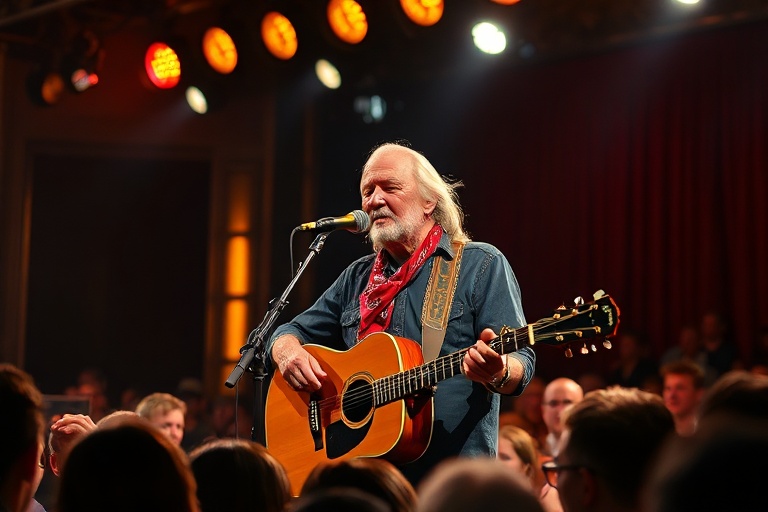
willie nelson
Few figures in American music have left as indelible a mark as Willie Nelson. Now in his ninth decade, the Texas-born troubadour remains a living legend—a poet of the people whose guitar strings and raspy baritone have soundtracked generations of rebellion, resilience, and raw humanity. His career spans more than 60 years, yet Nelson’s influence extends far beyond country music. He’s a cultural icon, a political firebrand, and an enduring symbol of artistic integrity in a rapidly commercializing world.
Born in 1933 in Abbott, Texas, Nelson grew up during the Great Depression, raised by his grandparents after his parents separated. Music became his refuge early on. By age seven, he was playing guitar and writing songs. His grandmother, a singer and pianist, nurtured his love for music, while his grandfather, a blacksmith, taught him the value of hard work—lessons Nelson would carry throughout his life. These dual influences—creativity and grit—shaped his artistic identity long before fame arrived.
The Rise of an Outlaw Icon
Nelson’s journey to stardom wasn’t linear. After serving in the Air Force and briefly attending Baylor University, he worked as a radio disc jockey and songwriter in Texas. His early compositions were recorded by stars like Patsy Cline and Faron Young, earning him a living as a behind-the-scenes wordsmith. But Nelson craved more—he wanted to perform his own music, in his own voice.
By the late 1960s, he had moved to Nashville, the heart of country music. His first albums for RCA didn’t achieve commercial success, despite critical acclaim. Frustrated with the industry’s constraints, Nelson retreated to Texas in the early 1970s. There, he reconnected with the outlaw spirit of Austin, where progressive musicians and longhairs were redefining the sound of country music. It was in this environment that Nelson shed his Nashville image and embraced a rawer, more authentic style.
His 1973 album Shotgun Willie marked a turning point. Produced independently and featuring a grittier sound, the record flopped commercially at first but laid the foundation for what would become the “Outlaw Country” movement. Nelson’s unpolished vocals, poetic lyrics, and refusal to conform to industry expectations resonated deeply with listeners who felt alienated by the polished pop-country of the era.
The Outlaw Movement and the Red-Headed Stranger
The mid-1970s solidified Nelson’s place in music history. In 1975, he released Red Headed Stranger, a concept album that told a dark, haunting story of love, loss, and redemption. The sparse instrumentation and Nelson’s emotive delivery made it a masterpiece of storytelling. Hits like “Blue Eyes Crying in the Rain” became anthems, and the album’s success catapulted him to superstardom.
Around the same time, Nelson collaborated with Waylon Jennings, Johnny Cash, and Kris Kristofferson to form the informal “Outlaw” collective. These artists rejected the slick production and conservative image of Nashville, instead embracing long hair, beards, and a rebellious attitude. Their music reflected the countercultural spirit of the time, blending country with rock, folk, and blues influences.
Nelson’s role in this movement wasn’t just musical—it was cultural. He became a symbol of artistic freedom, a man who put his principles above profits. His refusal to compromise his vision, even when record labels pressured him, set a new standard for artistic integrity. This defiance wasn’t just symbolic; it was practical. Nelson’s business savvy, including his early embrace of touring and merchandising, helped him build a sustainable career outside the traditional Nashville machine.
Beyond Music: A Life of Activism and Philanthropy
Nelson’s influence extends far beyond his music. He’s been a vocal advocate for progressive causes for decades. A lifelong supporter of marijuana legalization, he co-founded the National Organization for the Reform of Marijuana Laws (NORML) and has used his platform to push for drug policy reform. His advocacy isn’t just symbolic—he’s been arrested multiple times for cannabis possession, turning each incident into a public statement.
Nelson’s activism also includes environmental causes. He’s a staunch advocate for sustainable farming and animal rights, even launching his own line of organic products under the Willie Nelson Biodiesel brand. His farm in Texas, Pedernales, runs on renewable energy, and he’s spoken out against industrial agriculture and climate change.
In 2016, Nelson joined the board of the newly formed Marijuana Policy Project’s Super PAC, further cementing his role as a countercultural elder statesman. His willingness to use his celebrity for political and social change has earned him respect across generations and political spectrums.
Cultural Impact and Legacy
Nelson’s impact on global culture is difficult to overstate. He’s not just a country musician—he’s a folk hero, a symbol of Americana, and a bridge between generations. His music has been covered by artists across genres, from reggae to punk to classical. His collaborations with international stars like Julio Iglesias and Sinéad O’Connor have introduced his sound to new audiences worldwide.
In 2016, Nelson released God’s Problem Child, an album that reflected on aging, legacy, and mortality. The record’s raw honesty and emotional depth showcased his enduring artistry. That same year, he was awarded the Library of Congress Gershwin Prize for Popular Song, a lifetime achievement honor rarely bestowed on country artists.
Nelson’s influence can also be seen in the rise of Americana music, a genre that blends country, folk, and roots rock. Artists like Jason Isbell, Brandi Carlile, and Margo Price cite Nelson as a major inspiration. His ability to connect with listeners on a deeply personal level—whether through a ballad about heartbreak or an anthem about social justice—has ensured his music remains timeless.
Willie’s Enduring Relevance
At 91 years old, Willie Nelson shows no signs of slowing down. He continues to tour relentlessly, playing hundreds of shows a year. His annual Fourth of July Picnic in Texas has become a legendary event, drawing tens of thousands of fans for a day of music, camping, and community. The event is a testament to his ability to create spaces where people from all walks of life can come together to celebrate music and shared values.
Nelson’s recent projects reflect his ongoing relevance. In 2023, he collaborated with younger artists like Marcus King and Charley Crockett, proving that his appeal transcends generational boundaries. His voice, though weathered by time, still carries the same emotive power it did in his youth. Songs like “Still Not Dead” from his 2021 album That’s Life are playful yet poignant, blending humor with wisdom.
His influence also extends into the digital age. Nelson’s presence on social media—where he shares everything from political rants to behind-the-scenes tour footage—has helped him connect with younger fans. His authenticity in an era of curated personas has made him a rare figure of trust and admiration.
For those looking to explore Nelson’s music, his discography offers a journey through decades of American history. From the raw emotion of Red Headed Stranger to the politically charged The IRS Tapes: Who’ll Buy My Memories? (a response to his tax troubles in the 1990s), Nelson’s catalog is a testament to his versatility and integrity.
- Essential Albums:
- Shotgun Willie (1973) – The birth of Outlaw Country
- Red Headed Stranger (1975) – A masterpiece of storytelling
- Stardust (1978) – A collection of jazz and pop standards that surprised critics
- The IRS Tapes: Who’ll Buy My Memories? (1992) – A bold statement on injustice
- God’s Problem Child (2017) – Reflections on life and legacy
- Must-See Collaborations:
- With Waylon Jennings – Waylon & Willie (1978)
- With Julio Iglesias – Me and My Guitar (1988)
- With Snoop Dogg – Country Club (2013)
- With Margo Price – Live performances and duets
Conclusion: The Man Who Never Sold Out
Willie Nelson’s story is one of defiance, creativity, and unwavering authenticity. In an industry often driven by trends and commercialism, he has remained true to his roots and his principles. His music speaks to the human experience in all its complexity—joy, sorrow, love, and rebellion. His activism demonstrates that art and advocacy can coexist. And his longevity proves that great art doesn’t fade with time; it endures.
As Nelson himself once said, “Once you replace negative thoughts with positive ones, you’ll start having positive results.” It’s a philosophy that has guided his life and career. Whether he’s singing about heartbreak, advocating for justice, or simply enjoying a joint on stage, Nelson embodies the spirit of freedom. He’s not just a musician; he’s a living testament to the power of staying true to oneself.
For new listeners, diving into Nelson’s music is a journey worth taking. For longtime fans, his continued presence is a reminder that legends never truly fade—they just keep evolving. In a world that often prioritizes fleeting fame over lasting impact, Willie Nelson stands as a beacon of what it means to create art with integrity and live life with purpose.