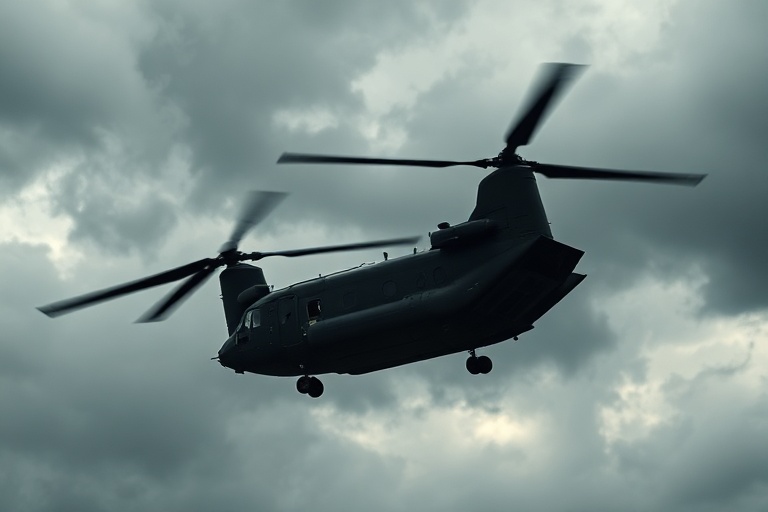
The Boeing CH-47 Chinook: A Decades-Long Legacy of Heavy-Lift Dominance
The Boeing CH-47 Chinook has remained one of the most recognizable and versatile rotorcraft in military aviation since its introduction in the early 1960s. Designed as a tandem-rotor heavy-lift helicopter, the Chinook has evolved through multiple variants, each enhancing its payload capacity, range, and technological sophistication. With a service record spanning conflicts from Vietnam to Afghanistan and beyond, the Chinook stands as a testament to durability, adaptability, and operational effectiveness.
Its distinctive tandem-rotor configuration—with two large horizontal rotors mounted at the front and rear—sets it apart visually and functionally. This design allows the Chinook to carry heavy loads internally and externally, operate in challenging environments, and maintain stability even when partially damaged. Over 1,200 Chinooks have been produced, serving not only the U.S. Army but also allied nations worldwide.
A Brief History: From Vietnam to Global Operations
The Chinook’s origins trace back to a 1956 U.S. Army requirement for a medium-lift helicopter capable of transporting troops, artillery, and supplies. Boeing’s Vertol division won the contract, and the first CH-47A entered service in 1962. Initially deployed during the Vietnam War, the Chinook quickly proved its worth by transporting troops, evacuating wounded soldiers, and even retrieving downed aircraft under fire.
Its ability to operate in hot and high conditions—where many helicopters struggle—made it particularly valuable in Southeast Asia. The CH-47B and CH-47C variants followed, each introducing improvements in power, avionics, and payload. By the 1980s, the CH-47D emerged as a modernized version with upgraded engines, transmissions, and digital flight controls, significantly extending the helicopter’s operational lifespan.
Today, the Chinook continues to serve in roles far beyond its original design parameters. It supports disaster relief, humanitarian missions, and special operations, proving its versatility far beyond combat. With over 60 years of service, the Chinook remains in active production, with the latest CH-47F Block II variant incorporating advanced avionics, composite rotor blades, and improved fuel efficiency.
Technical Specifications: Power, Payload, and Performance
The Chinook’s tandem-rotor design is not just iconic—it’s highly functional. The front and rear rotors spin in opposite directions, canceling out torque and eliminating the need for a tail rotor, which improves stability and control. Powered by two Honeywell T55 turboshaft engines, the CH-47F Block II can reach speeds of up to 170 knots (195 mph) and operate at altitudes exceeding 18,000 feet.
Its payload capacity is equally impressive. The Chinook can carry up to 33 troops, 24 litters for medical evacuation, or an external load of 26,000 pounds. This capability has made it indispensable for transporting artillery pieces, vehicles, and even downed aircraft. The helicopter’s rear-loading ramp and large side doors facilitate rapid loading and unloading, further enhancing its operational tempo.
Here’s a breakdown of key technical specifications for the CH-47F Block II:
- Rotor Diameter: 60 feet (18.3 meters)
- Length: 98 feet (29.9 meters)
- Height: 18.9 feet (5.8 meters)
- Empty Weight: 24,500 pounds (11,100 kg)
- Max Takeoff Weight: 50,000 pounds (22,680 kg)
- Range: 400 nautical miles (740 km) with auxiliary fuel tanks
- Service Ceiling: 18,500 feet (5,640 meters)
The Chinook’s ability to refuel in flight extends its range even further, making it one of the few helicopters capable of strategic deployment without intermediate stops. This feature has proven critical in long-range missions, such as those conducted in remote areas of Afghanistan and Africa.
Operational Roles: Beyond Just Heavy Lift
While the Chinook is best known for its heavy-lift capabilities, its operational roles have expanded significantly over the decades. One of its most critical functions is medical evacuation (MEDEVAC), where its spacious cabin and high cruising speed allow for rapid transport of wounded personnel. The CH-47’s ability to land in tight or unprepared sites makes it invaluable in combat zones where every minute counts.
Special operations forces also rely heavily on the Chinook. Its speed, range, and ability to carry large teams or equipment make it ideal for insertion and extraction missions. The 160th Special Operations Aviation Regiment (SOAR), known as the “Night Stalkers,” frequently uses modified Chinooks for clandestine operations, often equipped with advanced radar, infrared systems, and defensive countermeasures.
Beyond combat, the Chinook plays a vital role in humanitarian assistance and disaster response. After earthquakes, hurricanes, or floods, the Chinook’s ability to deliver supplies, evacuate civilians, and conduct aerial surveys has saved countless lives. Its rugged design allows it to operate in environments where other aircraft cannot, from dense jungles to urban rubble.
Other notable roles include:
- Air Assault: Rapidly deploying troops and equipment to secure objectives.
- Firefighting: Dropping water or retardant in wildfire suppression efforts.
- Search and Rescue: Locating and extracting personnel in remote or hazardous terrain.
- Infrastructure Support: Transporting construction materials for bridge-building or disaster recovery.
The Future of the Chinook: Upgrades and International Partnerships
The Chinook’s longevity is a result of continuous modernization. The U.S. Army’s CH-47F Block II program, currently in production, includes upgrades such as improved rotor blades, a digital cockpit, and enhanced survivability features. These improvements extend the helicopter’s service life into the 2060s, ensuring it remains relevant for decades to come.
International operators, including the United Kingdom, Canada, and Australia, have also invested in modernized Chinooks. The UK’s Chinook HC6 variant, for example, features advanced avionics, a common cockpit with the Apache helicopter, and improved defensive systems. Canada’s CH-147F Chinooks are equipped for Arctic operations, demonstrating the platform’s adaptability to extreme environments.
Looking ahead, Boeing is exploring further enhancements, including hybrid-electric propulsion and autonomous flight capabilities. These innovations could reduce fuel consumption, lower operating costs, and even enable unmanned Chinook variants for resupply or reconnaissance missions. While the tandem-rotor design remains largely unchanged, the underlying technology continues to evolve.
Conclusion: Why the Chinook Endures
The Boeing CH-47 Chinook is more than just a helicopter—it’s a symbol of resilience, adaptability, and engineering excellence. From its combat debut in Vietnam to its role in modern special operations, the Chinook has consistently delivered when it matters most. Its unique design, unmatched payload capacity, and ability to operate in unforgiving conditions have made it a cornerstone of military aviation.
As technology advances, the Chinook’s legacy shows no signs of fading. With ongoing upgrades and international demand, the Chinook will continue to serve in roles we can only begin to imagine. Whether lifting troops into battle, delivering critical supplies, or aiding in disaster relief, the Chinook remains a vital asset—one that has earned its place in the annals of aviation history.