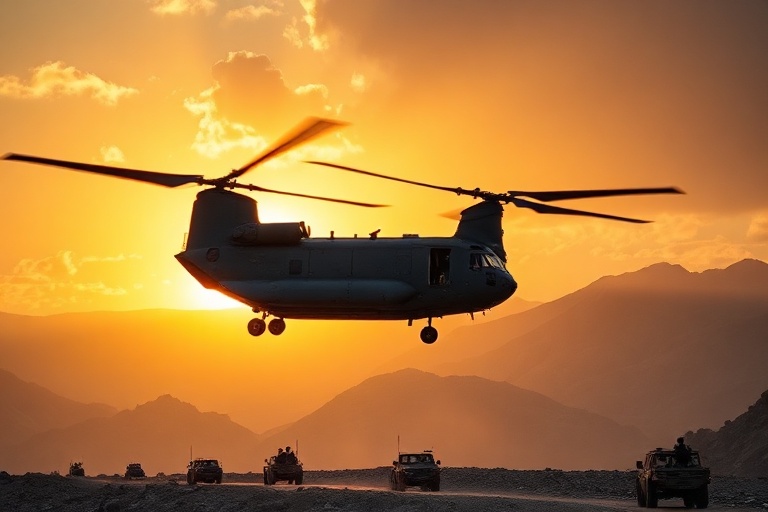
Chinook Helicopter: The Heavy-Lift Workhorse of Modern Aviation
The Boeing CH-47 Chinook stands as one of the most recognizable and versatile rotorcraft in military aviation history. First introduced in the early 1960s, this tandem-rotor helicopter has evolved through multiple generations while maintaining its core design philosophy: heavy-lift capability, reliability, and adaptability. With a service record spanning over six decades, the Chinook has participated in nearly every major conflict since Vietnam and continues to serve in roles ranging from troop transport to disaster relief.
Its distinctive tandem-rotor configuration—featuring two large horizontal rotors mounted at the front and rear—sets it apart from conventional helicopters. This design not only provides exceptional lift capacity but also enhances stability during hover and flight, especially in challenging environments. Powered by two turboshaft engines, the Chinook can carry payloads exceeding 24,000 pounds internally or slung externally, making it indispensable in both military and humanitarian operations.
Design and Technical Specifications
The Chinook’s airframe is built for endurance. Constructed primarily from aluminum and composite materials, the fuselage is reinforced to withstand harsh conditions, including sand, saltwater, and high-altitude operations. The helicopter measures 98 feet in length and 18 feet in height, with a rotor diameter of 60 feet. Its maximum gross weight reaches 50,000 pounds, allowing it to transport up to 55 troops, 24 litters with medical staff, or large cargo such as vehicles and artillery systems.
Power comes from two Honeywell T55-GA-714A turboshaft engines, each producing 4,733 shaft horsepower. These engines drive the dual rotors through a common driveshaft, enabling the Chinook to operate even if one engine fails—a critical safety feature in combat zones. The helicopter’s transmission system is designed for high torque loads, and its landing gear is ruggedized for unprepared landing sites.
Advanced avionics enhance the Chinook’s operational flexibility. Modern variants, such as the CH-47F and CH-47F Block II, feature digital flight controls, advanced navigation systems, and improved survivability suites. The Block II upgrade, currently in production, includes a strengthened airframe, upgraded fuel system, and increased payload capacity, extending the Chinook’s service life into the 2060s.
Operational Roles and Military Significance
The Chinook’s versatility has made it a cornerstone of modern military logistics. Its primary mission is heavy-lift transport, but it is also deployed for medical evacuation, special operations insertions, airborne command and control, and even search-and-rescue missions. Unlike lighter helicopters, the Chinook can operate at high altitudes and in hot climates without significant performance degradation—a critical advantage in mountainous regions like Afghanistan.
In combat, the Chinook plays a vital role in moving troops and equipment rapidly across the battlefield. Its ability to carry vehicles such as the M777 howitzer or HMMWVs allows commanders to reposition assets quickly. The helicopter also serves as a mobile command post, with variants equipped to relay communications and coordinate operations in real time.
The Chinook has seen action in nearly every U.S. military engagement since Vietnam. During the Gulf War, Chinooks transported troops and supplies across vast deserts. In Afghanistan, they conducted high-risk missions in rugged terrain, often under enemy fire. More recently, the U.S. Army deployed Chinooks in Eastern Europe to support NATO operations, demonstrating the aircraft’s continued relevance in global security.
Export and International Service
The Chinook’s reliability has made it a sought-after export. More than 20 nations operate the helicopter, including the United Kingdom, Canada, Australia, Japan, and India. The Royal Air Force’s Chinooks, in particular, have been instrumental in operations across the Middle East and Africa, often flying in extreme conditions.
Other operators use the Chinook for specialized roles. For example, Japan’s Ground Self-Defense Force employs it for disaster relief, leveraging its ability to carry large quantities of supplies to isolated areas. Canada’s CH-147F Chinooks have supported Arctic operations, proving the helicopter’s adaptability in polar environments.
Civilian and Humanitarian Applications
While the Chinook is best known for its military service, it has also made significant contributions in civilian and humanitarian contexts. After natural disasters, Chinooks have delivered food, water, and medical supplies to areas cut off by floods, earthquakes, or hurricanes. Their ability to carry heavy loads over long distances without refueling makes them ideal for emergency response.
In the United States, the Chinook has been used by the Federal Aviation Administration (FAA) for testing and research, particularly in air traffic management and heavy-lift operations. Some private operators have explored the Chinook for firefighting, using its capacity to carry large water buckets or slurry to combat wildfires.
Humanitarian organizations have also utilized Chinooks in global relief efforts. For instance, during the 2010 Haiti earthquake, Chinooks from the U.S. military delivered critical supplies to Port-au-Prince, where roads and infrastructure were severely damaged. The helicopter’s ability to land in tight spaces and carry large quantities of aid was instrumental in the response.
Future of the Chinook Program
The Chinook remains in active production, with Boeing continuing to develop upgrades and new variants. The CH-47F Block II, currently being fielded, represents a significant leap in capability. This upgrade includes a stronger airframe, improved fuel efficiency, and increased lift capacity. The U.S. Army plans to keep the Chinook in service until at least 2060, with ongoing modernization efforts ensuring it remains relevant in future conflicts.
Boeing is also exploring export opportunities for the latest variants. With increasing demand from allied nations seeking to modernize their fleets, the Chinook is poised to remain a global leader in heavy-lift aviation. The company has also proposed civilian versions, such as the Chinook HC.6, targeting commercial operators in industries like energy, construction, and emergency services.
Looking ahead, the Chinook’s role may expand further. Emerging technologies, such as autonomous flight systems and advanced materials, could enhance its capabilities. Boeing has tested unmanned Chinook configurations, suggesting potential for future drone variants that could operate alongside crewed helicopters in high-risk environments.
Challenges and Considerations
Despite its strengths, the Chinook faces challenges. Its size and noise profile make it a target in combat zones, requiring constant upgrades to survivability systems. Maintenance demands are high due to the complexity of its dual-rotor system, and operational costs remain significant. However, the helicopter’s unmatched lift capacity and reliability continue to justify its use.
Another consideration is the evolving nature of warfare. As conflicts increasingly involve drones, cyber warfare, and long-range precision strikes, the Chinook’s traditional role may need to adapt. Yet, its ability to operate in contested environments—where precision strikes and electronic warfare dominate—ensures it remains a critical asset.
Conclusion: A Legacy of Lift and Leadership
The Boeing CH-47 Chinook is more than just a helicopter; it is a symbol of engineering excellence and operational adaptability. From its origins in the Cold War to its role in modern conflicts, the Chinook has consistently delivered when it matters most. Its ability to transport troops, evacuate the wounded, and deliver critical supplies under the most demanding conditions has cemented its place in military aviation history.
As the Chinook program continues to evolve, the aircraft will likely remain a cornerstone of heavy-lift operations for decades to come. Whether supporting troops in combat, delivering aid in disasters, or enabling scientific research in remote locations, the Chinook’s legacy is defined by its unwavering performance. In an era of rapidly changing technology, the Chinook stands as a testament to the enduring value of a well-designed, purpose-built machine.
For those interested in exploring more about military aviation or rotorcraft technology, visit Dave’s Locker Aviation section, where you’ll find in-depth analysis and the latest updates on aircraft like the Chinook.