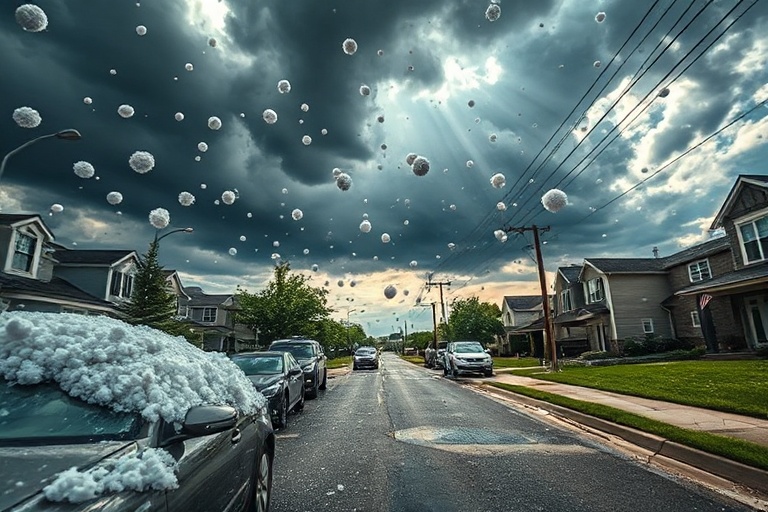
hailstones
The Anatomy of a Hailstone
Hailstones are not mere frozen raindrops. They are complex, layered structures born from violent updrafts in thunderstorms. When supercooled water droplets collide with ice pellets inside a storm cloud, they freeze in layers, creating hailstones that can range from pea-sized to grapefruit-sized. The largest hailstone ever recorded in the United States fell in Vivian, South Dakota, in 2010, measuring eight inches in diameter and weighing nearly two pounds.
The process begins with a tiny ice nucleus. As it cycles through the storm’s updrafts and downdrafts, it collects more supercooled water, growing larger with each pass. The speed of the updraft determines how big a hailstone can become. A storm with updrafts exceeding 100 mph can produce hailstones the size of softballs. These violent cycles can last for several minutes, allowing hailstones to accumulate dense layers of ice.
Not all hailstones are spherical. Some take on irregular shapes, with spikes or protrusions caused by collisions with other hailstones or water droplets. These jagged formations can make hailstones even more destructive when they strike the ground.
Where Hail Falls—and Why It Matters
Hail is a global phenomenon, but certain regions are more prone to its fury. The United States, particularly the Great Plains and the Midwest, experiences more frequent and severe hailstorms than anywhere else in the world. This is due to the collision of warm, moist air from the Gulf of Mexico with cold, dry air from Canada and the Rocky Mountains. The result is a perfect environment for thunderstorms capable of producing large hail.
Other parts of the world also face hail risks. Northern India and Bangladesh endure some of the most destructive hailstorms, often during the pre-monsoon season. In 2019, a hailstorm in India’s northern states killed dozens of people and destroyed crops worth millions. Similarly, parts of China, including the Sichuan Basin, experience frequent hail, which can devastate agricultural communities. In Europe, hailstorms are common in Germany, France, and Italy, where they often coincide with severe thunderstorms in the summer.
In South America, Argentina and Brazil are hotspots for hail. The Pampas region, known for its fertile farmland, frequently suffers from hailstorms that can wipe out entire harvests in minutes. Even Africa is not immune. South Africa’s Highveld region experiences hailstorms that can damage infrastructure and disrupt transportation.
- United States: Great Plains, Midwest, and parts of the Southeast.
- Asia: Northern India, Bangladesh, and China’s Sichuan Basin.
- Europe: Germany, France, and Italy.
- South America: Argentina and Brazil’s Pampas region.
- Africa: South Africa’s Highveld region.
The Cultural and Historical Impact of Hail
Hail has shaped human history in unexpected ways. Ancient civilizations often viewed hailstorms as divine punishment. In Norse mythology, hail was associated with the god Thor, whose thunderstorms were believed to bring both destruction and protection. The Vikings even had a term, “hagl,” which described not just the ice but the chaos it brought.
In medieval Europe, hailstorms were sometimes seen as omens of famine or war. Chroniclers recorded hailstorms as signs of God’s wrath, and communities would hold processions or prayers to ward off further disaster. The 1315 Great Famine in Europe was exacerbated by a series of harsh winters and hailstorms that destroyed crops, leading to widespread starvation.
Hail has also influenced agriculture and economics. The wine industry in France’s Bordeaux region has faced repeated setbacks from hailstorms, which can destroy entire vineyards in a matter of minutes. In 2017, a single hailstorm in the region caused an estimated €1 billion in damage. Similarly, fruit growers in the United States’ Pacific Northwest have invested in hail nets and insurance policies to protect their orchards.
In some cultures, hail is not just a threat but a resource. In parts of China, hailstones are collected and used in traditional medicine. The ice is believed to have cooling properties and is sometimes ground into powder for remedies. In rural India, farmers have developed techniques to minimize hail damage, such as planting crops in patterns that disrupt hailstone formation.
Surviving the Storm: Protection and Prediction
Modern science has made it easier to predict hailstorms, but preventing damage remains a challenge. Meteorologists use Doppler radar to detect hail within thunderstorms, giving communities precious minutes to take cover. The National Weather Service in the U.S. issues warnings when hail larger than one inch in diameter is expected. However, in regions with poor infrastructure, these warnings may not reach everyone in time.
For those caught in a hailstorm, finding shelter is critical. Cars are not safe during severe hailstorms, as hailstones can shatter windows and dent metal. Brick or concrete buildings with no windows are the best options. If caught outside, seeking cover under a sturdy structure or even a ditch can reduce the risk of injury.
In agricultural communities, farmers are turning to technology to protect their livelihoods. Hail cannons, devices that emit shockwaves to disrupt hail formation, have been used for over a century, though their effectiveness is debated. More recently, drones equipped with sensors are being tested to seed clouds and reduce hail size. Insurance companies are also offering specialized policies for farmers in hail-prone areas, though premiums can be high.
For cities, hail poses a different set of challenges. Infrastructure damage can be extensive, from shattered skylights to dented vehicles. In 2018, a hailstorm in Denver, Colorado, caused an estimated $2.3 billion in damage, making it one of the costliest in U.S. history. Cities are investing in stronger building codes and materials designed to withstand hail impact. For example, some newer roofs are made with impact-resistant shingles that can endure hail up to two inches in diameter.
As climate change alters weather patterns, the frequency and intensity of hailstorms may increase. Warmer temperatures can lead to more moisture in the atmosphere, fueling stronger thunderstorms. A 2021 study published in Nature Climate Change found that hailstorms could become more common in Europe and North America as global temperatures rise. This trend underscores the need for better preparedness and adaptive strategies.
Conclusion: The Sky’s Wrath and Human Resilience
Hailstones are a reminder of nature’s power. They can destroy in minutes, reshaping landscapes and livelihoods. Yet, they also reveal human ingenuity—from ancient prayers to modern radar systems, communities have sought to understand and mitigate hail’s impact. As weather patterns shift, the challenge will be to balance adaptation with innovation.
For now, the best defense remains awareness. Knowing the signs of a hailstorm, seeking shelter quickly, and investing in resilient infrastructure can make a difference. Hail may be unpredictable, but its consequences don’t have to be.