Hibernian FC: Scotland’s Historic Club and Modern Revival
Few football clubs carry the weight of history and tradition as Hibernian Football Club does. Founded in 1875 by Irish immigrants in Edinburgh, the club emerged as more than just a sporting institution—it became a symbol of community resilience and cultural identity. Over 150 years later, Hibernian remains a cornerstone of Scottish football, balancing its rich heritage with a push toward modern competitiveness.
While the club has experienced peaks and valleys, its enduring legacy is intertwined with the city it represents. From early dominance in the 1900s to financial struggles in the late 20th century, Hibernian’s story reflects broader themes of perseverance, adaptation, and the unifying power of football. Today, the club stands at a pivotal moment, rebuilding under new ownership while staying true to its roots.
The Founding Spirit: Irish Identity and Community Roots
Hibernian FC was established in the Cowgate area of Edinburgh, a neighborhood with a strong Irish immigrant population fleeing the Great Famine. The club’s founders—many of whom were members of the Irish Hibernian Benevolent Society—sought to provide a sense of belonging and recreation for their community. The name “Hibernian” itself is a nod to Hibernia, the ancient Roman name for Ireland.
From the outset, Hibernian was more than a football team. It was a cultural hub, offering Irish immigrants a space to celebrate their heritage while integrating into Scottish society. The club’s early years were marked by matches against local sides, often played in front of modest crowds but with immense local significance. By 1887, Hibernian had turned professional and joined the Scottish Football League, setting the stage for its first golden era.
The club’s green-and-white striped jerseys were not just a uniform; they were a statement. For many supporters, wearing the colors became an act of defiance and pride, reinforcing the club’s role as a bridge between Irish and Scottish identities. This duality remains a defining feature of Hibernian’s ethos, even as the team has evolved into a modern footballing entity.
A Golden Era and Financial Turmoil: The Highs and Lows of Hibs
The early 20th century marked Hibernian’s most successful period. Under the leadership of manager Dan McMichael, the club claimed three Scottish league titles in 1903, 1948, and 1951. The 1950s, in particular, saw Hibernian become one of Scotland’s most entertaining teams, thanks to the “Famous Five”—a forward line consisting of Gordon Smith, Bobby Johnstone, Lawrie Reilly, Eddie Turnbull, and Willie Ormond. Their attacking prowess made them a force to be reckoned with, both domestically and in European competitions.
However, success on the pitch did not translate to financial stability. By the 1980s and 1990s, Hibernian faced severe financial difficulties, culminating in administration in 2004. The club’s East Stand was demolished due to safety concerns, and the team was relegated to the Scottish First Division. The crisis reflected broader challenges in Scottish football, where smaller clubs struggled to compete with the financial might of larger European sides.
The turn of the millennium brought a period of instability, with ownership changes and on-field struggles testing the loyalty of supporters. Yet, the resilience of Hibs’ fanbase never wavered. Season ticket sales remained strong, and the club’s social media presence grew as fans turned to digital platforms to voice their frustrations and hopes.
Key Moments in Hibernian’s 20th-Century History
- 1903: Hibernian wins its first Scottish league title, becoming the first Edinburgh club to achieve the feat.
- 1948: The club secures its second league title under manager Willie McCartney.
- 1955: Hibernian reaches the semifinals of the European Cup, becoming the first British club to participate in the competition.
- 1972: The club wins the Scottish League Cup, its first major trophy in over two decades.
- 1991: Hibernian is relegated to the Scottish First Division, marking the beginning of a steep decline.
Rebirth and Renewal: Hibernian’s Path to Modern Competitiveness
The 21st century has brought renewed optimism to Hibernian. In 2014, Russian billionaire Roman Romanov acquired the club, injecting much-needed capital and ambition. Under his ownership, Hibernian began rebuilding its squad and infrastructure, culminating in a return to the Scottish Premiership in 2017. The club’s promotion was celebrated as a triumph of community spirit over financial adversity.
In 2016, Hibernian won the Scottish Cup, its first major trophy in 114 years. The victory was a defining moment, proving that the club could compete at the highest level while staying true to its values. The triumph was also a testament to the loyalty of the supporters, who had endured years of disappointment with unwavering passion.
Today, Hibernian continues to evolve under new ownership. In 2022, the club was acquired by a consortium led by Edinburgh businessman Ron Gordon, who has emphasized sustainability and long-term growth. The team’s recent performances in the Scottish Premiership and Europa Conference League have shown promise, with young talents like Martin Boyle and Dylan Vente emerging as key players.
The Future of Hibernian: Balancing Tradition and Ambition
Hibernian’s challenge moving forward is to honor its past while embracing the future. The club’s new stadium project, Leith Hibernian, represents a bold step toward modernizing its facilities and increasing revenue streams. However, the project also raises questions about gentrification and the club’s relationship with its working-class roots.
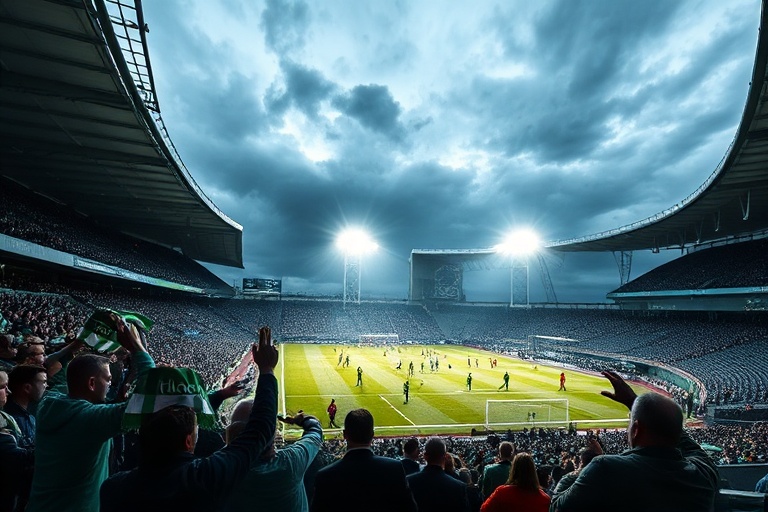
On the pitch, Hibernian must continue to develop its youth academy and scouting network to compete with Celtic and Rangers. Financial prudence will be key, as the club seeks to avoid repeating the mistakes of the past. Yet, the passion of the supporters remains Hibernian’s greatest asset. The Green Army, as the fanbase is known, has a history of standing by the club through thick and thin, and their loyalty will be crucial in the years ahead.
Hibernian’s story is one of resilience, identity, and the enduring power of football to unite communities. As the club looks to the future, it does so with the weight of its past—and the unshakable belief that, no matter the challenges, Hibs will always find a way to rise again.
For fans of Scottish football, Hibernian FC is more than a club; it’s a living testament to what happens when history, culture, and ambition collide on the pitch.
Further Reading
Explore more about football history and culture in our Sports and News sections.