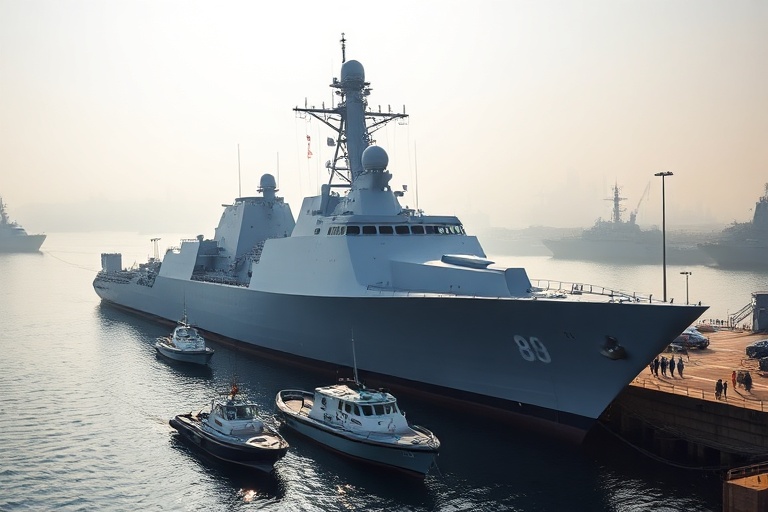
HMS Dragon: The Royal Navy’s Advanced Destroyer in Action
In the vast expanse of the world’s oceans, where geopolitical tensions and maritime security challenges continue to evolve, the Royal Navy’s Type 45 destroyers stand as formidable guardians of British interests. Among these, HMS Dragon represents the cutting edge of naval technology and operational capability. Commissioned in 2012, this advanced warship has become a symbol of the Royal Navy’s commitment to maintaining global maritime security in an increasingly uncertain world.
Designed primarily for anti-air warfare, HMS Dragon and her sister ships in the Type 45 class are among the most sophisticated destroyers afloat today. With a displacement of 8,500 tonnes and a length of 152.4 meters, these vessels are built to project power across vast distances while protecting allied forces and civilian shipping lanes. Their primary role involves defending against aerial threats, but their capabilities extend far beyond air defense, encompassing anti-surface and anti-submarine operations.
The Design and Technology Behind HMS Dragon
The Type 45 destroyers, including HMS Dragon, were conceived in response to the growing threat of anti-ship missiles and the need for robust area air defense. The ship’s design incorporates stealth features to reduce its radar cross-section, making it less detectable to enemy sensors. The hull form and superstructure are carefully shaped to minimize reflections, while advanced materials help absorb radar waves.
At the heart of HMS Dragon’s combat system is the Sea Viper air defense system, which integrates the SAMPSON multi-function radar and the PAAMS (Principal Anti Air Missile System). This combination allows the ship to track and engage multiple aerial targets simultaneously, from high-altitude bombers to low-flying cruise missiles. The SAMPSON radar, with its rotating dual-face array, provides 360-degree coverage and can detect targets at ranges exceeding 400 kilometers.
The propulsion system of HMS Dragon is another technological marvel. Powered by an integrated electric propulsion system, the ship can achieve speeds in excess of 30 knots. This system, known as Integrated Electric Propulsion (IEP), not only enhances operational flexibility but also reduces maintenance requirements compared to traditional mechanical systems. The ship’s two Rolls-Royce WR-21 gas turbines and two diesel generators provide the electrical power needed for both propulsion and the extensive array of sensors and weapons systems.
- Displacement: 8,500 tonnes
- Length: 152.4 meters
- Beam: 21.2 meters
- Speed: 30+ knots
- Range: 7,000 nautical miles at 18 knots
- Crew: Approximately 191 personnel
Operational History and Deployments
Since her commissioning, HMS Dragon has been involved in numerous high-profile deployments, demonstrating her capabilities in real-world scenarios. One of her earliest missions was in 2013, when she was deployed to the Mediterranean as part of the Standing NATO Maritime Group 2. This deployment highlighted the ship’s ability to operate within a multinational task force, a critical aspect of modern naval warfare.
In 2017, HMS Dragon embarked on a six-month deployment to the Asia-Pacific region, marking one of the most significant Royal Navy deployments to the area in recent years. During this deployment, the ship participated in exercises with allied navies, including the Japanese Maritime Self-Defense Force and the Republic of Singapore Navy. These exercises focused on anti-air and anti-submarine warfare, as well as maritime security operations, underscoring the ship’s versatility.
More recently, HMS Dragon has been involved in operations closer to home. In 2020, she was deployed to the eastern Mediterranean as part of the UK’s response to rising tensions in the region. The ship’s advanced radar and missile systems made her a valuable asset in monitoring and responding to potential threats. Her presence served as a deterrent and a reassurance to allied forces operating in the area.
Challenges and Future Upgrades
Despite her advanced capabilities, HMS Dragon has not been without challenges. One of the most significant issues faced by the Type 45 destroyers has been the reliability of their propulsion systems. In 2016, the Royal Navy acknowledged that the WR-21 turbines were prone to power failures, which could limit the ship’s operational availability. This issue led to a comprehensive upgrade program, known as the Power Improvement Project (PIP), which aims to enhance the reliability and efficiency of the propulsion systems.
The PIP involves replacing the existing turbines with more robust and efficient models, as well as upgrading the electrical systems to better manage power distribution. These upgrades are expected to extend the operational life of HMS Dragon and her sister ships, ensuring they remain relevant and effective in an evolving security environment. The first ship to undergo the PIP was HMS Dauntless, with HMS Dragon scheduled to follow in due course.
Looking ahead, the Royal Navy is also exploring ways to enhance the capabilities of the Type 45 destroyers. One area of focus is the integration of new technologies, such as directed energy weapons and advanced cyber defense systems. These upgrades will further enhance the ship’s ability to counter emerging threats, from hypersonic missiles to cyber attacks on naval systems.
HMS Dragon’s Role in Modern Naval Warfare
The modern battlespace is characterized by its complexity and the rapid pace of technological change. In this environment, ships like HMS Dragon play a crucial role in maintaining maritime security and projecting national power. The Type 45 destroyers are not just platforms for advanced weaponry; they are also hubs for command and control, capable of coordinating operations across multiple domains, from air and sea to cyber and space.
One of the key advantages of HMS Dragon is her ability to operate as part of a task group. In a typical scenario, a Type 45 destroyer might be deployed alongside a Royal Navy aircraft carrier, such as HMS Queen Elizabeth, and other support vessels. This integration allows for a layered defense, where the Type 45 provides air defense for the task group, while other ships focus on anti-submarine and anti-surface warfare. This synergy enhances the overall effectiveness of the task group and maximizes the combat power available to the commander.
Another critical aspect of HMS Dragon’s role is her contribution to maritime security operations. In regions such as the Gulf and the Indian Ocean, where piracy and smuggling pose significant threats, the presence of a warship like HMS Dragon can deter illicit activities and protect vital shipping lanes. The ship’s advanced sensors and helicopters enable her to monitor large areas of ocean and respond rapidly to any suspicious activity.
For those interested in exploring more about modern naval technology and the Royal Navy’s capabilities, our Technology section offers in-depth analysis and updates on the latest developments in defense systems. Additionally, our News section provides the latest coverage on military and security issues from around the world.
Conclusion: A Ship Built for the Future
HMS Dragon embodies the Royal Navy’s commitment to maintaining a world-class fleet capable of meeting the challenges of the 21st century. From her advanced air defense systems to her cutting-edge propulsion and command capabilities, she represents the pinnacle of modern naval engineering. While challenges such as propulsion reliability have required attention, the ongoing upgrades and modernization programs ensure that HMS Dragon will remain a cornerstone of the Royal Navy’s operational readiness for years to come.
As geopolitical tensions continue to rise and new threats emerge, the role of destroyers like HMS Dragon will only grow in importance. Whether operating independently or as part of a larger task group, these ships provide the United Kingdom with a powerful tool for deterrence, defense, and power projection. In an era where maritime security is more critical than ever, HMS Dragon stands as a testament to the enduring value of a strong and capable navy.