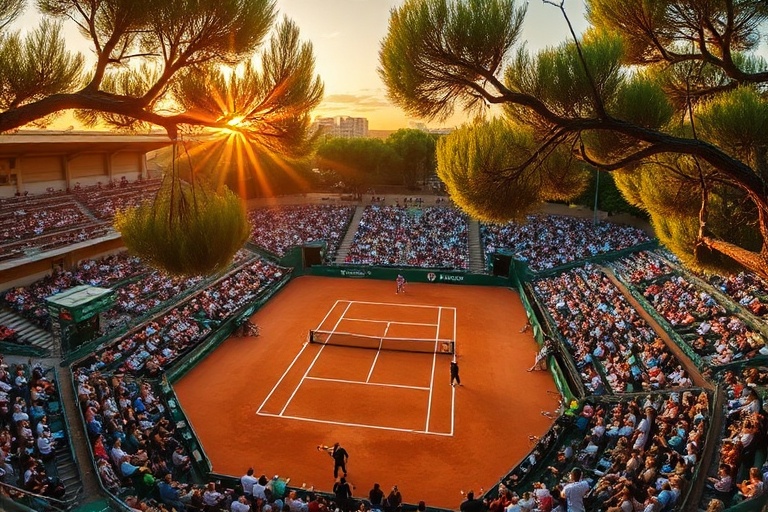
The Italian Open, known officially as the Internazionali BNL d’Italia, stands as one of tennis’s most prestigious clay-court tournaments. Held annually in Rome, this event draws the world’s top players, offering a compelling blend of athletic excellence, historical significance, and cultural richness. More than just a sporting occasion, the tournament reflects Italy’s deep connection to the sport and its role in shaping tennis’s global narrative.
With a history stretching back to 1930, the Italian Open has evolved from a continental gathering to a mandatory stop on the ATP and WTA tours. Its timing—just ahead of the French Open—makes it a critical proving ground for players targeting Roland Garros glory. Yet beyond the competition, the tournament embodies the spirit of Italian hospitality, artistic flair, and a passion for la bella vita that permeates every match.
The Tournament’s Storied Past and Evolution
Founded in Milan in 1930 as the Italian International Championships, the event was initially a men’s-only competition. It relocated to Rome in 1935, where it found its permanent home at the Foro Italico, a striking sports complex designed in the 1920s under Mussolini’s regime but later transformed into a symbol of athletic grandeur.
Women’s singles were added in 1935, creating a dual-gender format that mirrored the evolution of professional tennis. The tournament was canceled during World War II but resumed in 1949, gradually regaining its stature. By the 1960s and 70s, legends like Ilie Năstase, Chris Evert, and Björn Borg graced the courts, cementing its reputation as a proving ground for champions.
In 1979, the tournament was renamed the Internazionali d’Italia and adopted its current clay-court identity. The shift to Rome’s slow, high-bouncing surface provided a unique challenge—one that separated the tactically astute from the power hitters. This transformation aligned the Italian Open with the French Open’s preparation cycle, making it a strategic stop for players aiming for Paris.
Key Milestones in Tournament History
The Italian Open has been witness to some of tennis’s most dramatic moments:
- 1961: Nicola Pietrangeli’s First Title – The Italian legend became the first homegrown champion, a feat unmatched for decades.
- 1980: Chris Evert’s Dominance – The American great claimed her third title in Rome, showcasing the tournament’s appeal to women’s tennis.
- 1996: Thomas Muster’s Clay-Court Masterclass – The Austrian won his only Italian Open title, later going on to win the French Open that year.
- 2006: Rafael Nadal’s First Rome Win – A 20-year-old Nadal defeated Roger Federer in a five-set thriller, signaling the rise of a new clay-court king.
- 2023: Daniil Medvedev’s Redemption – After a disappointing French Open exit, the Russian rebounded to win in Rome, proving the tournament’s role as a reset button for elite players.
Why the Italian Open Matters in the Global Tennis Landscape
The Italian Open occupies a unique position in the tennis calendar. Sandwiched between the early clay swing and the French Open, it serves as both a litmus test and a pressure valve. Players arrive with varying objectives: some seek to fine-tune their clay-court games, while others aim to build momentum heading into Paris. The tournament’s demanding conditions—long rallies, high endurance demands, and tactical nuance—force competitors to adapt or face early exits.
For spectators, the event offers more than just world-class tennis. The Foro Italico’s iconic setting, with its white-marble courts and pine trees, creates an atmosphere unlike any other. The blend of ancient Roman architecture and modern athleticism embodies Italy’s ability to honor tradition while embracing progress. This cultural fusion extends beyond the court, as Rome’s vibrant food scene, historic landmarks, and artistic heritage provide a backdrop that enriches the tournament experience.
Television viewership reflects the event’s global reach. Broadcast in over 180 countries, the Italian Open draws millions of fans, particularly in Europe, Latin America, and parts of Asia. Its presence on streaming platforms has further expanded its audience, making it a cornerstone of tennis’s digital engagement strategy.
The Cultural Impact of Tennis in Italy
Tennis in Italy is more than a sport—it’s a cultural institution. The country has produced some of the game’s most revered figures, including Adriano Panatta, the only Italian man to win the French Open (1976), and Francesca Schiavone, the 2010 Roland Garros champion. These athletes inspire generations, proving that success on the court can transcend sport.
The Italian Open plays a central role in this narrative. It’s a stage where Italian pride meets international competition. The local fanbase, known for its passion and knowledge, fills the stands, creating an electric atmosphere. This support is especially evident during matches involving Italian players, where the crowd’s energy often mirrors the intensity on the court.
Beyond the players, the tournament reflects Italy’s broader relationship with sport. Football may dominate headlines, but tennis thrives in clubs across the country, from Milan to Palermo. The Italian Open acts as a unifying event, drawing fans from different regions and backgrounds under one banner.
Looking Ahead: The Future of the Italian Open
As tennis continues to evolve, the Italian Open faces new challenges and opportunities. Sustainability has become a priority, with organizers implementing eco-friendly initiatives such as reduced plastic use and energy-efficient operations. Digital innovation also plays a role, with enhanced fan experiences through augmented reality and interactive content.
The tournament’s organizers have also emphasized accessibility, ensuring that fans of all ages and backgrounds can attend. Community outreach programs, youth clinics, and cultural exhibitions enrich the event, reinforcing its role as a cultural festival as much as a sporting one.
For players, the Italian Open remains a must-win. The clay surface rewards precision and patience, traits that define champions. With the rise of young talents like Jannik Sinner and Carlos Alcaraz, the tournament is poised to write new chapters in its storied history.
As the tennis world turns its gaze toward Paris each year, the Italian Open serves as a vital chapter in the journey. It’s a place where legends are made, strategies are tested, and the spirit of the game is celebrated in all its complexity and beauty.
For fans and players alike, the Italian Open is more than a tournament—it’s a tradition, a challenge, and a celebration of what makes tennis truly timeless.
To explore more about tennis’s global influence, visit our Sports section, where we dive into the stories shaping the world of athletics.