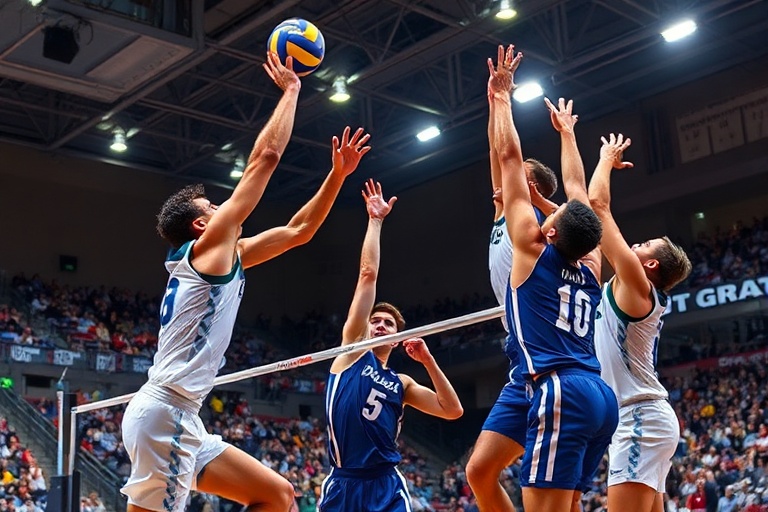
The NCAA men’s volleyball landscape has quietly undergone a transformation in recent years. Once overshadowed by sports like basketball and football, the sport has steadily carved out a niche, driven by competitive parity, growing fan engagement, and strategic investments in facilities and broadcasting. This shift isn’t just about on-court performance; it reflects broader trends in college athletics, where niche sports are finding new relevance in an era of shifting fan expectations and media consumption.
The Evolution of NCAA Men’s Volleyball
NCAA men’s volleyball has evolved from a regional sport into a national conversation. For decades, the sport was concentrated in specific regions like California and Hawaii, where it had deep roots. However, the past 15 years have seen a deliberate push to expand its footprint. The NCAA now sanctions men’s volleyball as an official sport at the Division I, II, and III levels, with Division I leading the charge in terms of competition and visibility.
One of the most significant milestones came in 2021 when the NCAA announced that men’s volleyball would receive an automatic qualifier to the Division I men’s volleyball championship. This decision elevated the sport’s prestige, ensuring that the top teams from conferences like the Big West, MIVA, and Conference Carolinas would compete for a national title. The move was a recognition of the sport’s growing competitiveness and fan appeal.
Key Factors Driving Growth
The sport’s growth can be attributed to several key factors:
- Increased Media Exposure: Matches are now broadcast on platforms like ESPN+, increasing accessibility for fans who may not have local access to games.
- Facility Upgrades: Programs like UCLA, Long Beach State, and BYU have invested in state-of-the-art facilities, attracting top recruits and enhancing the fan experience.
- Star Power: Players like Micah Ma’a of Hawaii and Alex Knight of Stanford have become household names in volleyball circles, drawing attention to the sport’s high level of play.
- Olympic Pipeline: With volleyball’s inclusion in the Olympics, NCAA men’s volleyball serves as a critical development ground for future national team athletes.
The Competitive Landscape: Who’s Dominating?
While the sport remains competitive across all levels, a handful of programs have emerged as perennial contenders. UCLA, with its 19 national titles, remains the gold standard in men’s volleyball. The Bruins’ dominance is a testament to their recruiting prowess and coaching stability under head coach John Speraw. However, the gap between UCLA and the rest of the field is narrowing, as programs like Long Beach State, Pepperdine, and Hawaii have closed the performance gap.
Long Beach State, under the leadership of Alan Knipe, has become a consistent threat, with multiple Final Four appearances in recent years. The 49ers’ success is built on a foundation of strong defense and disciplined play, traits that have defined their program for decades. Meanwhile, Hawaii has leveraged its geographic advantage and high-energy fan base to become a perennial contender, with the Rainbow Warriors making deep tournament runs in recent years.
The rise of mid-major programs like BYU and Stanford has also added depth to the competitive landscape. BYU, in particular, has become a model for program-building outside traditional volleyball hotbeds, thanks to its investment in facilities and coaching. Stanford’s emergence as a national contender highlights the sport’s widening appeal beyond its traditional coastal strongholds.
The Broader Implications for College Athletics
The growth of NCAA men’s volleyball is more than just a story about a single sport; it’s a case study in how college athletics is adapting to new realities. As the cost of operating major sports programs continues to rise, schools are looking for ways to maximize the value of their athletic investments. Men’s volleyball offers a compelling model: it’s a high-participation, low-cost sport that can generate significant fan engagement without the financial burdens of football or basketball.
Moreover, men’s volleyball aligns with broader trends in college sports, where student-athlete well-being and career development are becoming priorities. Volleyball players often graduate at higher rates than athletes in revenue-generating sports, and the sport’s shorter season (typically 20-25 matches) reduces the physical and mental toll on players. This makes it an attractive option for schools seeking to balance competition with academic success.
The sport’s growth also reflects shifting fan preferences. Younger audiences, in particular, are drawn to the speed and athleticism of volleyball, as well as its accessibility. Unlike sports that require large stadiums or expensive equipment, volleyball can be played and enjoyed in a variety of settings, from gyms to beaches. This versatility makes it a natural fit for an era where fans expect flexibility in how they consume sports.
The Road Ahead: Challenges and Opportunities
Despite its progress, NCAA men’s volleyball faces challenges as it seeks to solidify its place in the college sports landscape. One of the biggest hurdles is visibility. While the sport has made strides in broadcasting, it still lags behind major sports in terms of mainstream exposure. The NCAA and conferences must continue to invest in marketing and storytelling to attract casual fans who may not be familiar with the sport’s nuances.
Another challenge is the financial disparity between traditional volleyball powers and upstart programs. Schools with deep pockets can afford to recruit top talent and invest in facilities, creating an uneven playing field. To address this, the NCAA and conferences could explore revenue-sharing models or scholarship caps to ensure competitive balance.
However, the opportunities far outweigh the challenges. The sport’s inclusion in the NCAA’s emerging sports program has opened doors for expansion, with new programs joining the ranks each year. Additionally, the growing popularity of beach volleyball—another NCAA sport—could create synergies, such as joint marketing campaigns or shared resources.
For fans and observers, the future of NCAA men’s volleyball looks bright. With more matches being broadcast, higher levels of competition, and a new generation of stars emerging, the sport is poised for continued growth. It may never reach the heights of football or basketball, but men’s volleyball is carving out its own identity—a fast-paced, inclusive, and increasingly competitive spectacle that deserves a place in the college sports conversation.
For those looking to dive deeper into volleyball’s broader impact, check out our Trending and Analysis sections for more insights.