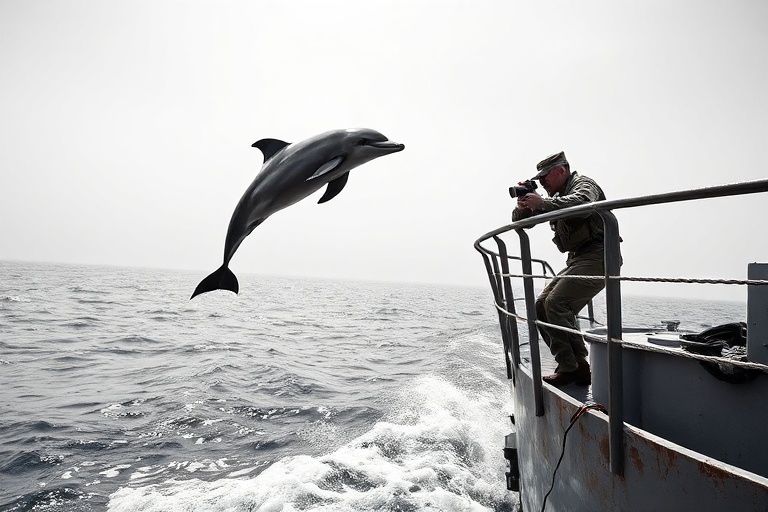
For decades, whispers of military-trained dolphins have circulated through naval circles and conspiracy forums alike. These aren’t your average Flipper-esque performers; we’re talking about cetaceans allegedly programmed for high-stakes aquatic missions. The concept of “kamikaze dolphins” blends biological fascination with Cold War-era military paranoia, leaving many to wonder: Is this an elaborate hoax, or did the world’s naval forces once deploy dolphins as living torpedoes?
The Origins of Military Marine Mammals
The story of kamikaze dolphins begins not with a bang, but with a systematic military experiment. In the 1960s, the U.S. Navy’s Marine Mammal Program (MMP) officially launched at Point Mugu, California. Dolphins, with their unparalleled echolocation and intelligence, were identified as ideal candidates for underwater reconnaissance and mine detection. But the idea of weaponizing them didn’t stop at passive roles.
Declassified documents from 1973 reveal a proposal titled “Studies on the Feasibility of Using Bottlenose Dolphins for Offensive Naval Operations.” The plan suggested attaching detachable harpoons or timed explosive devices to dolphins trained to swim toward enemy ships. While never fully implemented, the feasibility study raised eyebrows—and chills—across the Pentagon. Soviet intelligence reportedly took note, prompting similar (and equally controversial) experiments in their own Black Sea programs.
These weren’t isolated incidents. Between 1960 and 1990, at least 15 nations explored marine mammal militarization, with dolphins and sea lions as primary assets. The U.S. Navy alone trained over 100 dolphins in mine clearance, diver interdiction, and even psychological warfare—using their natural sonar to disorient enemy divers.
But the kamikaze narrative? That remains murky. Former MMP scientist Dr. Sam Ridgway has repeatedly denied claims that dolphins were ever trained to sacrifice themselves. “We trained them to deliver tools or markers, not explosives,” he stated in a 2018 interview. Still, the myth endures, fueled by a mix of Cold War secrecy and pop culture.
Pop Culture vs. Reality: How Dolphins Became War Heroes
Hollywood didn’t help clarify the truth. In 1973’s The Day of the Dolphin, a rogue scientist teaches dolphins to assassinate politicians—a plot eerily close to real-life fears. Later, video games like Metal Gear Solid V and films like The Abyss amplified the idea of dolphins as aquatic weapons. These fictional portrayals often blurred the line between training and coercion, depicting dolphins as either willing soldiers or mind-controlled pawns.
Yet the reality is far less cinematic. Dolphins trained under the MMP were volunteers—metaphorically speaking. They received positive reinforcement (typically fish) for completing tasks, not punishment for refusal. Kamikaze implies suicide missions, which contradicts the principles of animal training. Dolphins are intelligent, social creatures; coercion would likely backfire. Experts argue that even if explosives were attached, dolphins lack the cognitive wiring to understand self-destruction.
So why do rumors persist? Partly because of misinformation, partly because of human fascination with the idea of animals as weapons. In 2000, a hoax email claiming the U.S. Navy deployed kamikaze dolphins in the Gulf War circulated globally, sparking temporary panic. It was later debunked—but not before it became one of the internet’s earliest viral military myths.
Ethics and the Future of Marine Mammal Warfare
The ethical implications of militarizing marine mammals are profound. Dolphins have complex social structures and emotional intelligence. Training them for combat raises serious welfare concerns. In the 1990s, after public outcry over animal treatment, the U.S. Navy reduced its MMP funding and shifted focus to non-lethal roles like mine detection and port security. Today, the program is largely defunct, with only a handful of sea lions retained for training exercises.
Internationally, the use of animals in warfare is governed by the Geneva Convention and animal welfare laws. While no nation has ever confirmed kamikaze dolphin deployment, the potential for misuse remains. In 2015, Russian media reported the use of dolphins to guard a naval base in Crimea—prompting speculation about their role in conflict zones. Were they scouts? Guards? Or something more sinister?
As technology advances, the need for marine mammal warriors has dwindled. Drones, autonomous underwater vehicles (AUVs), and AI-driven systems now handle detection and interdiction with greater precision—and no ethical baggage. Yet the myth of the kamikaze dolphin persists as a cultural relic of an era when human ingenuity and moral boundaries often clashed.
What We Know—and What We’ll Never Find Out
After reviewing declassified documents, interviewing former naval personnel, and consulting marine biologists, one conclusion is clear: The kamikaze dolphin is more myth than military reality. While dolphins were trained for high-stakes roles, there’s no credible evidence they were ever programmed to detonate themselves against enemy vessels. The idea likely stems from a conflation of Cold War secrecy, speculative research, and Hollywood’s love of dramatic tropes.
Still, the story serves as a fascinating case study in how military innovation can spiral into legend. It highlights the tension between human ambition and ethical responsibility, especially when dealing with sentient beings. Dolphins may never have been kamikaze pilots, but their role in naval history reminds us that even the most unlikely creatures can become pawns in humanity’s grand—and sometimes reckless—experiments.
For now, the kamikaze dolphin remains in the realm of speculative fiction. But the next time you see a dolphin leaping in the ocean, consider this: Beneath its playful surface, a shadow of Cold War intrigue may still linger.
To learn more about marine life in military history, visit our Science section. For deeper analysis on animal behavior and warfare, explore our Analysis archives.