The story of Our Lady of Fatima begins in a quiet Portuguese village in 1917, but its echoes have traveled across continents and centuries. This Marian apparition—reported by three shepherd children—has shaped Catholic spirituality, influenced global events, and continues to inspire pilgrims and scholars alike. More than a historical footnote, Fatima represents a moment when the divine intersected with human frailty, leaving behind a legacy of prayer, prophecy, and persistent devotion.
The Apparitions and Their Witnesses
Between May 13 and October 13, 1917, the Blessed Virgin Mary is said to have appeared six times to three children in Cova da Iria, near Fatima, Portugal. Lucia dos Santos, aged 10, and her cousins Francisco and Jacinta Marto, ages 9 and 7, were tending their families’ sheep when the first apparition occurred. According to their accounts, a radiant woman appeared above a holm oak tree, dressed in white with a blue mantle, and delivered messages of prayer, penance, and divine warning.
The messages were not abstract. On July 13, 1917, the Virgin revealed a secret divided into three parts—popularly known as the Three Secrets of Fatima. The first two involved visions of hell and a prophecy of a future war worse than World War I, while the third was sealed by the Church until 2000. These revelations, combined with the public miracle of the “Dancing Sun” on October 13—witnessed by 70,000 people—cemented Fatima as a site of profound spiritual significance.
Core Messages Delivered at Fatima
- Prayer: A call for daily recitation of the Rosary, especially for peace.
- Penance: Emphasis on reparation for sins and personal conversion.
- Sacrifice: Suffering offered in reparation for the salvation of souls.
- Devotion to the Immaculate Heart: A spiritual path aimed at healing a broken world.
These themes were not new, but their delivery through children—uneducated and from a rural background—added a layer of authenticity that resonated deeply within the Catholic imagination. The Church later canonized Francisco and Jacinta Marto in 2017, underscoring their role as witnesses to divine truth.
Fatima in Historical and Theological Context
Fatima emerged during a period of profound crisis: World War I was raging, Europe was fractured by political upheaval, and the Catholic Church faced internal and external challenges. The apparitions occurred against the backdrop of anti-clerical sentiment in Portugal, where the government had recently separated church and state. In this climate, Fatima became a counter-narrative—a divine intervention in human affairs, offering hope through faith and prayer.
Theologically, Fatima reinforced traditional Marian doctrines while introducing new elements. The Virgin’s call for consecration to her Immaculate Heart and the emphasis on reparation aligned with Catholic teachings on sin, redemption, and the Communion of Saints. Yet, the apocalyptic tone of the secrets introduced a sense of urgency, framing Fatima as both a consolation and a warning.
Pope Pius XII, who consecrated the world to the Immaculate Heart of Mary in 1942, later credited Fatima with shaping his pontificate. The 1981 assassination attempt on Pope John Paul II occurred on the anniversary of the first apparition, further deepening the connection between Fatima and papal leadership. Such intersections suggest that Fatima was not merely a local phenomenon but a global event with ecclesial implications.
Pilgrimage, Devotion, and Modern Influence
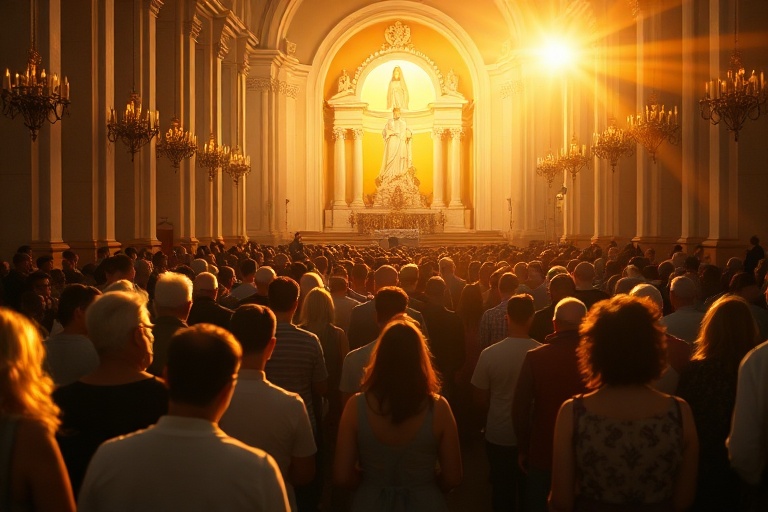
Since 1917, Fatima has become one of the most visited Marian shrines in the world, drawing millions of pilgrims annually. The Basilica of Our Lady of the Rosary, built at the site of the apparitions, stands as a testament to enduring faith. Pilgrims journey on foot, often from distant regions, to pray at the Chapel of the Apparitions, where a statue of the Virgin marks the exact spot of the visions.
The shrine’s influence extends beyond Catholicism. The messages of peace and reconciliation have attracted interfaith dialogue, with leaders from other Christian denominations and even non-Christian traditions visiting to reflect on Fatima’s universal themes. In 2017, Pope Francis canonized Francisco and Jacinta Marto and declared them patron saints of the sick and poor, further elevating their story.
Yet, Fatima’s legacy is not without controversy. Some critics argue that the Church has overemphasized the apocalyptic aspects of the secrets, while others question the historical reliability of the children’s accounts. Theologians debate whether the third secret refers to a specific event, such as the 1981 assassination attempt, or a broader spiritual warning. These discussions highlight the tension between faith and critical inquiry—a tension that has defined Fatima’s reception.
Why Fatima Still Matters Today
In an age marked by division, environmental crisis, and moral uncertainty, Fatima offers a counter-narrative rooted in humility, prayer, and hope. The call to pray the Rosary for peace resonates in a world still torn by war, from Ukraine to the Middle East. The emphasis on reparation challenges modern individualism, urging believers to see suffering as a redemptive act.
Fatima also intersects with broader cultural movements. In literature and film, the apparitions have been reimagined as symbols of divine intervention in human history. The 2020 film The 13th Day and the 2023 documentary Fatima: A Message of Hope reintroduced the story to new audiences, proving that its power endures even outside traditional religious contexts.
For many, Fatima is not just about the past—it is a living call to action. The messages of prayer, sacrifice, and conversion remain relevant, offering a blueprint for spiritual renewal in a secular age. Whether through pilgrimage, study, or personal devotion, the legacy of Fatima continues to shape lives, inviting reflection on the intersection of faith and the modern world.
As society grapples with existential threats—climate change, political instability, and social fragmentation—the themes of Fatima remind us that hope is not passive. It is cultivated through discipline, community, and an unwavering belief in the possibility of transformation. In this sense, Fatima is not a relic of the early 20th century. It is a mirror, reflecting both the fragility and the resilience of the human spirit.
For those interested in exploring Marian devotion further, visit our Culture and Entertainment sections for related articles and discussions.