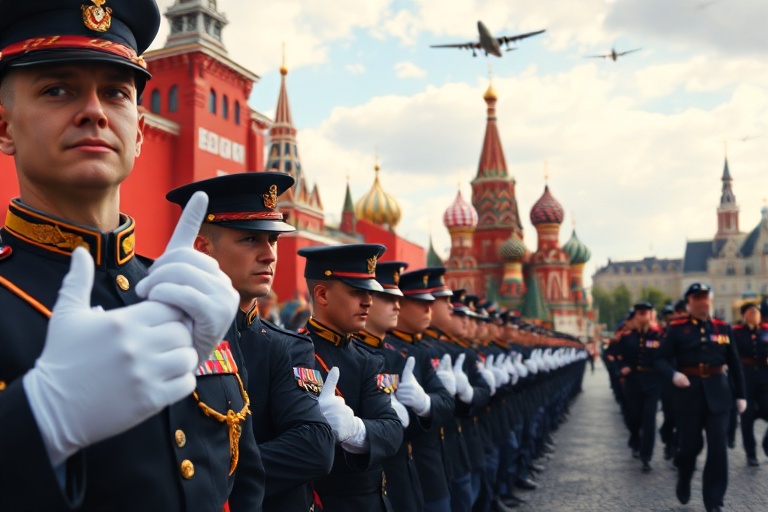
Putin’s 2024 Victory Day Parade: Military Show and Global Message
The annual Victory Day parade in Moscow, held on May 9th, has long served as a powerful display of Russian military strength and national pride. Under Vladimir Putin’s leadership, these parades have evolved into carefully choreographed spectacles that blend historical commemoration with contemporary geopolitical messaging. The 2024 edition, held amid ongoing conflicts in Ukraine, took on added significance as both a domestic rallying point and an international statement.
For decades, Victory Day has commemorated the Soviet Union’s triumph over Nazi Germany in World War II, a legacy that remains deeply embedded in Russian identity. Yet in recent years, the parade has increasingly reflected Putin’s vision of a resurgent Russia, one that asserts its place on the global stage through military posturing and historical revisionism. The 2024 event was no exception, featuring an array of new weaponry, a scaled-down but symbolically potent display of troops, and a clear attempt to reinforce narratives of strength and resilience.
The Parade’s Evolving Role in Putin’s Russia
Since Putin assumed power in 2000, the Victory Day parade has transformed from a traditional military ceremony into a state-sanctioned extravaganza. The event serves multiple purposes: honoring veterans, reinforcing national unity, and projecting power. In 2024, the parade took place against the backdrop of Russia’s full-scale invasion of Ukraine, which began in February 2022. This context lent the proceedings an air of defiance, as Moscow sought to demonstrate its continued military capability despite Western sanctions and international isolation.
The parade’s format has also adapted to modern expectations. While the core elements—marching troops, military hardware displays, and flyovers—remain intact, the 2024 edition introduced several notable shifts. For the first time, the parade included a segment dedicated to the so-called “special military operation” in Ukraine, framing the conflict as a continuation of Russia’s historic struggle against fascism. This narrative, though disputed by many historians, aligns with the Kremlin’s efforts to legitimize its actions domestically.
Analysts noted the absence of certain Western leaders at the parade, a reflection of the strained relations between Russia and many of its former allies. While representatives from countries such as China, India, and several African nations attended, the turnout underscored Russia’s pivot toward non-Western partnerships in the face of sanctions and diplomatic isolation. This shift highlights the parade’s role not just as a military showcase but as a diplomatic barometer.
New Weaponry and Strategic Messaging
One of the most closely watched aspects of the 2024 parade was the display of new and advanced military hardware. Russia showcased an array of missiles, drones, and armored vehicles, signaling its commitment to modernizing its arsenal despite economic constraints. Among the highlights were:
- Avangard Hypersonic Missile System: A weapon capable of delivering nuclear warheads at speeds exceeding Mach 20, rendering it nearly impossible to intercept.
- Burevestnik Cruise Missile: A nuclear-powered missile touted by Putin as a game-changing technology, though its development remains shrouded in secrecy.
- Latest Tanks and Armored Vehicles: Including upgraded versions of the T-14 Armata, designed to counter Western advancements in anti-tank weaponry.
The inclusion of these systems was not merely a technical display but a deliberate message to Russia’s adversaries, particularly NATO. The parade served as a reminder that, despite setbacks in Ukraine, Russia retains a formidable military-industrial complex and the political will to invest in its defense capabilities. The emphasis on hypersonic weapons, in particular, underscores Moscow’s strategy of deterrence, leveraging technology that outpaces current missile defense systems.
Yet the parade also revealed vulnerabilities. Reports of delays in the production of certain weapons systems, as well as the reliance on older, Soviet-era equipment, hint at the economic strain caused by sanctions and the prolonged conflict in Ukraine. This juxtaposition of technological prowess and logistical challenges paints a nuanced picture of Russia’s military posture in 2024.
Domestic and International Reactions
The Kremlin’s messaging during the parade was unmistakably aimed at two audiences: the Russian public and the global community. Domestically, the event was designed to foster patriotism and unity, particularly in the face of economic hardship and international condemnation. State media coverage emphasized the parade’s historical continuity, portraying Putin as the rightful heir to the Soviet victory in World War II. This narrative is particularly potent in a country where WWII, known as the Great Patriotic War, holds near-sacred status.
Internationally, the parade’s reception was mixed. Western governments largely dismissed the event as a propaganda exercise, highlighting Russia’s isolation and the illegitimacy of its war in Ukraine. Meanwhile, allies such as China and India framed their attendance as a gesture of diplomatic support, though their leaders avoided direct endorsements of Russia’s actions. The presence of African and Latin American representatives underscored Moscow’s efforts to cultivate ties beyond its traditional spheres of influence.
For observers of Russian politics, the parade offered clues about the regime’s priorities and vulnerabilities. The scaled-down presence of foreign dignitaries, compared to pre-2022 parades, reflects the shrinking of Russia’s diplomatic footprint. At the same time, the heavy emphasis on military hardware suggests that, despite economic challenges, the Kremlin remains committed to projecting strength as a cornerstone of its survival strategy.
A Cultural and Historical Context
The Victory Day parade is more than a military event; it is a cultural institution that encapsulates Russia’s complex relationship with its past. The parade’s choreography—with its precise formations, synchronized marches, and dramatic flyovers—echoes Soviet-era aesthetics, evoking nostalgia for a time when Russia was a superpower. This deliberate use of symbolism serves to reinforce the idea of a continuous historical struggle, one that transcends generations and justifies contemporary actions.
Yet the parade also highlights the tensions within Russian society. While the event is intended to unify, it also exposes divisions. For many veterans and their families, Victory Day remains a deeply personal occasion, a chance to honor those who fought in WWII. For younger Russians, however, the parade’s militaristic undertones may feel disconnected from their lived experiences, particularly as the realities of war in Ukraine seep into public consciousness. The Kremlin’s attempt to co-opt this history risks alienating segments of the population who view the parade as a tool of state control rather than a genuine celebration.
Culturally, the parade reflects Russia’s broader efforts to reclaim its place in the global order. By positioning itself as a defender against fascism—both historical and contemporary—Russia seeks to position its actions in Ukraine as a moral imperative. This narrative, though contested, resonates with some audiences, particularly in the Global South, where skepticism of Western narratives runs deep. The parade, therefore, functions as both a domestic pacifier and an international gambit, a duality that defines Putin’s Russia.
Looking Ahead: What’s Next for Russia’s Military Posturing?
The 2024 Victory Day parade leaves several questions unanswered. How will Russia’s military-industrial complex adapt to ongoing sanctions and the demands of the war in Ukraine? Will the parade’s emphasis on new weaponry translate into battlefield successes, or will logistical challenges continue to hinder progress? And perhaps most critically, how will the Russian public respond to the prolonged economic strain and the human cost of the war?
For now, the parade stands as a testament to Putin’s strategy of blending historical mythmaking with contemporary power projection. Whether this approach will sustain the regime in the long term remains uncertain, but its immediate impact is undeniable. As Russia continues to assert itself on the global stage, the Victory Day parade will remain a key tool in its arsenal of soft and hard power.
For those interested in the broader implications of Russia’s military strategies, our analysis section offers deeper insights into the geopolitical dynamics at play. Similarly, for a closer look at how military parades function as cultural phenomena, explore our coverage of global traditions.
The 2024 Victory Day parade was a masterclass in statecraft, blending spectacle with substance, history with propaganda, and strength with vulnerability. As the world watches, the question remains: Will this display of power translate into lasting influence, or will it ultimately reveal the cracks in Russia’s carefully constructed narrative?