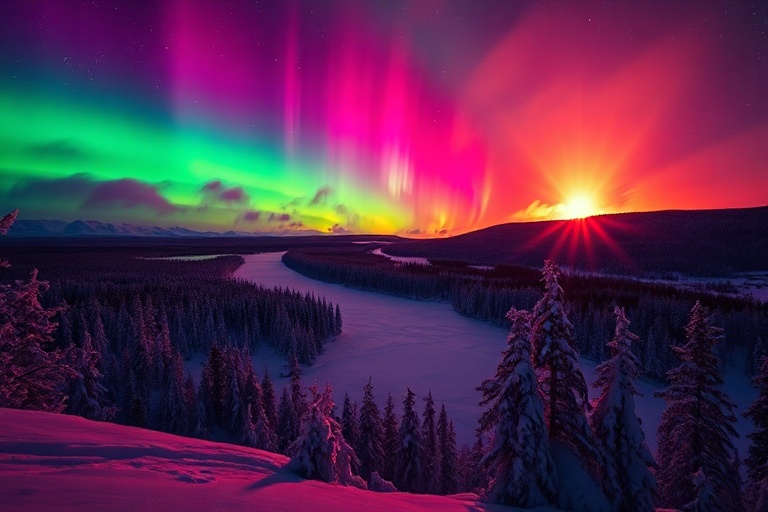
The sun, our nearest star, occasionally reminds us of its immense power through solar flares—sudden, intense bursts of energy that can disrupt satellites and power grids while simultaneously creating one of nature’s most spectacular light shows. When these charged particles collide with Earth’s magnetic field, they ignite the aurora borealis, or northern lights, transforming the night sky into a canvas of shimmering greens, purples, and pinks. This rare cosmic ballet between solar activity and terrestrial phenomena offers both scientific wonder and practical challenges.
How Solar Flares Trigger the Northern Lights
A solar flare is a sudden, intense eruption of magnetic energy from the sun’s surface, releasing vast amounts of radiation and charged particles into space. These particles travel toward Earth at speeds of up to 3 million miles per hour, taking roughly 17 hours to 3 days to arrive. Upon reaching our planet, they interact with the Earth’s magnetosphere—the protective bubble of magnetic fields surrounding the planet. This interaction funnels the particles toward the polar regions, where they collide with oxygen and nitrogen atoms in the upper atmosphere.
The collisions excite these atoms, causing them to release photons—particles of light—which we perceive as the northern lights. The colors depend on the type of atom and the altitude at which the collisions occur. Oxygen at higher altitudes produces red auroras, while oxygen at lower altitudes creates the familiar green glow. Nitrogen, on the other hand, contributes shades of blue and purple, adding depth to the display.
Not all solar flares result in visible northern lights. The strength and direction of the flare, as well as the orientation of Earth’s magnetic field, play crucial roles. Stronger flares, classified as X-class, are most likely to produce widespread auroras visible even at mid-latitudes. During the historic solar storm of 1859, known as the Carrington Event, auroras were reported as far south as the Caribbean. While such extreme events are rare, even moderate flares can create dazzling displays in the northern latitudes of Canada, Scandinavia, and Alaska.
The Science Behind the Spectacle
Solar flares are classified by their brightness in the x-ray spectrum, ranging from B-class (weakest) to X-class (strongest). An X-class flare can release energy equivalent to a billion megatons of TNT, dwarfing even the most powerful nuclear explosions. These flares are often associated with coronal mass ejections (CMEs), massive bubbles of plasma that erupt from the sun’s outer atmosphere. When a CME collides with Earth, it can compress the magnetosphere and trigger geomagnetic storms, intensifying auroral activity.
The National Oceanic and Atmospheric Administration (NOAA) monitors solar activity through its Space Weather Prediction Center. Using satellites like the Deep Space Climate Observatory (DSCOVR) and the Solar Dynamics Observatory (SDO), scientists track flares and CMEs in real time. These observations help predict when and where auroras will be visible, allowing enthusiasts to plan their viewings.
The relationship between solar flares and northern lights is not just a visual spectacle—it’s a reminder of the sun’s dynamic influence on our planet. While most solar flares pose no direct threat to life on Earth, extreme events can pose risks to technology. In 1989, a geomagnetic storm caused by a solar flare knocked out power across Quebec, affecting millions of people. Understanding these events is crucial for safeguarding modern infrastructure.
Key Facts About Solar Flares and Auroras
- Solar Cycle: The sun operates on an 11-year cycle of activity, with flares peaking during solar maximum. The next peak is expected around 2025.
- Aurora Oval: The northern lights are most frequently visible within a ring-shaped zone around the magnetic poles, known as the auroral oval.
- Solar Wind: The constant stream of charged particles from the sun, called the solar wind, also contributes to auroral activity, though it is less intense than flare-driven events.
- Best Viewing Conditions: Clear, dark skies far from city lights offer the best conditions for aurora watching, particularly between 10 PM and 2 AM local time.
When and Where to See the Northern Lights
While the northern lights are a regular feature in Arctic regions, their visibility expands during periods of heightened solar activity. The best time to see them is during the winter months, when long, dark nights provide the ideal backdrop. Locations like Tromsø in Norway, Fairbanks in Alaska, and Yellowknife in Canada are renowned for their aurora sightings. However, even travelers to these regions must contend with unpredictable weather and cloud cover, which can obscure the display.
Photographers and aurora chasers often rely on tools like the Aurora Forecast and the NOAA’s Space Weather Prediction Center for real-time updates. Apps such as My Aurora Forecast and Aurora Alerts provide notifications when conditions are favorable. Patience is key—sometimes the lights appear only briefly before vanishing into the night.
For those unable to travel to the far north, rare but memorable displays have been reported as far south as the northern United States and even parts of Europe during major solar storms. In 2017, auroras were visible in Scotland and northern England, while in 2021, a geomagnetic storm allowed residents in Michigan and Maine to witness the spectacle. These events, while less frequent, remind us that the northern lights are not confined to the Arctic.
The Cultural and Historical Significance of the Northern Lights
Long before science explained the northern lights, ancient cultures wove myths and legends around these celestial displays. The Inuit of Greenland and Canada believed the auroras were the spirits of ancestors playing a game of football with a walrus skull. In Norse mythology, the lights were thought to be the reflections of the shields and armor of the Valkyries, warrior maidens who guided fallen soldiers to Valhalla.
The indigenous Sámi people of Scandinavia viewed the auroras with awe and caution, considering them a bridge between the earthly and spiritual realms. Similarly, the Finns called the phenomenon revontulet, or “fox fires,” believing they were caused by a magical fox sweeping its tail across the snow, sending sparks into the sky. These stories reflect humanity’s enduring fascination with the unknown and our need to find meaning in natural phenomena.
In modern times, the northern lights have become a symbol of adventure and natural beauty. Tourism industries in countries like Norway, Iceland, and Canada thrive on aurora tourism, drawing visitors eager to witness the lights firsthand. The spectacle has also inspired artists, writers, and musicians, from the haunting melodies of Edvard Grieg to the cinematic visuals of films like Northern Lights by Philip Pullman.
“The northern lights are one of nature’s most breathtaking displays, a reminder that our planet is part of a vast, interconnected universe.” — Dr. Ellen Stofan, former NASA Chief Scientist
Preparing for the Next Solar Maximum
As the sun approaches its next solar maximum, expected around 2025, scientists and aurora enthusiasts alike are preparing for an increase in solar activity. While this promises more frequent and intense auroras, it also raises concerns about the potential impacts on technology. Power grids, satellite communications, and GPS systems are particularly vulnerable to geomagnetic storms. In 2012, a massive CME narrowly missed Earth, which, if it had hit, could have caused widespread blackouts and trillions of dollars in damage.
Governments and industries are taking steps to mitigate these risks. The U.S. Federal Energy Regulatory Commission has mandated that power grid operators prepare for geomagnetic disturbances. Satellite operators like SpaceX have implemented safeguards to protect their constellations, including Starlink, during periods of high solar activity. Meanwhile, researchers continue to refine their models of solar behavior, aiming to provide earlier and more accurate warnings of impending storms.
For the average person, the solar maximum offers a unique opportunity to witness the northern lights in all their glory. Whether you’re an avid photographer, a curious traveler, or simply someone who appreciates the wonders of nature, keeping an eye on space weather forecasts can help you plan the perfect aurora adventure. As technology advances and our understanding of the sun grows, the northern lights remain a humbling reminder of the dynamic forces that shape our world.
The next time you gaze up at a starry night sky, remember that the sun is always working behind the scenes, painting the heavens with its invisible brushstrokes. When a solar flare sends its charged particles hurtling toward Earth, the result is a dazzling display that connects us to the cosmos in a way few other natural phenomena can.