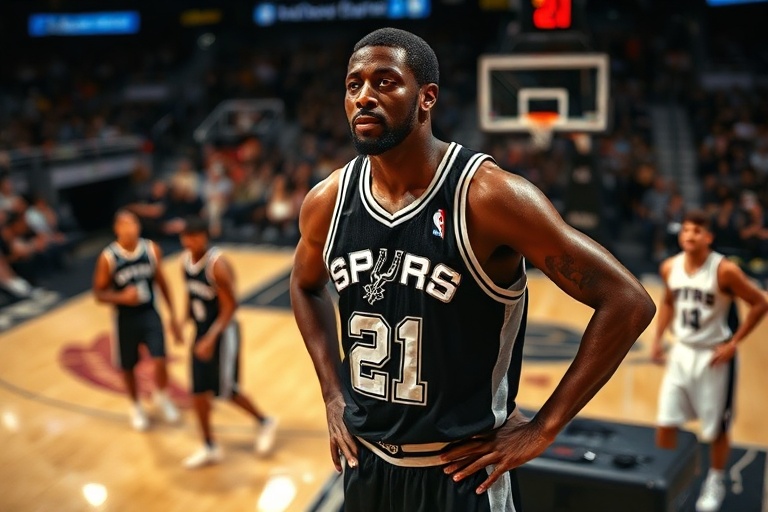
Tim Duncan: How a Quiet Titan Redefined Global Basketball
The Quiet Titan: Tim Duncan’s Global Impact Beyond Basketball
Tim Duncan, often overshadowed by the flamboyance of his era, reshaped not just basketball but the very idea of sustained excellence in sports. His career spanned 19 seasons with the San Antonio Spurs, during which he became the backbone of a dynasty that redefined team success. While players came and went in flashes of brilliance, Duncan’s consistency was unparalleled—a testament to discipline, intelligence, and an unshakable commitment to fundamentals.
Born in St. Croix, U.S. Virgin Islands, Duncan’s journey began far from the NBA spotlight. His early life was marked by tragedy when Hurricane Hugo destroyed his family home in 1989, forcing him to move to a more modest residence. The experience instilled resilience, but it was swimming that initially defined his athletic ambitions. After his sister’s death in a car accident, Duncan channeled his grief into the pool, training for the Olympics. When Hurricane Marilyn damaged the island’s pools in 1995, his Olympic dreams faded, and basketball unexpectedly became his path forward. This pivot, though unplanned, would alter the course of professional sports history.
The Architect of the Spurs Legacy
Duncan arrived in San Antonio in 1997 as the first overall pick in the NBA Draft, joining a franchise that had struggled for relevance. Under the guidance of coach Gregg Popovich, Duncan evolved from a raw but promising big man into the NBA’s most complete power forward. His partnership with the Spurs transcended statistics; it was a blueprint for how a team could thrive through collective effort, tactical precision, and mutual respect.
The Spurs’ success under Duncan wasn’t merely about winning games—it was about redefining what a basketball team could be. In an era dominated by individual stars, Duncan thrived as the ultimate teammate. His unselfish play, defensive mastery, and ability to elevate those around him set a new standard. Over two decades, he led the Spurs to five NBA championships, earning Finals MVP honors three times and league MVP twice. His influence extended beyond the court, shaping a culture of accountability and preparation that became a model for organizations worldwide.
Duncan’s global impact is most evident in how his approach to the game influenced international players. Before the NBA’s globalization, Duncan demonstrated that fundamentals—footwork, positioning, and teamwork—were universal. European players like Tony Parker and Manu Ginóbili, who became stars alongside him, thrived in San Antonio because Duncan’s system prioritized cohesion over individual brilliance. This philosophy resonated globally, helping to shift the league’s emphasis from flash to function.
Cultural Quiet: How Duncan Redefined Leadership
In an age where athletes often leverage their platforms for activism or entertainment, Duncan remained famously private. His leadership style was understated, built on actions rather than words. This quiet authority made him a paradox—a cultural icon who shunned the spotlight. His influence was felt most deeply in the NBA’s locker rooms, where his presence demanded respect without a single syllable.
Duncan’s legacy raises questions about the nature of leadership in sports. Unlike the vocal captains of other eras, he led through example. His work ethic was legendary; teammates often recalled seeing lights on in the gym late into the night, long after others had left. This dedication wasn’t performative—it was a daily commitment to excellence. In doing so, he challenged the notion that leadership required charisma or rhetoric. Instead, he proved that consistency, humility, and results could command the same reverence.
This approach had a ripple effect across sports and beyond. In corporate settings, Duncan’s model of leadership is frequently cited as a case study in quiet competence. His ability to inspire without demanding attention offers a counterpoint to the modern obsession with personal branding. For young athletes, especially in team sports, Duncan’s career serves as a reminder that greatness isn’t always loud.
A Global Game-Changer
Duncan’s career coincided with the NBA’s expansion into international markets. The Spurs’ success in the 2000s helped popularize the league in Europe, Asia, and beyond. Duncan’s stoic demeanor and fundamental-driven play appealed to global audiences who valued substance over spectacle. While players like Michael Jordan and Kobe Bryant became cultural icons in the U.S., Duncan’s influence was more subtle but equally profound. He embodied the values of a global sport: teamwork, discipline, and quiet dominance.
The Spurs’ 2003 championship run, for instance, was a masterclass in international basketball. With Parker from France and Ginóbili from Argentina, Duncan anchored a team that played a style of basketball unfamiliar to many opponents. Their half-court offense and suffocating defense forced the NBA to reconsider its approach to the game. Duncan’s ability to adapt and elevate his teammates showcased basketball as a global language, one that transcended borders.
Even after his retirement in 2016, Duncan’s impact endured. Current Spurs players, as well as athletes in other sports, cite him as a model for longevity and professionalism. His influence is visible in the rise of “positionless” basketball, where versatility and IQ are prized over traditional roles—a philosophy Duncan embodied throughout his career.
The Numbers Don’t Lie
While Duncan’s intangibles are often highlighted, his statistical resume is equally staggering. He ranks among the NBA’s all-time leaders in points, rebounds, blocks, and wins. Here’s a closer look at his career milestones:
- 5× NBA Champion (1999, 2003, 2005, 2007, 2014)
- 2× NBA MVP (2002, 2003)
- 3× NBA Finals MVP
- 15× NBA All-Star
- 10× All-NBA First Team
- 8× NBA All-Defensive First Team
- NBA Rookie of the Year (1998)
- Over 26,000 points and 15,000 rebounds
- Only player in NBA history to be top-10 all-time in points, rebounds, and blocks
These numbers place Duncan in the pantheon of basketball greats, but they only tell part of the story. His career averages of 19 points, 11 rebounds, and 2.2 blocks per game underscore his two-way dominance. What’s often overlooked is his role in the Spurs’ late-game execution. Duncan’s free-throw shooting, often a weakness early in his career, became a reliable weapon in clutch moments—a testament to his adaptability.
A Legacy That Transcends Sport
Tim Duncan’s retirement in 2016 marked the end of an era, but his legacy extends far beyond basketball. He redefined what it means to be a professional athlete in the modern age, proving that greatness isn’t measured solely by accolades or fame. His impact is seen in the way teams now prioritize culture, preparation, and fundamentals—a direct result of the Spurs’ blueprint.
For global audiences, Duncan represents a different kind of hero. In a world obsessed with instant gratification and viral moments, his career is a reminder that sustained success requires patience, humility, and relentless effort. His story resonates particularly in regions where sports are still evolving, offering a model for how to build a team, a franchise, and a legacy.
As basketball continues to grow internationally, Duncan’s influence remains a guiding force. Young players in Europe, Africa, and Asia look to his career not just for inspiration, but for a roadmap to achieving greatness without compromise. In this way, Tim Duncan isn’t just a basketball legend—he’s a global symbol of what’s possible when talent meets discipline.
For those seeking to understand the deeper currents of sports history, Duncan’s career is essential study. It challenges the notion that only the loudest voices leave a mark. Instead, it celebrates the power of quiet persistence—a lesson that extends far beyond the hardwood.
To explore more about the evolution of basketball and its cultural impact, visit our Sports section. For deeper analysis on leadership in sports, check out our Analysis category.