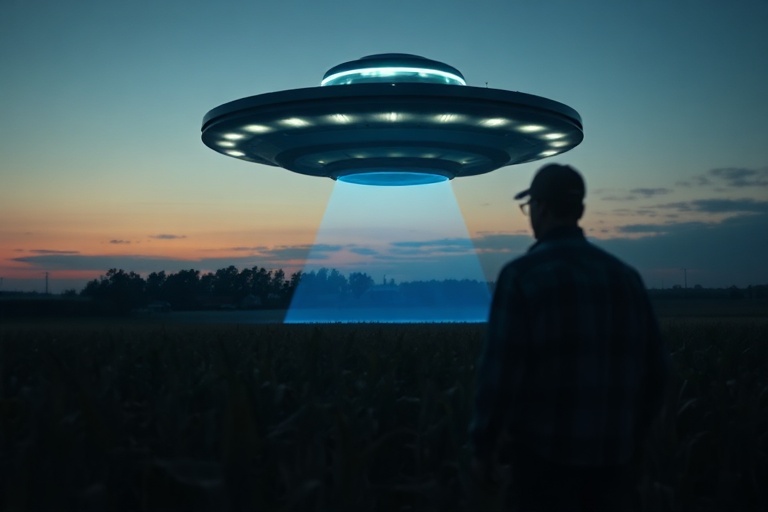
What Exactly Are Unidentified Flying Objects?
Unidentified Flying Objects, commonly abbreviated as UFOs, refer to aerial phenomena that cannot be immediately explained by conventional scientific or military standards. These objects often exhibit unusual flight patterns, speeds, or shapes that defy current aeronautical knowledge. While the term UFO carries a pop-culture stigma in some circles, it remains a neutral descriptor for any aerial anomaly that resists immediate classification.
The distinction between UFOs and extraterrestrial spacecraft is a frequent point of debate. Not all UFO sightings involve little green men or advanced alien technology. Many cases have plausible explanations—weather balloons, drone swarms, or atmospheric illusions—yet a small percentage remain unresolved despite rigorous investigation. This ambiguity fuels public fascination and drives ongoing research into aerial phenomena.
Governments worldwide have taken notice. In 2021, the U.S. Office of the Director of National Intelligence released a preliminary assessment acknowledging 144 UFO sightings from 2004 to 2021, none of which could be conclusively explained. Similar reports have emerged from France, Canada, and Brazil, suggesting that this is not merely an American phenomenon but a global one.
Historical UFO Sightings Around the World
The modern era of UFO reporting is often traced to 1947, when pilot Kenneth Arnold described seeing nine crescent-shaped objects flying near Mount Rainier in Washington State. This event, now known as the “Arnold sighting,” popularized the term “flying saucer” and sparked widespread media coverage. Yet documented cases of unexplained aerial phenomena date back centuries.
In medieval Europe, chroniclers recorded sightings of strange lights and objects in the sky, often interpreting them as divine omens or supernatural events. One notable example comes from Nuremberg, Germany, in 1561, where citizens reported a battle between celestial objects that left behind a trail of smoke and debris. Similarly, in 1661, a Swedish bishop documented a “fiery shield” moving across the sky, an account that remains unexplained.
20th-century sightings became more technologically documented. The 1980 Rendlesham Forest incident in England, often called “Britain’s Roswell,” involved U.S. military personnel who reported strange lights and a metallic object in a Suffolk forest. Decades later, the case remains one of the most compelling military UFO encounters in history. Meanwhile, in 1978, Australian pilot Frederick Valentich vanished during a flight while reporting a strange aircraft following him. No wreckage was found, and the case remains one of aviation’s great mysteries.
These historical threads reveal a pattern: humanity has long observed and recorded unexplained aerial phenomena, long before modern conspiracy theories took root. Whether interpreted as misidentified aircraft, atmospheric phenomena, or something beyond our current understanding, the global history of UFO sightings is rich and multifaceted.
Governments and UFOs: From Secrecy to Transparency
For decades, UFOs were treated as a fringe topic, dismissed by governments and mainstream science alike. The U.S. Air Force’s Project Blue Book (1952–1969) investigated over 12,000 reports, concluding that most had mundane explanations. Yet a small number remained classified as “unidentified,” a label that only deepened public skepticism and conspiracy theories.
That began to change in 2017, when a series of New York Times reports revealed that the Pentagon had secretly funded a UFO research program called the Advanced Aerospace Threat Identification Program (AATIP). Leaked footage from Navy pilots showed Tic Tac-shaped objects moving at impossible speeds without visible propulsion. The Pentagon later confirmed the authenticity of the videos, though it stopped short of endorsing extraterrestrial origins.
Other nations have taken different approaches. France established GEIPAN (Group for the Study and Information on Unidentified Aerospace Phenomena) in 1977, making it one of the few government agencies to openly investigate UFO reports. Over 40 years, GEIPAN has logged over 3,000 cases, with about 28% remaining unexplained. The agency’s transparency has earned it respect among researchers worldwide.
In 2022, Mexico held its first congressional hearing on UFOs, featuring testimony from former U.S. intelligence officer David Grusch, who claimed that the U.S. government had recovered “non-human biologics” from crashed craft. While Grusch’s testimony was met with skepticism, it underscored a growing willingness among lawmakers to engage with the topic publicly.
This shift reflects a broader trend: as technology improves and data becomes more accessible, governments can no longer ignore the phenomenon. Whether through congressional hearings, declassified documents, or scientific symposia, the conversation around UFOs is increasingly moving into the mainstream.
Cultural Impact: How UFOs Shape Art, Media, and Belief
UFOs have seeped into every corner of global culture, shaping everything from cinema to religion. In Japan, the concept of “tokusatsu”—live-action films featuring giant monsters—often draws on UFO lore, as seen in classics like “Warning from Space” (1956). Meanwhile, in Latin America, UFOs are woven into folklore, with stories of “ovnis” (ovnis) appearing alongside tales of indigenous spirits and pre-Columbian deities.
Hollywood has played a pivotal role in shaping public perception. Films like “Close Encounters of the Third Kind” (1977) and “E.T. the Extra-Terrestrial” (1982) framed UFOs as benevolent, almost magical phenomena, while “Independence Day” (1996) and “Battle: Los Angeles” (2011) depicted extraterrestrial visitors as existential threats. This duality—between wonder and fear—reflects broader societal anxieties about the unknown.
Music, too, has been influenced by UFO lore. David Bowie’s “Life on Mars?” and Pink Floyd’s “The Wall” both reference extraterrestrial themes, while genres like synthwave and psychedelic rock often evoke the sonic atmosphere of UFO sightings. Even country music has embraced the topic, with artists like Waylon Jennings and Merle Haggard referencing “flying saucers” in their lyrics as symbols of freedom and mystery.
Religious movements have also emerged around UFOs. In the 1950s, contactee movements in the U.S. claimed that benevolent aliens were guiding humanity toward enlightenment. Groups like the Raëlian Movement, founded in 1974, believe that UFOs are physical proof of advanced extraterrestrial life and that humans were genetically engineered by these beings. While fringe, such movements highlight how UFOs can become intertwined with spiritual and philosophical beliefs.
This cultural permeation underscores a deeper truth: UFOs are not just about science or government cover-ups. They are a mirror reflecting humanity’s hopes, fears, and endless curiosity about what lies beyond the stars.
What’s Next for UFO Research?
The future of UFO research is being written now. In 2023, NASA convened an independent study team to examine UFO data from a scientific perspective, emphasizing the need for rigorous, data-driven analysis. The team’s final report, released in 2023, recommended that NASA take a more active role in collecting and analyzing UFO sightings, using satellites and AI to sift through vast amounts of data.
Private organizations are also stepping up. The Galileo Project, led by Harvard astrophysicist Avi Loeb, aims to search for alien technological signatures using high-resolution telescopes and AI. Unlike traditional SETI (Search for Extraterrestrial Intelligence) projects, which focus on radio signals, Galileo seeks physical evidence—such as unusual materials or artifacts—that could suggest extraterrestrial origin.
Meanwhile, advances in technology are making it easier for civilians to document UFOs. Smartphone cameras, drone footage, and open-source analysis tools empower amateur researchers to contribute to the field. Platforms like MUFON (Mutual UFO Network) allow users to report sightings and access a global database of cases, fostering a collaborative approach to investigation.
Yet challenges remain. Stigma persists in scientific communities, where UFO research is often dismissed as pseudoscience. Misidentifications—such as drones, weather balloons, or even optical illusions—continue to muddy the waters. And as geopolitical tensions rise, the risk of UFO sightings being misinterpreted as military threats could escalate, particularly in regions like the South China Sea or the Arctic.
Despite these hurdles, the momentum is undeniable. From congressional hearings to academic symposia, the conversation around UFOs is evolving. Whether these objects are evidence of alien life, advanced human technology, or something yet to be understood, their study is pushing the boundaries of science, culture, and human imagination.
One thing is clear: the sky is not the limit. It’s just the beginning.