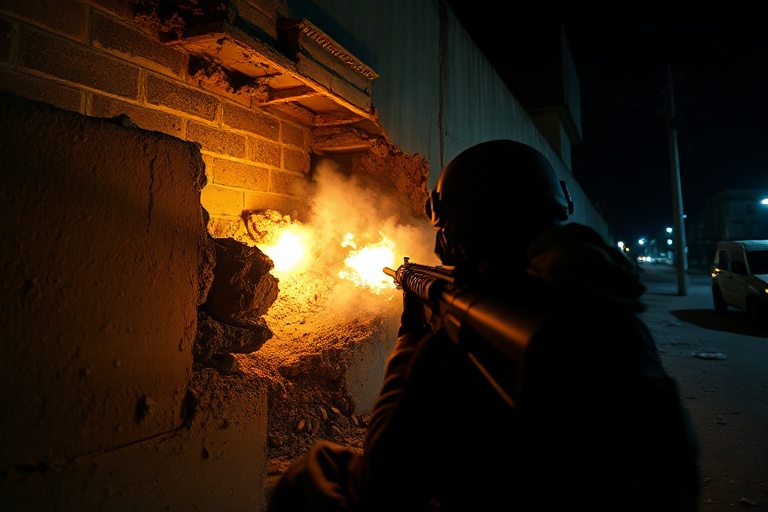
The blindfire mechanic isn’t new—military training has long emphasized shooting without looking—but its transition into competitive gaming represents a bold evolution in shooter design. Blindfire, a tactical multiplayer title developed by Hidden Path Entertainment, has quietly carved out a niche by forcing players to master an unforgiving system where accuracy depends on muscle memory and prediction rather than crosshair precision.
Unlike traditional shooters where players rely on visual feedback, Blindfire removes the crutch of aiming down sights. Instead, it rewards quick reactions and spatial awareness. The game’s core loop revolves around predicting enemy movements and firing blindly in their likely path—a mechanic that sounds simple but demands intense focus and adaptability.
The Core Mechanics: How Blindfire Works
Blindfire’s gameplay hinges on three key systems that differentiate it from other shooters:
- Sound-Based Targeting: Players rely on audio cues to detect enemies. Footsteps, weapon reloads, and even breath sounds become critical data points. The game uses spatial audio to create an immersive soundscape where direction and distance matter more than visuals.
- Predictive Firing: Since players can’t see their targets, they must fire in the direction enemies are moving. The game calculates bullet drop and travel time, but success depends on reading opponents’ behavior patterns.
- Limited Ammunition: Blindfire features a finite ammo supply per round. Wasting shots by guessing poorly can leave players defenseless, adding a layer of high-stakes tension.
These mechanics create a steep learning curve. New players often struggle with the initial frustration of firing blindly and missing, while veterans develop almost reflexive instincts for predicting enemy paths. The game’s AI enemies are particularly punishing, forcing players to adapt quickly or face elimination.
Why Blindfire Stands Out in the Tactical Shooter Landscape
In an era dominated by photorealistic graphics and cinematic storytelling, Blindfire’s minimalist approach feels refreshing yet challenging. Most tactical shooters—like traditional military shooters on Dave’s Locker—emphasize realism through detailed environments and complex weapon systems. Blindfire, by contrast, strips away visual clutter to focus on pure reflexes and strategy.
The game’s design philosophy aligns with a growing trend in competitive gaming: the rise of skill-based mechanics that prioritize player adaptability over graphical fidelity. This trend is evident in titles like Getting Over It and Getting Up, where success hinges on precise control rather than raw power or visual spectacle.
Blindfire also taps into the psychology of risk and reward. Players must constantly weigh whether to take a blind shot or play it safe, knowing that hesitation often leads to death. This tension creates moments of high drama, particularly in ranked matches where every decision carries weight.
The Community Response: A Divisive Yet Growing Niche
Reception to Blindfire has been polarizing. Purists in the tactical shooter community argue that the game’s mechanics feel unfair, as success often hinges on luck rather than skill. Others praise it for offering a fresh challenge that rewards creativity and quick thinking.
On platforms like Reddit and Discord, players share clips of their most clutch blindfire moments, often accompanied by heated debates about whether the mechanic is skill-based or luck-driven. Some argue that the game’s difficulty curve is too steep, while others claim that mastery is achievable through practice and pattern recognition.
The game’s competitive scene is still in its infancy, but early tournaments have shown that top players develop uncanny instincts for predicting enemy movements. This suggests that Blindfire’s mechanics, while initially frustrating, can be mastered with enough dedication—a hallmark of a well-designed competitive game.
Broader Implications: What Blindfire Teaches Us About Game Design
Blindfire’s success—or at least its growing popularity—highlights a broader shift in game design toward mechanics that prioritize player agency and unpredictability. In an industry often criticized for relying on recycled formulas, Blindfire proves that innovation can come from revisiting old ideas with a fresh perspective.
The game also raises interesting questions about accessibility. While Blindfire is undeniably challenging, its reliance on audio cues makes it more inclusive for players with visual impairments. This aligns with a growing movement in gaming toward creating experiences that cater to a wider audience without sacrificing depth.
For developers, Blindfire serves as a case study in how constraints can breed creativity. By limiting visual feedback, the game forces players to engage with its mechanics on a deeper level. This approach could inspire future titles to experiment with unconventional control schemes or sensory-based gameplay.
Final Thoughts: Should You Try Blindfire?
Blindfire isn’t for everyone. If you prefer shooters with clear visual feedback and straightforward mechanics, this game will likely frustrate you. But for players seeking a fresh challenge—or those tired of the same tactical shooter tropes—it offers a uniquely rewarding experience.
The key to enjoying Blindfire lies in embracing its unpredictability. Success isn’t about landing every shot; it’s about adapting to the chaos and learning from every failure. In a gaming landscape saturated with battle royales and open-world epics, Blindfire reminds us that sometimes, the best experiences come from stripping away the excess and focusing on pure gameplay.
For those ready to take the plunge, the game is available on PC via Steam. Whether it becomes a cult classic or remains a niche title, Blindfire undeniably pushes the boundaries of what a shooter can be.
Dave’s Locker is your destination for the latest in gaming news, reviews, and analysis. Check out our Gaming section for more deep dives into your favorite titles.