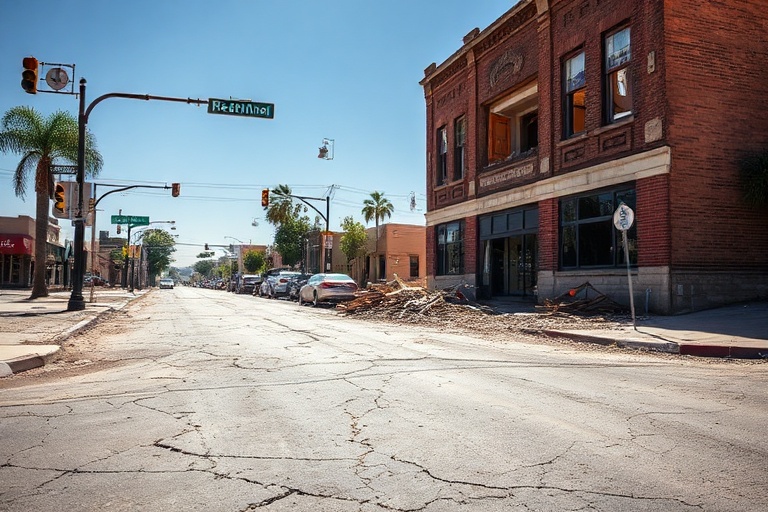
The city of Redlands, nestled at the foothills of the San Bernardino Mountains in Southern California, has experienced a series of earthquakes in recent weeks. These tremors, ranging from minor rumbles to more noticeable shakes, have drawn attention from residents and seismologists alike. With California’s long history of seismic activity, understanding the specifics of these events is crucial for both public safety and awareness.
The Science Behind the Shakes
Redlands sits near several fault lines, including the San Andreas Fault, one of the most significant in the world. The earthquakes felt in the area are typically associated with the San Jacinto Fault Zone, which runs through the Inland Empire. According to the United States Geological Survey (USGS), the region has experienced over 20 earthquakes with magnitudes above 2.5 in the past month alone.
The most notable recent event occurred on October 12, 2023, when a magnitude 4.1 quake struck near Redlands. While relatively moderate, it was strong enough to rattle windows and prompt calls to local emergency services. Seismologists attribute these tremors to the complex interactions between the San Jacinto and nearby faults, which are constantly shifting due to tectonic plate movements.
For those interested in tracking seismic activity in real-time, the Science section of Dave’s Locker provides updates on notable geological events across California. This resource can be invaluable for residents looking to stay informed about potential risks.
Why Redlands is Prone to Earthquakes
Redlands’ location places it in a high-risk zone for seismic activity. The San Jacinto Fault Zone is one of the most active in Southern California, capable of producing significant quakes. Historical data shows that faults in this region have generated earthquakes exceeding magnitude 6.0 in the past, such as the 1899 San Jacinto earthquake.
The geological makeup of the area further exacerbates the risk. The region is characterized by a mix of sedimentary and crystalline rocks, which can amplify ground shaking during an earthquake. Additionally, the proximity to the San Andreas Fault means that stress from larger regional faults can transfer to smaller, nearby faults, increasing the likelihood of tremors.
Residents should also be aware of the liquefaction potential in certain areas. Liquefaction occurs when saturated soil temporarily loses its strength and behaves like a liquid, which can lead to structural damage. Areas near the Santa Ana River and other water sources in Redlands are particularly susceptible to this phenomenon.
Impact on the Community
The recent earthquakes have had a mixed impact on Redlands. While most quakes have been minor, they serve as a reminder of the region’s vulnerability. Local businesses and schools have reported minimal disruptions, though some residents have expressed concerns about older buildings and infrastructure.
The Redlands Police Department has stressed the importance of preparedness. Chief Chris Catren emphasized that while the city has robust emergency response plans, individual preparedness is key. He recommends that residents maintain an emergency kit with essentials such as water, non-perishable food, flashlights, and first-aid supplies.
Community response has been measured but proactive. The Redlands City Council has scheduled a public forum on earthquake preparedness, inviting experts from the USGS and local emergency services to discuss risk mitigation strategies. This event aims to educate residents on how to secure their homes, create family emergency plans, and recognize the signs of structural damage.
Preparedness Tips for Residents
Earthquakes strike without warning, making preparedness essential. Here are some critical steps residents can take to stay safe:
- Secure Your Space: Anchor heavy furniture, appliances, and shelves to walls. Use museum putty or earthquake putty to secure breakable items.
- Develop a Family Plan: Identify a safe meeting spot outside your home and establish a communication plan in case family members are separated during an earthquake.
- Prepare an Emergency Kit: Include at least three days’ worth of water, non-perishable food, medications, a flashlight, batteries, a portable charger, and copies of important documents.
- Know the Drop, Cover, and Hold On Drill: During an earthquake, drop to your hands and knees, cover your head and neck, and hold on until the shaking stops. Avoid doorways, as they are not necessarily safer than other parts of a room.
- Check Your Insurance: Standard homeowners’ insurance policies often do not cover earthquake damage. Consider purchasing separate earthquake insurance if you live in a high-risk area.
For more detailed guidance, the Education section of Dave’s Locker offers resources on disaster preparedness and safety tips for natural disasters.
Expert Insights and Future Outlook
Seismologists from the University of California, Riverside, have been closely monitoring the recent activity in Redlands. Dr. Gareth Funning, an associate professor of geophysics, noted that while the current swarm of earthquakes is not unusual, it serves as a reminder of the region’s seismic potential.
“The San Jacinto Fault is one of the most active in Southern California,” Funning explained. “While we cannot predict when the next significant earthquake will occur, we know that it is inevitable. The question is not if, but when.”
Funning also highlighted the importance of retrofitting older buildings, particularly those constructed before modern seismic codes were implemented. In Redlands, many historic structures—such as those in the downtown area—could be vulnerable to strong shaking. The city has implemented a voluntary retrofitting program, but experts urge property owners to consider structural upgrades to enhance safety.
The USGS has also been working on improving early warning systems. The ShakeAlert system, which provides seconds to minutes of warning before shaking arrives, is now operational in California. Residents can download the MyShake app to receive alerts and learn more about earthquake preparedness.
Long-Term Risks and Mitigation Efforts
The long-term risks in Redlands are tied to the broader seismic landscape of Southern California. The USGS estimates that there is a 75% chance of a magnitude 7.0 or greater earthquake striking Southern California in the next 30 years. While the San Andreas Fault is often the focus of such predictions, the San Jacinto Fault is also capable of producing major quakes.
In response to these risks, local authorities have been working on several initiatives:
- Infrastructure Upgrades: The city has invested in retrofitting critical infrastructure, such as bridges and public buildings, to better withstand seismic activity.
- Public Education Campaigns: Ongoing efforts to educate residents about earthquake risks and preparedness, including workshops and informational materials.
- Collaboration with Research Institutions: Partnerships with universities and geological organizations to monitor fault activity and improve early warning systems.
- Emergency Response Planning: Regular drills and simulations to ensure that first responders and city officials are prepared to act swiftly in the event of a major quake.
While these efforts are commendable, experts caution that individual preparedness remains the most effective way to mitigate risks. The recent earthquakes in Redlands are a reminder that seismic activity is a constant reality in California. By taking proactive steps, residents can significantly reduce the potential impact on their lives and property.
Conclusion
The earthquakes in Redlands serve as a wake-up call for a region accustomed to seismic activity. While the recent tremors have been relatively minor, they underscore the importance of preparedness and awareness. For residents, this means securing homes, creating emergency plans, and staying informed about local risks.
For those looking to learn more about earthquake preparedness or stay updated on seismic activity in California, resources like Dave’s Locker provide valuable insights. By taking action now, the community can build resilience against future events.
As Dr. Funning noted, “The ground beneath us is always moving. It’s not a question of if another significant earthquake will occur, but when. The key is to be ready.”