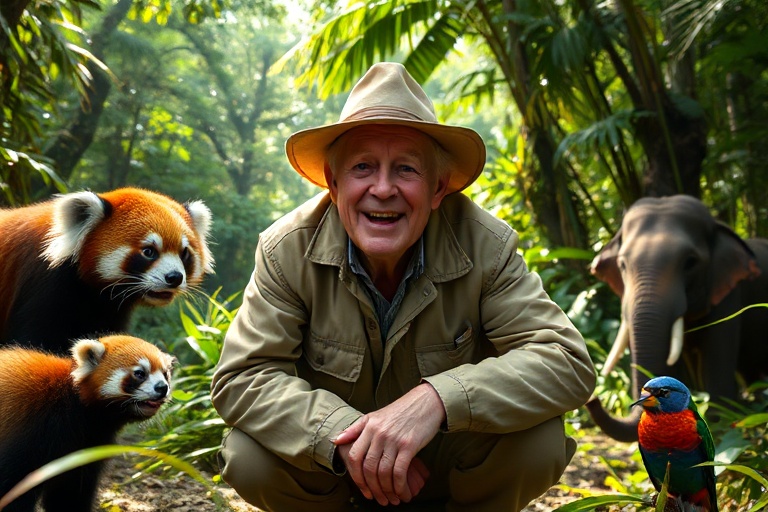
Few figures in modern media have done as much to bridge the gap between education and entertainment as Sir David Attenborough. His soothing voice, boundless curiosity, and unparalleled storytelling have captivated audiences for decades. But his influence extends far beyond adult documentaries. For children, Attenborough’s work serves as an enchanting introduction to the natural world—a way to spark curiosity, inspire wonder, and even shape lifelong values.
In an era where screens dominate childhood, Attenborough’s documentaries offer something rare: a chance to explore ecosystems, wildlife, and scientific discovery without leaving home. Whether through Planet Earth, The Blue Planet, or Life on Earth, his narrations transform complex ecological concepts into accessible, awe-inspiring adventures. For parents and educators, his films are more than just entertainment—they’re tools for learning, discussion, and even activism.
Why Attenborough Stands Out for Young Audiences
Attenborough’s appeal to children isn’t accidental. His approach combines several key elements that make his work uniquely engaging for younger viewers:
- Storytelling Over Lectures: He doesn’t just present facts—he weaves narratives that feel like grand expeditions. A lion’s hunt becomes a suspenseful drama, while the life cycle of a butterfly unfolds like an epic adventure.
- Visual Spectacle: The cinematography in his documentaries is cinematic in scale. High-definition footage of underwater worlds, dense rainforests, and vast savannas pulls kids into environments they may never see in person.
- Gentle Authority: His calm, measured tone reassures rather than overwhelms. Unlike some educational content that feels rushed or sensationalized, Attenborough’s delivery feels like a trusted guide leading children through discovery.
- Emotional Connection: By highlighting the struggles and triumphs of animals, he fosters empathy. Kids don’t just learn about ecosystems—they grow to care about them.
These qualities make his documentaries ideal for a range of ages, from early elementary schoolers watching Planet Earth II with their families to middle schoolers diving into The Living Planet for school projects.
The Educational Value of Attenborough’s Work
Beyond entertainment, Attenborough’s documentaries align closely with educational goals. His content naturally complements science curricula, particularly in biology, ecology, and environmental science. Here’s how teachers and homeschoolers can leverage his work:
- Cross-Curricular Learning: A single episode can touch on geography (mapping animal habitats), math (calculating migration distances), and language arts (writing descriptive passages about wildlife).
- Critical Thinking: His films often present natural phenomena in ways that encourage questions. Why do some animals hibernate? How do predators adapt to their environments? These prompts lead to deeper exploration.
- Environmental Awareness: Attenborough’s later work, such as Our Planet, explicitly addresses conservation. This introduces kids to real-world challenges like climate change and habitat destruction, fostering a sense of responsibility.
- Multimedia Integration: Clips from his documentaries can be used in presentations, art projects, or even coding exercises (e.g., designing a virtual ecosystem).
For parents concerned about screen time, Attenborough’s documentaries offer a rare “high-quality” option—content that educates, entertains, and even inspires action. Many families report that watching his films together sparks outdoor activities, from birdwatching to nature walks, as kids seek to connect what they’ve seen on screen to the world around them.
How to Introduce Attenborough to Kids
Not all of Attenborough’s work is equally suited for young audiences. Some documentaries, like The Private Life of Plants, are better for older kids or adults. However, several series and films stand out as perfect starting points:
- Planet Earth II (2016) – The stunning visuals and accessible narration make it a top choice. Episodes like “Islands” and “Mountains” are particularly engaging.
- The Blue Planet (2001) and Blue Planet II (2017) – These dive into ocean life, a subject that fascinates many kids. The latter includes episodes on coral reefs and deep-sea creatures.
- Life in Cold Blood (2008) – A focus on reptiles and amphibians, presented in a way that highlights their often-misunderstood behaviors.
- Our Planet (2019) – Narrated by Attenborough, this Netflix series emphasizes conservation and is ideal for discussions about environmental stewardship.
For younger children (ages 4–8), consider BBC Earth’s “Explore” series, which condenses Attenborough’s themes into shorter, more digestible episodes. These retain his signature style while catering to shorter attention spans.
Parents can enhance the viewing experience by:
- Watching together and pausing to discuss what they’re seeing.
- Following up with related activities, like visiting a zoo, aquarium, or local park with a scavenger hunt.
- Encouraging kids to keep a “nature journal” where they sketch or write about animals they’ve encountered in Attenborough’s films.
The Broader Impact: More Than Just a Documentary
Attenborough’s influence on children extends beyond casual learning. His work has indirectly shaped generations of scientists, conservationists, and nature enthusiasts. Many researchers and wildlife biologists credit his documentaries as early inspirations for their careers. For example, Dr. Jane Goodall has spoken about how Attenborough’s films deepened her connection to chimpanzees, while marine biologists often cite The Blue Planet as a pivotal moment in their interest in oceanography.
Beyond individual careers, Attenborough’s films contribute to broader cultural shifts. As climate change and biodiversity loss become increasingly urgent topics, his later work—particularly Our Planet and A Life on Our Planet (2020)—plays a role in educating the public. By introducing these concepts to children early, his documentaries help normalize discussions about sustainability and conservation.
There’s also a social dimension to his appeal. Attenborough’s documentaries are widely available on platforms like Netflix, BBC iPlayer, and Disney+, making them accessible across different socioeconomic backgrounds. This universality ensures that kids from various parts of the world can experience the wonders of nature, fostering a global perspective on environmental issues.
A Lasting Legacy
David Attenborough’s work for kids is more than just a series of educational films—it’s a cultural touchstone. His ability to make the natural world feel both vast and intimate ensures that his documentaries remain relevant, decade after decade. For parents and educators, his films offer a rare opportunity: to entertain, educate, and inspire wonder all at once.
As technology advances and children’s media becomes increasingly fragmented, Attenborough’s documentaries stand as a testament to the power of thoughtful, well-crafted storytelling. They remind us that the best educational content doesn’t just teach facts—it sparks curiosity, nurtures empathy, and opens doors to new worlds.
For families looking to foster a love of nature in their children, there’s no better guide than Sir David Attenborough. His legacy isn’t just in the animals he’s documented or the ecosystems he’s brought to life—it’s in the millions of young minds he’s helped shape, one episode at a time.
For more on family-friendly educational content, explore our Education and Entertainment categories on Dave’s Locker.