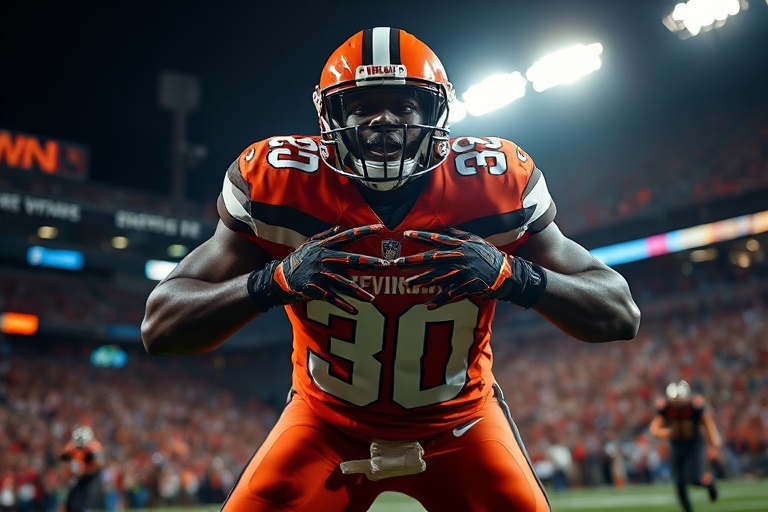
Jeremiah Owusu-Koramoah: Ghanaian Roots and NFL Ambitions
From Ghanaian Roots to NFL Stardom: Jeremiah Owusu-Koramoah’s Journey
Jeremiah Owusu-Koramoah’s rise in professional football is more than a sports story—it’s a narrative of cultural exchange, athletic evolution, and global opportunity. Born in Accra, Ghana, and raised in the United States, Owusu-Koramoah embodies the increasingly interconnected world of college and professional sports. His journey from a young athlete in Virginia to a second-round NFL draft pick has drawn attention not only for his on-field prowess but also for what he represents in the modern landscape of American football.
The 6’2”, 221-pound linebacker and defensive back, known for his explosive playmaking and versatility, played college football at Notre Dame, where he earned All-American honors and became one of the most dynamic defensive players in NCAA history. His ability to disrupt offenses as a blitzer, cover ground in pass defense, and make game-changing tackles made him a prized prospect in the 2021 NFL Draft. Selected 52nd overall by the Cleveland Browns, Owusu-Koramoah quickly became a key piece of a defense navigating both high expectations and internal transitions.
Cultural Identity and the Global Athlete
Owusu-Koramoah’s story resonates deeply within the growing trend of international athletes making their mark in the NFL. While the league has long drawn talent from Africa—especially through programs like the NFL International Combine—his success highlights the cultural bridges being built through sport. Ghana, a nation with a rich tradition in soccer, has increasingly produced athletes who excel in American football, often through pathways involving high school and college in the U.S.
This cross-cultural athletic migration reflects broader global trends. As youth sports become more accessible and international academies expand, athletes from outside traditional football powerhouses are finding opportunities to compete at the highest levels. For Owusu-Koramoah, representing Ghana on the global stage isn’t just personal pride—it’s part of a larger movement where African athletes are redefining what it means to be a football player in America.
His journey also underscores the importance of mentorship and community in the development of international athletes. Programs like the NFL’s African Development Combine and partnerships with organizations in Ghana have created pathways for young players to be scouted and supported. Owusu-Koramoah’s success serves as a model for aspiring athletes in West Africa who dream of playing in the NFL.
The Notre Dame Effect: A Blueprint for Defensive Versatility
At Notre Dame, Owusu-Koramoah thrived in a system that demanded adaptability. Under defensive coordinator Clark Lea, he played multiple roles—linebacker, edge rusher, and even in the nickel package—showcasing a skill set that modern NFL defenses covet. His 2020 season was particularly notable: he led the team in tackles for loss, recorded 13.5 sacks, and forced five fumbles, earning unanimous All-American honors and the Butkus Award as the nation’s top linebacker.
This kind of defensive versatility is becoming essential in the NFL, where offenses prioritize speed and spacing. Players who can move seamlessly between positions—blitzing from the edge one play and dropping into coverage the next—give coordinators tactical flexibility. Owusu-Koramoah’s ability to play both linebacker and safety in college mirrored the kind of hybrid roles seen in today’s NFL, where defenders like Micah Parsons and Isaiah Simmons have redefined the position.
His development at Notre Dame also reflects a broader evolution in defensive football education. The Fighting Irish program, under head coach Brian Kelly, emphasized physicality, intelligence, and adaptability—traits that Owusu-Koramoah internalized and brought to the professional level. The college to pro pipeline has long been a critical pathway, but Owusu-Koramoah’s trajectory shows how modern college systems can prepare athletes for the multifaceted demands of the NFL.
Challenges and Growth in Cleveland
Transitioning to the NFL is never easy, especially for a rookie stepping into a complex defense. Owusu-Koramoah’s first two seasons in Cleveland were marked by both promise and setbacks. Injuries, including a high-ankle sprain in 2022, limited his playing time and forced him to adapt to a new role within a shifting defensive scheme. Under new head coach Kevin Stefanski and defensive coordinator Jim Schwartz, Owusu-Koramoah began to find his footing in 2023, contributing as a rotational defender and special teams ace.
His role in Cleveland’s defense has evolved into one of strategic deployment. Rather than being a full-time starter, he’s used in situational packages—blitzing on third downs, covering tight ends, or rotating into the secondary. This usage reflects a growing trend in the NFL: positionless defenders who can be deployed creatively to exploit matchups. It’s a role Owusu-Koramoah is well-suited for, given his athleticism and football IQ.
The Browns’ defensive identity has also shifted in recent years, moving toward a more aggressive, blitz-heavy approach. Owusu-Koramoah’s ability to generate pressure from the second level aligns with this philosophy. While he hasn’t yet reached the statistical heights of his college career, his contributions in key moments—especially in playoff games—have begun to earn him the trust of coaches and teammates.
Beyond the Field: Leadership and Community Impact
Owusu-Koramoah’s influence extends beyond the gridiron. As one of the NFL’s few Ghanaian-born players, he has become a cultural ambassador, using his platform to connect with fans in both the U.S. and Africa. His social media presence, which often highlights his heritage and community involvement, has resonated with a global audience. In 2022, he launched the JOK Foundation, aimed at supporting youth sports and education initiatives in Ghana and the U.S.
His commitment to giving back reflects a growing awareness among athletes about the power of their platforms. In an era where athletes are increasingly vocal about social and global issues, Owusu-Koramoah’s story offers a blueprint for using sport as a tool for change. Whether through hosting football camps in Accra or partnering with organizations that promote education and health, he’s helping to redefine what it means to be a role model in the NFL.
Moreover, his journey challenges stereotypes about African athletes in American football. While soccer remains the dominant sport in many African nations, stories like his demonstrate that the pathway to the NFL is becoming more accessible—and more diverse—than ever before.
Looking Ahead: What’s Next for Jeremiah Owusu-Koramoah?
As Owusu-Koramoah enters his fourth NFL season, expectations are high. The Browns have invested in their defense, adding talent like Jim Leonhard and drafting playmakers such as Denzel Burke and Siakamniuku. With a new defensive scheme in place, Owusu-Koramoah’s role could expand, especially if he continues to refine his pass-rushing and coverage skills.
For Owusu-Koramoah, the path forward involves balancing consistency with impact. The NFL is a league of specialization, and players who can thrive in defined roles—whether as a blitzer, coverage defender, or special teams standout—often carve out long careers. His ability to stay healthy and contribute in multiple phases of the game will be critical to his development.
On a broader scale, his career trajectory will be watched closely by young athletes in Ghana and across Africa. If he can establish himself as a key contributor in Cleveland—or even become a Pro Bowl-caliber player—he could inspire a new generation of football talent from the continent. The NFL’s growing presence in international markets, including Africa, means players like Owusu-Koramoah are not just exceptions—they’re part of a growing trend.
For now, Owusu-Koramoah remains a player in transition, but one with immense potential. His story is still being written, and each snap offers a new chapter in a journey that began thousands of miles from an NFL stadium.
Conclusion
Jeremiah Owusu-Koramoah’s career is a testament to the power of sport as a unifying force—bridging continents, cultures, and communities. From his Ghanaian roots to the NFL fields of Cleveland, he represents the evolving face of American football: faster, more versatile, and more globally connected than ever before. While his path hasn’t been without challenges, his resilience and adaptability suggest a promising future. As the NFL continues to expand its global footprint, players like Owusu-Koramoah aren’t just participants—they’re pioneers.
His story also reminds us that success in sports isn’t just about physical talent—it’s about identity, opportunity, and the courage to represent something greater than oneself. As he continues to grow, so too does the narrative of what it means to be an athlete in the modern world.