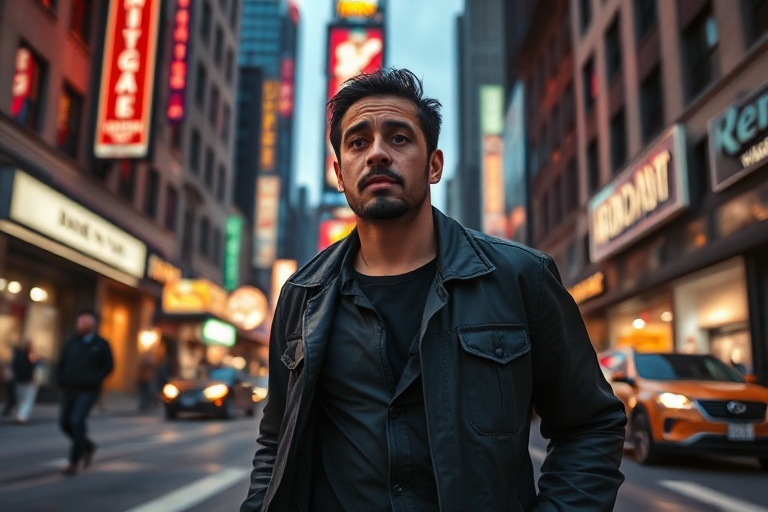
Kervin Castro: The Cuban Perspective in a Global Dialogue
Kervin Castro stands at the intersection of tradition and innovation, a Cuban artist whose work transcends borders while remaining deeply rooted in his island’s cultural DNA. Born in Havana in 1989, Castro emerged during a transformative period for Cuban art—one where digital connectivity began to reshape creative boundaries that had long been constrained by geography. His practice spans painting, sculpture, and digital media, often incorporating found objects and discarded materials that speak to themes of memory, migration, and environmental decay.
Castro’s international recognition grew alongside the rise of social media platforms that allowed Cuban artists to bypass state-controlled galleries. His breakthrough came through platforms like Instagram, where his vivid, textured compositions—often featuring fragmented Cuban iconography—began to circulate globally. By 2018, he was included in Arts and Culture roundups in Dave’s Locker, signaling his arrival on the world stage. Today, his works hang in private collections from Miami to Madrid, challenging viewers to reconsider Cuba’s place not as a relic of Cold War politics, but as a dynamic participant in contemporary art discourse.
The Cuban Context: Art as Resistance and Expression
To understand Castro’s work, one must first grasp the unique pressures faced by artists in Cuba. Since the 1960s, the Cuban government has tightly controlled artistic production through institutions like the National Council of Culture, which historically promoted socialist realism while censoring dissent. Yet paradoxically, the island’s isolation fostered an underground art scene that thrived on resourcefulness and subversion.
Castro belongs to a generation of Cuban artists who came of age after the collapse of the Soviet Union, a period known as the “Special Period,” when scarcity became a creative catalyst. Many turned to recycled materials—broken tiles, rusted metal, discarded plastic—as both a necessity and a statement. Castro’s signature use of these materials isn’t merely aesthetic; it’s a commentary on Cuba’s dual crises of environmental neglect and economic precarity. His 2021 series Isla en Pedazos (“Island in Pieces”) used fragmented ceramic shards to evoke both the beauty and fragility of Cuban heritage.
- Cuban Art in Isolation: Before the internet, Cuban art circulated through biennials in Venice, São Paulo, and Havana—highly curated spaces with political implications.
- Digital Dawn: The arrival of Wi-Fi parks in Havana in 2015 allowed artists like Castro to share work globally, bypassing state censorship.
- Material as Message: The use of found objects reflects both scarcity and resistance—turning trash into art is an act of reclaiming agency.
Global Recognition: From Havana to the World
Castro’s ascent mirrors a broader shift in how Latin American art is consumed globally. While artists like Wilfredo Lam and Ana Mendieta paved the way, Castro represents a new wave—one that leverages digital tools and hybrid practices to reach audiences directly. His work has been exhibited in Berlin, Miami, and Seoul, often alongside artists from Africa, the Middle East, and the Caribbean, reflecting a shared postcolonial experience.
In 2022, Castro participated in Transcultura, an EU-funded program connecting Caribbean and European artists. The initiative highlighted how artists from the Global South are increasingly defining the terms of their own representation, moving beyond the “exoticism” often imposed by Western curators. Castro’s 2023 solo show Fronteras Invisibles (“Invisible Borders”) at Madrid’s Centro Cultural Fernán Gómez toured to Lisbon and Buenos Aires, drawing comparisons to artists like Yinka Shonibare and Do Ho Suh for his exploration of identity and displacement.
Cultural Critique: Castro’s Commentary on Modernity and Memory
Castro’s art is not merely decorative; it’s a form of cultural archaeology. His mixed-media pieces often juxtapose vintage Cuban posters, American pop culture imagery, and industrial detritus, creating visual collisions that mirror the island’s layered history. In El Sueño Americano (“The American Dream”), a 2019 installation, Castro encased a 1950s American car model in a glass box filled with Havana Club rum bottles—an ironic nod to both Cuba’s colonial past and its fraught relationship with the U.S.
Critics have noted Castro’s debt to the arte de la confección—the Cuban tradition of crafting beauty from scarcity—but his digital interventions set him apart. His 2020 NFT series Memorias Digitales (“Digital Memories”) reimagined classic Cuban songs as glitchy, pixelated animations, exploring how technology both preserves and distorts cultural memory. The project sparked debate in Havana’s art circles about the ethics of digital ownership, a topic rarely discussed in Cuba’s state media.
The Future: Castro and the Next Chapter of Cuban Art
As Cuba’s political and economic landscape continues to evolve, Castro’s role as both observer and participant becomes ever more critical. The 2021 protests in Cuba and subsequent crackdowns have renewed international interest in the island’s creative voices, with Castro emerging as a key interlocutor. His recent collaborations with diaspora artists—particularly those in Miami and Spain—signal a new phase of transnational Cuban art-making.
Yet challenges remain. Despite his global reach, Castro still faces restrictions in Cuba, where internet access is limited and materials are scarce. His studio in Havana’s Vedado neighborhood is a testament to ingenuity: walls lined with salvaged wood, shelves cluttered with jars of paint mixed from pigments found in hardware stores. There, he continues to work, turning limitations into strengths.
For those outside Cuba, Castro’s art offers a lens to understand the island’s complexities—not as a postcard paradise or a political pariah, but as a living, evolving society. His work reminds us that art, at its best, is not just a mirror but a tool for reimagining the world.
“In Cuba, art is not a luxury. It is a way of surviving, of resisting erasure. Every piece is a conversation with history—and with the future we want to build.”
Kervin Castro, 2023 interview with Hyperallergic
Where to See Castro’s Work
While Castro’s pieces are frequently shown in pop-up exhibitions across Europe and the Americas, here are some reliable venues and platforms to follow:
- Centro de Arte Contemporáneo Wifredo Lam (Havana, Cuba): The island’s premier contemporary art space, which has hosted his early works.
- Bakehouse Art Complex (Miami, USA): A hub for Cuban diaspora artists, where Castro has exhibited in group shows.
- Artsy and Saatchi Art: Both platforms regularly feature Castro’s works for online viewing and purchase.
- Annual Havana Biennial: Though state-influenced, the biennial has increasingly included independent voices like Castro’s.
For real-time updates, Castro’s Instagram (@kervincastroart) remains the most active platform, offering glimpses into his process, studio, and occasional live Q&As. His website, launched in 2022, also features a catalog of works and information on upcoming exhibitions.