Manchester City FC: From Humble Beginnings to Global Dominance
Manchester City Football Club stands today as one of the most recognizable names in world football, a transformation that spans over a century of triumph, turmoil, and reinvention. Founded in 1880 as St. Mark’s (West Gorton), the club adopted its current identity in 1894 and has since evolved from a local Manchester side into a global sporting institution. Its journey—marked by financial investment, tactical evolution, and cultural influence—reflects broader shifts in the modern game, where sport is as much about identity and spectacle as it is about competition.
With roots deeply embedded in the working-class communities of East Manchester, City has mirrored the city’s own story: resilient, ambitious, and unafraid to challenge convention. The club’s rise to prominence in the 21st century, particularly under the ownership of the Abu Dhabi United Group since 2008, has redefined expectations in English football and brought unprecedented success to a club once overshadowed by its more illustrious neighbors.
The Sheikh Mansour Era: A Blueprint for Modern Football
The turning point for Manchester City came in August 2008 when Sheikh Mansour bin Zayed Al Nahyan, a member of the Abu Dhabi royal family, acquired the club through the Abu Dhabi United Group. This investment was not merely financial—it was ideological, signaling a new era where football clubs could become global brands while maintaining strong local ties.
Under this ownership, City pursued a strategy combining elite recruitment, state-of-the-art infrastructure, and a clear footballing philosophy. The most visible symbol of this transformation was the construction of the £210 million Etihad Campus, a 38-acre training and youth development hub that opened in 2014. It houses the club’s academy, medical facilities, and first-team training base, all designed to nurture talent from within.
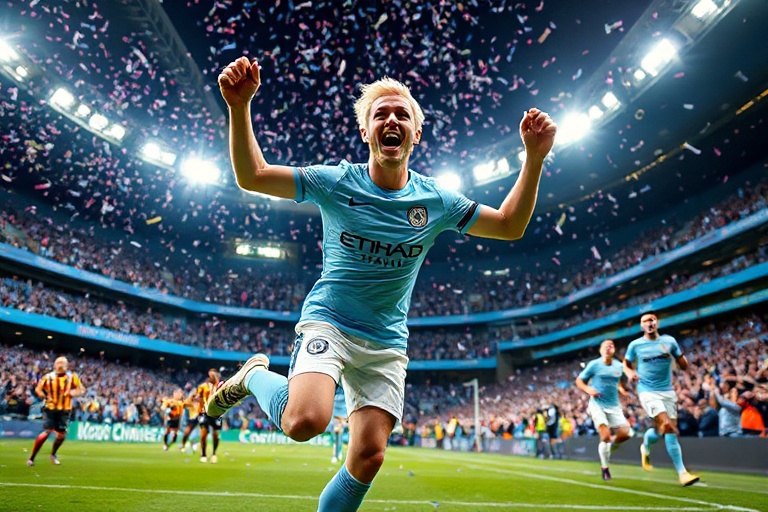
The results were immediate and sustained. Between 2011 and 2023, Manchester City won seven Premier League titles, six FA Cups, eight League Cups, and their first-ever UEFA Champions League trophy in 2023. This unprecedented period of success positioned them alongside football’s traditional powerhouses—Real Madrid, Barcelona, Bayern Munich—and redefined what was possible for clubs outside the sport’s traditional financial heartlands.
A Club That Reflects Its City
Manchester City’s identity remains intrinsically linked to Manchester itself. The club’s blue kit and the sky-blue anthem “Blue Moon” are woven into the fabric of the city’s cultural narrative. Unlike some elite European clubs that have become detached from their communities, City has maintained strong local engagement through initiatives like the City in the Community foundation, which delivers sports programs to over 30,000 young people annually.
The Etihad Stadium, located in the heart of East Manchester, was once part of a post-industrial landscape. Today, it sits at the center of a regenerating neighborhood, symbolizing how sport can catalyze urban renewal. The club’s training ground, also in East Manchester, has become a landmark, drawing visitors from around the world who want to experience the “Cityzens” way of life.
This connection to place has fostered a unique kind of loyalty. While global stars like Kevin De Bruyne, Erling Haaland, and Rodri have become icons, the club’s fanbase remains deeply rooted in Manchester’s working-class traditions. The club’s supporters’ trust, often tested during lean years, has been repaid with a level of consistency rarely seen in English football.
Tactical Innovation and Managerial Evolution
Manchester City’s on-field success is inseparable from its tactical evolution. Under managers Roberto Mancini, Manuel Pellegrini, and Pep Guardiola, the club has embraced a philosophy rooted in possession, positional play, and high pressing. Guardiola’s arrival in 2016 marked a turning point, as he refined City’s style into a more fluid, expressive form of football that prioritized creativity and fluid transitions.
This approach has produced some of the most dominant seasons in Premier League history. The 2017–18 side set a record for most points (100) in a single top-flight campaign, while the 2022–23 team completed a historic Treble—winning the Premier League, FA Cup, and Champions League in the same season. Their Champions League victory in Istanbul, coming from behind to defeat Inter Milan, will be remembered as a defining moment in the club’s modern era.
The club’s recruitment strategy has complemented this philosophy. Rather than relying solely on expensive marquee signings, City has developed a model that combines data analytics, scouting networks, and youth development. Players like Phil Foden, who came through the academy, and academy graduates like Rico Lewis and Cole Palmer have become first-team regulars, embodying the club’s belief in long-term development.
A Global Brand with Local Roots
Manchester City is no longer just a football club—it is a global brand with operations spanning broadcasting, digital media, and community engagement. The club’s social media presence is among the most influential in world sport, with over 60 million followers across platforms. Its global fanbase, known as “Cityzens,” stretches from Manchester to Melbourne, Mumbai to Miami, reflecting football’s unifying power.
The club has also expanded its commercial reach through partnerships with global brands like Etihad Airways, Nissan, and EA Sports. In 2017, City launched the City Football Group (CFG), a network of clubs including New York City FC, Melbourne City FC, and Girona FC. This global expansion allows the club to share best practices, scout talent across continents, and engage fans worldwide.
Despite this global reach, City has maintained a commitment to sustainability. The club was the first in the Premier League to achieve carbon-neutral status and has invested in renewable energy projects. This dual focus—on global growth and local responsibility—sets a new standard for how football clubs can operate in the 21st century.
The Future: Sustaining Success and Building Legacy
As Manchester City looks to the future, several challenges and opportunities lie ahead. The post-Guardíola era will test the club’s ability to maintain its competitive edge. The retirement of key figures like Fernandinho and the potential departures of stars such as Erling Haaland require careful management. Yet the depth of the squad, the strength of the academy, and the clarity of the club’s vision suggest that City is well-positioned for sustained success.
The club’s long-term ambitions extend beyond trophies. Through the City Football Schools and CFG academies, City is investing in the next generation of players and fans. Its focus on sustainability and community engagement aligns with growing public demand for responsible corporate citizenship in sport.
More than a decade after the Sheikh Mansour takeover, Manchester City has redefined what it means to be a football club in the modern era. It is a club that balances ambition with humility, global ambition with local identity, and financial power with sporting integrity. In doing so, it has not only transformed its own fortunes but also set a new benchmark for how football clubs can thrive in an increasingly complex world.
For fans old and new, Manchester City represents more than a team—it is a story of resilience, reinvention, and relentless pursuit of excellence. And as the club continues to write its next chapter, one thing is certain: the world will be watching.