By Jane Thompson | Published June 10, 2024
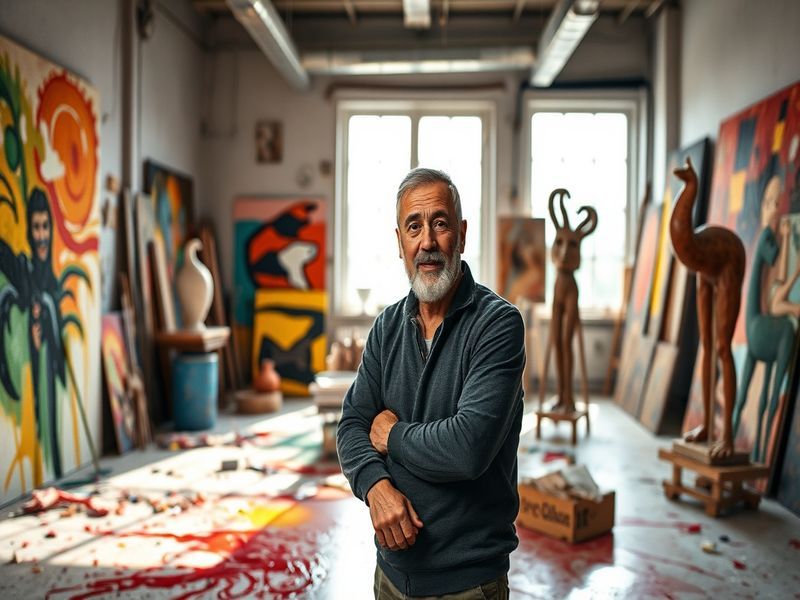
Noel Rodriguez Alvarez has emerged as a compelling voice in contemporary art and social activism, blending vibrant visual storytelling with unapologetic political commentary. Born in Miami to Cuban immigrant parents, Alvarez’s work reflects a lifelong negotiation between heritage, displacement, and the search for belonging. His art—ranging from large-scale murals to intimate mixed-media pieces—serves as both a personal catharsis and a public call to action, particularly around issues of immigration, racial justice, and cultural erasure.
Alvarez’s rise to prominence has been marked by a deliberate rejection of traditional artistic boundaries. While trained in classical techniques at the Rhode Island School of Design, his practice quickly evolved into something far more urgent. Today, his work is celebrated in galleries across the U.S. and Europe, but it is his street art—often created in collaboration with undocumented communities—that has cemented his reputation as a fearless advocate for marginalized voices. Alvarez’s murals, such as “Sueños Despiertos” (Wakeful Dreams), have become landmarks in cities like New York, Los Angeles, and Miami, transforming public spaces into sites of resistance and remembrance.
The Evolution of Alvarez’s Artistic Vision
Alvarez’s artistic journey is one of constant reinvention, shaped by personal and political awakening. In his early career, he focused on abstract expressionism, using bold colors and gestural brushstrokes to explore themes of memory and displacement. However, a 2018 trip to the U.S.-Mexico border profoundly altered his trajectory. The experience—witnessing firsthand the human toll of immigration policies—inspired a shift toward more figurative and narrative-driven work. This period gave birth to his “Fronteras” series, a collection of portraits of migrants rendered in layers of torn paper and spray paint, symbolizing both fragility and resilience.
By 2020, Alvarez’s work had become synonymous with the protest art movement that swept the nation following the murder of George Floyd. His mural “Bloodlines”, completed in Minneapolis, depicted Floyd’s face interwoven with the names of other victims of police violence, using a palette of reds and blacks to evoke both blood and soil. The piece went viral, shared millions of times across social media and sparking debates about the role of art in activism. Alvarez, however, has been vocal about his discomfort with being labeled solely as a “protest artist.” In interviews, he emphasizes that his work is first and foremost an exploration of identity—one that happens to intersect with urgent social issues.
- Early Influences: Alvarez cites Jean-Michel Basquiat and Ana Mendieta as formative figures in his development, admiring their ability to fuse personal narrative with broader political critiques.
- Technical Evolution: His use of mixed media—incorporating textiles, found objects, and digital elements—reflects a desire to challenge the elitism of the art world while making his work accessible to diverse audiences.
- Collaborative Approach: Many of Alvarez’s projects are co-created with communities directly affected by the issues he addresses, ensuring that the art remains rooted in lived experience rather than abstraction.
Activism as Art: Alvarez’s Most Provocative Projects
Alvarez’s activism is inseparable from his artistry, a fact that has drawn both admiration and criticism. His 2021 project “The Undocumented Portrait Project” invited undocumented immigrants to sit for portraits, which were then exhibited in public spaces with accompanying audio recordings of their stories. The project toured major cities, including Chicago and San Francisco, and was later adapted into a documentary that premiered at the Tribeca Film Festival. Critics praised its emotional depth, while detractors accused Alvarez of exploiting vulnerable communities for artistic gain. Alvarez responded by stating, “Art is not neutral. If my work can make someone feel seen—or make someone uncomfortable enough to act—then it is fulfilling its purpose.”
Another standout initiative was “Muros sin Fronteras” (Walls Without Borders), a 2022 collaboration with muralists in Tijuana and San Diego. The project transformed the border wall itself into a canvas, with Alvarez leading teams of artists from both sides of the divide to create a continuous mural spanning the international boundary. The artwork, which took six months to complete, featured imagery of endangered species, indigenous symbols, and messages of unity. The project faced significant bureaucratic hurdles, including delays from U.S. Customs and Border Protection, but ultimately succeeded in drawing global attention to the environmental and humanitarian crises at the border. Alvarez later reflected, “The wall was never meant to be a barrier between people—it became one. Our art was an attempt to reclaim that space.”
“Art is not neutral. If my work can make someone feel seen—or make someone uncomfortable enough to act—then it is fulfilling its purpose.”
—Noel Rodriguez Alvarez
Challenges and Criticisms: Navigating the Art World’s Paradoxes
Despite his growing acclaim, Alvarez has not been immune to the contradictions of the art world, where radical messages often coexist with commercial interests. His 2023 solo exhibition at a prominent Chelsea gallery, titled “Ghosts of the American Dream”, was met with both critical acclaim and backlash. While some reviewers praised the exhibition’s unflinching portrayal of systemic inequality, others accused Alvarez of “selling out” by exhibiting in a space that many view as a bastion of elitism. Alvarez addressed the controversy in an interview with The New York Times, stating, “I don’t believe in purity in art. The system is broken, but I have to work within it to reach people who wouldn’t otherwise engage with these ideas.”
Financial sustainability has also been a persistent challenge. Unlike many of his contemporaries who transition to commercial galleries or lucrative commissions, Alvarez has remained committed to community-based projects that often yield little financial return. To fund these initiatives, he relies on a mix of grants, crowdfunding, and partnerships with nonprofits. In 2022, he launched the Alvarez Arts Collective, a nonprofit dedicated to supporting emerging artists from underrepresented backgrounds. The collective offers free workshops and mentorship programs, with Alvarez personally overseeing its operations. “I could spend all my time making sellable art,” he said in a 2023 interview with Hyperallergic. “But what’s the point if the people who need to hear these messages the most aren’t in the room?”
- Commercial vs. Activist Tensions: Alvarez’s refusal to compromise his political messaging for market appeal has limited his presence in certain high-profile art circles.
- Funding Struggles: Many of his community projects operate on shoestring budgets, relying on volunteers and in-kind donations.
- Backlash from Both Sides: Some activists argue that his work is too “aestheticized” to be truly impactful, while conservative critics dismiss his art as “propaganda.”
- Burnout Risks: The emotional labor of creating art under such high-stakes conditions has led Alvarez to take periodic breaks, most notably in 2021 when he paused all public projects for three months.
What’s Next for Noel Rodriguez Alvarez?
As Alvarez looks to the future, he has hinted at several ambitious projects that promise to push his artistic and activist boundaries even further. One of his most anticipated works is “The Long March”, a multimedia installation that will retrace the journey of a single immigrant family from Central America to the U.S. border, using GPS-tracked artworks that evolve in real-time as the subjects travel. The project, slated for 2025, will involve collaborations with technologists and geographers to create an immersive experience blending virtual reality, sculpture, and documentary filmmaking.
Alvarez is also turning his attention to education, with plans to establish a permanent arts center in Miami’s Little Havana neighborhood. The center, which he describes as a “hub for cultural resistance,” will offer free classes in muralism, printmaking, and digital art, with a focus on empowering youth from immigrant families. “I want to create a space where kids can see themselves as artists and activists—not just as statistics,” he explained in a recent interview. This initiative aligns with his broader goal of decentralizing the art world, making it more inclusive and responsive to the communities it often overlooks.
Despite the challenges he faces, Alvarez remains steadfast in his belief that art must serve a higher purpose. “I don’t make art to decorate walls,” he said in a 2024 TED Talk. “I make it to build bridges, to hold up mirrors, and sometimes to throw rocks. The question isn’t whether art should be political—it’s whether we have the courage to let it change us.”
About the Author: Jane Thompson is a staff writer for Art & Culture at Dave’s Locker. Her work focuses on the intersection of creativity and social change. Follow her on Twitter for more insights.
For further reading on the intersection of art and activism, explore our News and Analysis sections.