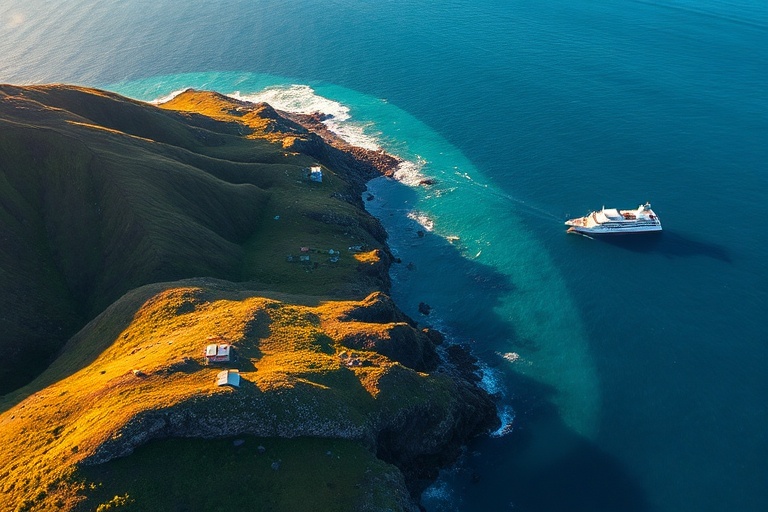
Perched in the South Pacific Ocean, Pitcairn Island remains one of Earth’s most isolated yet intriguing destinations. With a population of fewer than 50 people, this British Overseas Territory offers a unique blend of history, resilience, and untouched natural beauty. More than just a dot on the map, Pitcairn represents humanity’s enduring connection to place, even in the face of overwhelming odds.
The History of Pitcairn: From Mutiny to Modernity
Pitcairn’s story begins with a dramatic chapter in maritime history. In 1789, the HMS Bounty’s infamous mutiny left Captain William Bligh and loyal crew members adrift. The mutineers, led by Fletcher Christian, eventually settled on Pitcairn Island in 1790, burning their ship to prevent escape. This act of desperation forged an isolated community that would survive against all odds.
The descendants of these mutineers, along with Tahitian companions, created a society that thrived in secrecy for generations. By the 1850s, overpopulation forced many to resettle to Norfolk Island, reducing Pitcairn’s population significantly. Today, the island’s residents are direct descendants of those original settlers, maintaining traditions that stretch back over two centuries.
Key Historical Moments
- 1790: Mutineers from the HMS Bounty settle on Pitcairn Island
- 1808: The island is rediscovered by an American ship, confirming its existence to the outside world
- 1838: Pitcairn becomes a British colony
- 1856: Most of the population relocates to Norfolk Island due to overcrowding
- 1902: The island’s remaining residents petition to return, establishing the current community
Life on Pitcairn Today: Challenges and Uniqueness
Living on Pitcairn is not for the faint-hearted. The island’s remoteness presents daily challenges that most people never encounter. Access is limited to a single ship, the Silver Supporter, which visits just four times a year from New Zealand. Communication with the outside world relies on satellite internet, often interrupted by storms or technical difficulties.
Yet, for those who call Pitcairn home, these hardships are outweighed by the island’s unique advantages. Residents enjoy a crime-free environment, strong community bonds, and a lifestyle that prioritizes sustainability and self-reliance. The island runs on solar power and rainwater collection, with a focus on organic farming and fishing.
Tourism remains minimal, with only a handful of visitors arriving each year. Those who do make the journey are often struck by the warmth of the locals and the unspoiled nature of the landscape. The island’s small size—just 4.6 square kilometers—means that everyone knows each other, creating a tight-knit society that feels worlds away from modern urban life.
The Future of Pitcairn: Sustainability and Survival
Pitcairn’s future hinges on its ability to balance tradition with adaptation. The island faces pressing challenges, including climate change, which threatens its coastal ecosystems, and an aging population that risks depopulation. Efforts to attract new residents have included incentives like land grants and tax breaks, but the allure of such a remote life remains limited.
One potential solution lies in sustainable tourism and niche industries. Pitcairn’s pristine waters are home to some of the world’s healthiest coral reefs, making it a prime location for marine research and eco-tourism. The island has also explored opportunities in digital nomadism, leveraging its satellite internet to attract remote workers seeking a truly off-grid experience.
However, these efforts require significant investment and infrastructure development. The British government has provided funding for projects like a new school and improved internet connectivity, but long-term sustainability remains uncertain. The question lingers: Can Pitcairn Island preserve its way of life while adapting to a rapidly changing world?
Why Pitcairn Matters: Lessons from the Most Remote Community on Earth
Pitcairn Island serves as a fascinating case study in human resilience and isolation. In an era where globalization connects billions instantaneously, Pitcairn stands as a reminder of the value of community, simplicity, and self-sufficiency. Its story challenges modern assumptions about progress, showing that fulfillment doesn’t require constant connectivity or material abundance.
For those interested in off-grid living, sustainable communities, or historical resilience, Pitcairn offers valuable lessons. It demonstrates how a small group of people can thrive when united by shared history and purpose. Yet, it also highlights the fragility of such communities, where a single storm or economic shift can threaten existence.
Pitcairn’s future may be uncertain, but its legacy as a symbol of human endurance is secure. As the world becomes increasingly interconnected, places like Pitcairn remind us of the beauty and challenges of living differently.
For those who dream of escaping the noise of modern life, Pitcairn Island remains a beacon of possibility—a place where time slows down, and community takes precedence.
“Pitcairn is not just a place on a map; it’s a testament to what humans can achieve when they come together with purpose and determination.” — The Pitcairn Newsletter
To explore more about remote communities and their unique challenges, visit our Travel section. For insights into sustainable living practices, check out our Environment category.