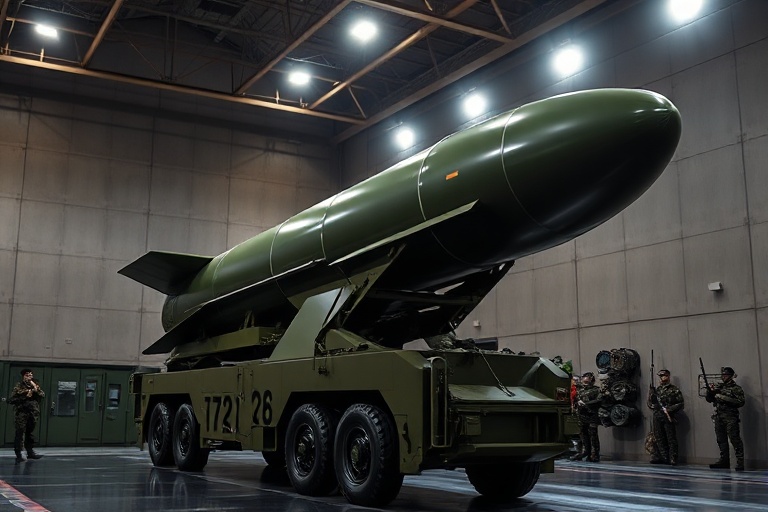
Russia’s RS-28 Sarmat ICBM: The Missile Reshaping Global Security
The RS-28 Sarmat intercontinental ballistic missile (ICBM), developed by Russia’s Makeyev Rocket Design Bureau, stands as one of the most advanced and controversial weapons systems in the world. Often referred to by its NATO reporting name, Satan 2, this liquid-fueled monster represents a significant leap in Moscow’s nuclear modernization efforts. With a reported range of up to 18,000 kilometers and the capacity to carry multiple warheads, the Sarmat is designed to penetrate even the most sophisticated missile defense systems.
Its development reflects broader geopolitical tensions, particularly Russia’s response to perceived threats from NATO expansion and U.S. missile defense deployments. But beyond the headlines, the Sarmat raises critical questions about the future of arms control, deterrence theory, and global security architecture. This is not just another missile in a long line of Russian weapons—it is a deliberate statement of intent.
The Sarmat: Capabilities and Technical Specifications
Officially entering service in April 2023, the RS-28 Sarmat is a third-generation heavy ICBM designed to replace the aging UR-100NUTTKh (SS-19 Stiletto) systems. Its most striking feature is its sheer size and payload capacity. The missile weighs approximately 220 tons at launch and measures about 35 meters in length—making it one of the largest ICBMs ever deployed. This massive structure allows it to carry a warhead payload of up to 10 metric tons.
What sets the Sarmat apart is not just its payload capacity but its innovative delivery mechanisms. Unlike traditional ICBMs that follow predictable ballistic trajectories, the Sarmat employs a combination of:
- Multiple independently targetable reentry vehicles (MIRVs): Capable of delivering up to 15 nuclear warheads, each with a yield of up to 750 kilotons, to different targets.
- Hypersonic glide vehicles (HGVs): The missile can deploy Avangard-class hypersonic glide vehicles, which travel at speeds exceeding Mach 20 and maneuver unpredictably, making interception nearly impossible.
- Decoy and countermeasure systems: Advanced penetration aids confuse missile defense radars, increasing the likelihood of warheads reaching their targets.
Russian officials have claimed that the Sarmat can strike targets in the continental United States, Europe, and Asia with unparalleled precision. The missile’s range and payload flexibility allow it to target not only military installations but also strategic political and economic centers, reinforcing Russia’s doctrine of “escalate to de-escalate.” This strategy involves the potential use of limited nuclear strikes to force an adversary to back down in a conflict.
Strategic Context: Why the Sarmat Matters in Modern Warfare
The deployment of the RS-28 Sarmat cannot be understood in isolation. It is part of a broader Russian military modernization program that has accelerated since 2014, following the annexation of Crimea and the deterioration of relations with the West. The missile’s development was publicly acknowledged in 2016, and test launches have been conducted regularly since 2017, including one in April 2022 that drew international condemnation.
Strategically, the Sarmat serves multiple purposes for Moscow. First, it ensures the survivability of Russia’s nuclear arsenal. By fielding a missile with unpredictable flight paths and advanced countermeasures, Russia complicates U.S. and NATO missile defense calculations. The U.S. Ground-Based Midcourse Defense (GMD) system, designed to intercept ICBMs, would struggle to track and engage a Sarmat equipped with HGVs.
Second, the Sarmat reinforces Russia’s nuclear deterrence posture. In the event of a large-scale conventional conflict, the missile serves as a “sword of Damocles,” reminding adversaries of the catastrophic consequences of escalation. This psychological dimension is critical in modern deterrence theory, where the mere existence of such a weapon can influence diplomatic and military decisions.
Third, the Sarmat is a tool of political messaging. Its unveiling and testing coincide with periods of heightened tensions, such as the war in Ukraine. By demonstrating technological prowess and military readiness, Russia signals both to its domestic audience and to external observers that it remains a formidable global power, undeterred by sanctions or isolation.
Controversies and Geopolitical Implications
The deployment of the RS-28 Sarmat has sparked intense debate among analysts, policymakers, and arms control advocates. Critics argue that the missile undermines global stability by lowering the threshold for nuclear use and intensifying an already dangerous arms race. The U.S. and NATO have responded by accelerating their own missile defense programs, including the development of hypersonic interceptors and space-based sensors.
One of the most contentious aspects of the Sarmat is its potential to trigger a new era of nuclear brinkmanship. The missile’s ability to deliver a massive, rapid nuclear strike in a single launch could tempt military planners to consider preemptive options in a crisis. This risk is exacerbated by Russia’s doctrine of “escalate to de-escalate,” which some analysts warn could lead to miscalculation and unintended escalation.
Moreover, the Sarmat highlights the erosion of arms control agreements. The U.S. withdrew from the Intermediate-Range Nuclear Forces (INF) Treaty in 2019, citing Russian violations. While New START remains in force, its future is uncertain, particularly after Russia suspended inspections in 2023. The Sarmat’s development, therefore, occurs in a vacuum of transparency and mutual accountability.
Environmental concerns have also been raised. The Sarmat uses highly toxic hydrazine fuel, which poses risks during launch and potential accidents. In 2019, a failed test launch in Plesetsk Cosmodrome reportedly resulted in a toxic spill, raising alarms among local communities and environmental groups.
Looking Ahead: The Future of the Sarmat and Global Security
The RS-28 Sarmat is more than a weapon—it is a symbol of 21st-century military ambition and the enduring role of nuclear deterrence in international relations. Its deployment reflects a world where great-power competition is intensifying, and where technological superiority is increasingly measured in terms of destructive capability.
For Russia, the Sarmat is a cornerstone of its military strategy, ensuring that NATO cannot achieve a decisive conventional or nuclear advantage. For the U.S. and its allies, the missile underscores the need to invest in missile defense, hypersonic interception, and cyber-resilient command-and-control systems. The result is a feedback loop of military innovation, where each advancement by one side spurs further development by the other.
Yet, the Sarmat also presents an opportunity—however slim—for renewed arms control efforts. The sheer destructiveness of modern ICBMs makes their use unthinkable, but their existence demands dialogue. The next decade will be critical in determining whether the world can avoid a new arms race or whether the Sarmat becomes just the first of many such systems.
One thing is clear: the RS-28 Sarmat has redefined the calculus of nuclear deterrence. It forces us to confront uncomfortable truths about the fragility of global security and the enduring legacy of Cold War-era weapons in a multipolar world.
As geopolitical tensions rise and technological boundaries are pushed further, the Sarmat serves as a stark reminder that in the realm of strategic weapons, the line between deterrence and provocation is thinner than ever.
“The RS-28 Sarmat is not just a missile. It is a statement—a declaration that Russia remains a nuclear superpower, capable of challenging the military dominance of the West on its own terms.”
For further insights into Russia’s military modernization and its global implications, explore our Technology and Politics sections. These categories offer in-depth analysis on the intersection of military technology, geopolitics, and international security.