U.S.-China Tensions in the South China Sea: A Global Flashpoint
The South China Sea has become one of the most contested maritime regions in the world, where geopolitical ambitions, historical claims, and military posturing collide. At the center of this dispute are the United States and China, two global powers whose rivalry extends from trade to technology—and now, to control over some of the world’s busiest shipping lanes. The stakes are high: trillions of dollars in annual trade, vast untapped energy reserves, and the strategic dominance of a region that connects the Indian and Pacific Oceans.
For decades, China has asserted its territorial claims through the controversial “Nine-Dash Line,” a demarcation that encompasses nearly 90% of the South China Sea. Neighboring nations like Vietnam, the Philippines, Malaysia, and Brunei have pushed back, contesting Beijing’s expansive interpretation of historical sovereignty. The U.S., though not a claimant, has positioned itself as a guarantor of freedom of navigation and a counterbalance to China’s growing influence. This dynamic has transformed the South China Sea into a symbol of broader U.S.-China competition, one that carries implications for global trade, security alliances, and the future of international law.
The Historical Roots of Dispute
Tensions in the South China Sea are not new; they trace back to the mid-20th century, when decolonization and rising nationalism reshaped territorial claims across Asia. China’s modern claims are often linked to maps from the 1940s, including a 1947 version that first depicted the Nine-Dash Line. However, these claims have never been clearly defined under international law, and neighboring countries have long disputed their legitimacy.
In 2016, the Permanent Court of Arbitration in The Hague delivered a landmark ruling in favor of the Philippines, declaring China’s claims invalid under the United Nations Convention on the Law of the Sea (UNCLOS). Beijing rejected the decision outright, framing it as a political maneuver rather than a legal one. Since then, China has doubled down on its presence, constructing artificial islands, installing military infrastructure, and asserting administrative control over disputed features.
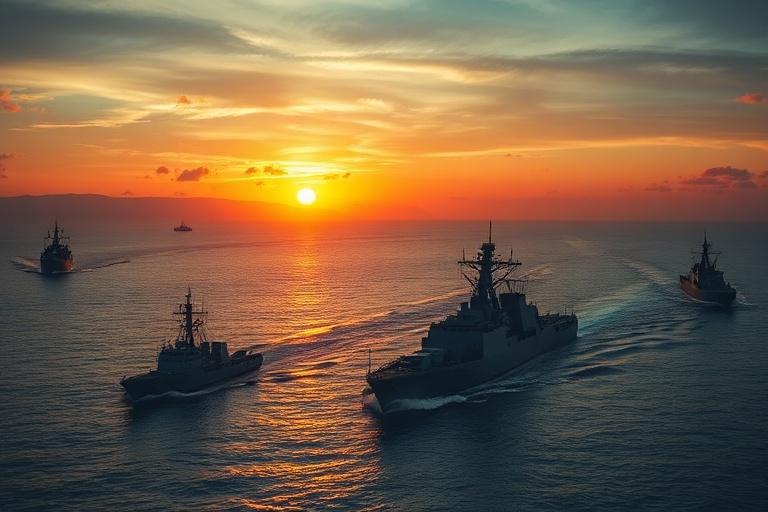
Meanwhile, the U.S. has maintained a policy of “strategic ambiguity,” neither acknowledging nor rejecting China’s claims while conducting regular freedom of navigation operations (FONOPs) to challenge excessive maritime claims. These operations—often involving U.S. Navy destroyers—have drawn sharp rebukes from Beijing, which views them as provocations.
Military Buildup and Escalating Risks
The South China Sea is now one of the most militarized regions on Earth. China has transformed small reefs and atolls into fortified islands equipped with runways, radar systems, missile launchers, and deep-water ports capable of hosting naval vessels. These installations extend China’s defensive perimeter hundreds of miles south, effectively turning contested waters into a Chinese sphere of influence.
The U.S. has responded with increased patrols, joint military exercises with allies, and expanded access to regional bases. In 2020, the U.S. formally rejected China’s maritime claims in a policy statement, aligning with the 2016 arbitral ruling. This shift signaled a more assertive stance under the Trump administration, which continued under President Biden, despite broader efforts to stabilize U.S.-China relations in other areas.
The military buildup has raised concerns about unintended escalation. In 2023, a near-collision between a U.S. Navy destroyer and a Chinese warship highlighted the risks of miscalculation. Analysts warn that any direct conflict—even a limited one—could draw in regional powers like Japan, Australia, and India, potentially destabilizing global supply chains and triggering a broader security crisis.
Economic and Environmental Consequences
Beyond geopolitics, the South China Sea is a vital economic corridor. Over 30% of global maritime trade—including oil shipments from the Middle East and goods bound for Europe and the Americas—passes through the region. Any disruption to shipping lanes could trigger price spikes in energy and food commodities, affecting economies worldwide.
The environmental toll is also severe. China’s island-building has destroyed coral reefs, disrupted marine ecosystems, and threatened endangered species like the hawksbill sea turtle. Illegal fishing by Chinese vessels has depleted fish stocks, undermining the livelihoods of coastal communities from Vietnam to Indonesia.
International efforts to address these issues have yielded mixed results. While ASEAN nations have pursued a Code of Conduct (COC) with China to manage disputes, negotiations have stalled amid competing interests and China’s reluctance to accept binding commitments. Meanwhile, smaller claimant states have increasingly turned to external partners—including the U.S., Japan, and India—for support in enforcing maritime rights and countering coercion.
Cultural and Diplomatic Narratives
The South China Sea dispute is not just a matter of sovereignty and strategy; it is also a clash of narratives. In China, state media frequently portrays the region as a “core interest,” framing foreign interference as an affront to national dignity. Historical grievances—such as past humiliations during the “Century of Humiliation”—are invoked to justify Beijing’s assertiveness.
In contrast, Southeast Asian nations often emphasize multilateralism and the rule of law. Vietnam, for instance, has leveraged historical ties with both China and the U.S. to navigate the crisis, while the Philippines has pursued legal avenues despite pressure from Beijing. Cultural identity also plays a role: many coastal communities view the sea as a shared heritage, tied to livelihoods and traditions stretching back centuries.
For the U.S., the South China Sea represents a test of its role as a Pacific power. While Washington insists it does not take sides in territorial disputes, its military presence and diplomatic support for allies send a clear message: the region must remain open and free from coercion. This stance resonates in capitals from Canberra to New Delhi, where governments increasingly see China’s rise as a challenge to the existing international order.
What Lies Ahead?
The future of the South China Sea remains uncertain. Three possible trajectories have emerged:
- Status Quo with Increased Tensions: China continues to consolidate control, while the U.S. and allies respond with more patrols and deterrence measures. Risk of conflict remains low but escalation is possible through miscalculation.
- Diplomatic Breakthrough: A revised Code of Conduct or confidence-building measures could reduce tensions, though past attempts have struggled to bridge deep divides.
- Regional Realignment: Smaller claimants may deepen ties with external powers, leading to a more fragmented security landscape in Southeast Asia.
Regardless of the path forward, one thing is clear: the South China Sea will remain a defining challenge of the 21st century. Its waters are not just a stage for great power rivalry; they are a lifeline for millions and a barometer of whether international law can endure in an era of shifting power dynamics.
For those watching closely, the stakes extend far beyond geography. They touch on the very principles that have underpinned global stability since World War II: the sanctity of borders, the freedom of the seas, and the peaceful resolution of disputes. How this drama unfolds will shape not only the future of Asia but the character of the international system itself.
Further Reading and Resources
For those interested in deeper analysis, the following resources from Dave’s Locker provide additional context on regional security and U.S.-China relations:
- ASEAN Summit 2024: Can Southeast Asia Stay Neutral in U.S.-China Rivalry?
- China’s Military Expansion: A Timeline of Key Developments
Understanding the South China Sea dispute requires more than tracking military movements or legal rulings. It demands a grasp of history, culture, and economics—threads that connect fishermen in the Spratly Islands to policymakers in Washington and Beijing. In that complexity lies both the challenge and the necessity of finding a path forward.