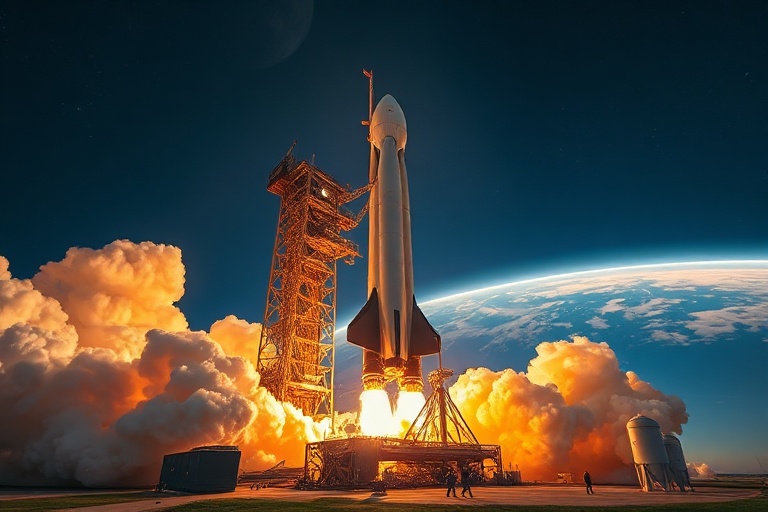
spacex starship rocket launch
The third integrated flight test of SpaceX’s Starship on March 14, 2024, marked another milestone in humanity’s quest to become a multi-planetary species. Rising from the launchpad at Starbase in Boca Chica, Texas, the fully stacked 394-foot-tall rocket soared into the clear morning sky, capturing global attention not just for its raw power but for what it represents—a potential revolution in space travel.
The test flight, though ending in the loss of the vehicle during re-entry, demonstrated significant progress. Unlike traditional aerospace programs that prioritize gradual, incremental milestones, Starship’s rapid iterative approach has redefined how the world views spaceflight. It’s not just about reaching orbit anymore; it’s about doing so with unprecedented scale, affordability, and speed.
The Vision Behind Starship
Elon Musk’s SpaceX conceived Starship as a fully reusable, super heavy-lift launch vehicle designed to carry both crew and cargo to Earth orbit, the Moon, Mars, and beyond. With a payload capacity of up to 150 metric tons to low Earth orbit, Starship dwarfs most rockets in operation today, including NASA’s Space Launch System (SLS).
What sets Starship apart is its ambition to slash the cost of space access by orders of magnitude. Traditional expendable rockets discard millions of dollars in hardware with every launch. Starship, by contrast, is built to be fully reusable—its Super Heavy booster and Starship upper stage are both designed to land, refuel, and fly again. This philosophy aligns with Musk’s long-term vision: making life interplanetary by making space travel routine and affordable.
Culturally, Starship has become a symbol of 21st-century innovation. It embodies the Silicon Valley ethos of disruption, merging aerospace engineering with software-like iteration cycles. While NASA’s Artemis program aims to return humans to the Moon using more traditional methods, SpaceX’s approach is radical—fast, iterative, and driven by data rather than decades-long development timelines.
Global Reactions and Collaborations
The Starship program has sparked international interest. NASA, despite its own competing lunar ambitions, has invested over $4 billion in Starship as part of the Artemis program. The agency plans to use a modified Starship as the Human Landing System (HLS) for the Artemis III and IV missions, aiming to land astronauts near the lunar south pole as early as 2026. This collaboration highlights a rare alignment between a legacy government agency and a private company pushing boundaries.
Internationally, reactions have been mixed. In Europe, officials at the European Space Agency (ESA) have expressed both admiration and concern. Admiration for the technological leap, but concern over market disruption. Europe’s Ariane 6 rocket, still in development, faces an uncertain future as Starship promises lower launch costs. Meanwhile, in Japan and India, space agencies are closely monitoring Starship’s progress, seeing potential for future partnerships or even competition.
In China, state media has alternated between skepticism and strategic observation. While China’s own space program, including the Long March rocket family and plans for lunar bases, progresses steadily, there is recognition that a fully reusable, high-capacity rocket like Starship could shift the global balance of power in space access.
A Cultural Shift in Space Narratives
The rise of Starship coincides with a broader cultural shift in how humanity imagines its future among the stars. Science fiction has long portrayed space travel as the domain of governments and large corporations. But Starship—and SpaceX more broadly—has democratized the narrative. The company’s live streams, social media presence, and even meme-worthy moments (like the launchpad explosion in 2023) have made space exploration feel immediate and accessible.
This accessibility has resonated globally. In Africa, where many nations are just beginning to develop space programs, Starship serves as both inspiration and a challenge. The continent’s growing space sector, including countries like Nigeria, Kenya, and South Africa, now faces a new benchmark: can they compete with a rocket that promises to reduce the cost of sending satellites to orbit by a factor of ten?
Even in pop culture, Starship has left its mark. From its appearances in video games like Kerbal Space Program to frequent references in online communities, the rocket has become a cultural touchstone—representing both the promise and peril of modern technological ambition.
Technical Challenges and Environmental Considerations
Despite its promise, Starship’s development has not been without controversy. The rocket’s fuel—liquid methane and oxygen—offers advantages in reusability and efficiency but raises environmental questions. Methane is a potent greenhouse gas, and the sheer scale of Starship’s operations at Boca Chica has drawn scrutiny from environmental groups concerned about local ecosystems and air quality.
SpaceX has worked to address these concerns, implementing mitigation strategies such as scrubbers to reduce methane emissions and collaborating with conservation groups to monitor wildlife. Still, the environmental impact of frequent, large-scale rocket launches remains an open question as the company scales up operations.
Technically, Starship’s flight tests have revealed critical challenges. The first two integrated flights ended in explosions—one during ascent, another during stage separation. While these were expected in a development program, they underscore the complexity of building a fully reusable rocket. Engineers at SpaceX have attributed the failures to issues like fuel slosh, engine reliability, and heat shield performance, all of which are being addressed in subsequent iterations.
Looking ahead, the next phase of testing will focus on in-orbit refueling, a critical capability for missions to Mars. Without the ability to transfer propellant between Starship vehicles in space, long-duration missions to the Red Planet remain out of reach. This technology, known as orbital refueling, has never been demonstrated at scale, adding another layer of technical risk.
What Comes Next?
The timeline for Starship’s operational readiness remains fluid. SpaceX has suggested that the rocket could begin commercial satellite launches as early as 2024, followed by crewed missions in the late 2020s. A crewed lunar flyby, similar to NASA’s Apollo 8 mission, is also under consideration.
Yet, the path forward is not solely technical. Regulatory hurdles, international competition, and public perception will all play a role. The Federal Aviation Administration (FAA), which oversees U.S. launch licenses, has already imposed extensive environmental and safety reviews. As Starship’s cadence of launches increases, these regulatory frameworks will need to evolve.
For the broader space community, Starship represents more than just a rocket. It is a catalyst—a force that is accelerating innovation across the industry. From reusable upper stages to rapid prototyping, many of Starship’s technologies are being adopted by competitors and startups alike. This ripple effect is already visible in companies like Relativity Space and Rocket Lab, both of which are developing partially reusable launch systems inspired by SpaceX’s approach.
The third flight test may not have achieved all its objectives, but it moved the needle forward. The loss of the vehicle during re-entry, while disappointing, provided invaluable data that will refine the next iteration. In the grand timeline of spaceflight, these setbacks are not failures—they are milestones.
Conclusion: A Rocket for the Future
Starship is more than an engineering marvel; it is a cultural artifact of our time—a symbol of human ambition in an era defined by rapid technological change. Its success would not only redefine space exploration but also reshape global power dynamics, economic opportunities, and even our collective imagination of what is possible.
As SpaceX continues to iterate, the world watches. Whether Starship ultimately fulfills its promise remains to be seen, but its journey has already transformed the conversation around spaceflight. It has shown that the future of space is not a distant dream reserved for governments and billionaires—it is being built today, launch by launch, in the dust and fire of a remote Texas shoreline.
For those following humanity’s journey to the stars, that is reason enough to pay attention.
Explore more about space innovation and technology on our Science page. For insights into how space exploration intersects with global culture, visit our Culture section.