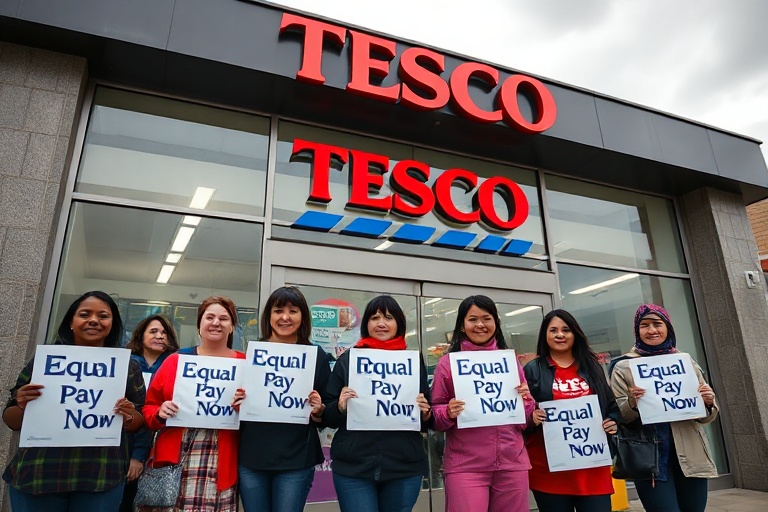
Tesco Equal Pay Ruling: A Global Turning Point for Workers’ Rights
Tesco’s Legal Battle Over Equal Pay Reaches a Critical Juncture
In a landmark decision that reverberated across the retail sector, Tesco’s appeal against an equal pay ruling has been rejected by the UK’s highest court. The case, which began nearly a decade ago, centered on allegations that the supermarket giant underpaid predominantly female shopfloor staff while paying male counterparts in distribution centers significantly more for comparable roles. The Supreme Court’s refusal to entertain Tesco’s final appeal in October 2023 marked a definitive victory for workers advocating pay equity, setting a precedent that could influence similar disputes worldwide.
This legal saga unfolded against the backdrop of growing global scrutiny over gender pay disparities. Countries from Germany to the United States have seen similar battles play out in courtrooms and boardrooms, where the fight for equal compensation has become a defining labor issue of the 21st century. Tesco’s case, however, stands out due to the sheer scale of its workforce—over 200,000 employees—and the potential ripple effects on multinational corporations grappling with comparable claims.
The Origins of the Dispute: How It All Started
The conflict traces back to 2016, when a group of Tesco shop workers, represented by the union Usdaw, filed a claim arguing that their roles were of equal value to those performed by higher-paid male colleagues in distribution and warehouse positions. The claimants pointed to the 2010 Equality Act, which mandates equal pay for work of equal value, regardless of gender. Initially, Tesco contested the claim, arguing that the jobs were not comparable due to differences in location and working conditions.
However, an employment tribunal in 2019 sided with the workers, ruling that Tesco’s pay structure was discriminatory. The tribunal’s decision was grounded in evidence showing that male employees in distribution centers earned up to £3 an hour more than female shop staff, despite the roles being deemed equivalent. Tesco appealed the ruling multiple times, but each challenge was ultimately dismissed, culminating in the Supreme Court’s refusal to hear the case—a move that effectively closed the door on further legal avenues for the retailer.
For labor advocates, the ruling was a watershed moment. It reinforced the principle that systemic pay discrimination cannot be justified by operational or logistical arguments. The case also highlighted the persistent gender pay gap in sectors traditionally dominated by women, such as retail, where roles are often undervalued despite their critical importance to the economy.
A Global Perspective: Equal Pay Battles Beyond the UK
The Tesco case is not an isolated incident. Around the world, workers are challenging pay disparities through legal and collective action. In the United States, for example, the push for equal pay has gained momentum in recent years, with states like California and New York passing stringent laws to close the gender wage gap. The #MeToo movement further amplified these efforts, emboldening employees to speak out against inequities in the workplace.
In Europe, the issue has taken on a continental dimension. The European Union’s 2023 Pay Transparency Directive requires companies to disclose gender pay gaps and take corrective action if disparities exceed 5%. Countries like Iceland and Norway have gone even further, implementing mandatory equal pay certifications for businesses. Meanwhile, in Asia, progress has been slower but notable. Japan, which has one of the widest gender pay gaps among developed nations, has seen a surge in lawsuits targeting corporations like Toshiba and Panasonic for discriminatory pay practices.
- United Kingdom: The Tesco ruling has emboldened other retail workers to file similar claims. Companies like Sainsbury’s and Asda are currently facing equal pay litigation, with potential payouts running into billions.
- United States: The Biden administration has prioritized pay equity, with the Equal Pay Act of 2023 strengthening protections for workers. High-profile cases, such as the lawsuit against Walmart, have drawn national attention.
- Germany: Retail giant Lidl faced a class-action lawsuit in 2022, resulting in a €1.5 billion settlement for female employees. The case underscored the risks of ignoring pay equity in male-dominated industries.
- Japan: With a gender pay gap of 24.5% (as of 2023), activists are pushing for legal reforms. The government has pledged to reduce the gap to 15% by 2030, but progress remains uneven.
The Tesco case serves as a cautionary tale for multinational corporations. The ruling demonstrates that legal victories for workers are not just possible but increasingly likely, particularly in jurisdictions with robust labor protections. For companies operating across borders, the implications are clear: ignoring pay equity is no longer a viable strategy. Instead, proactive measures—such as regular pay audits and transparent compensation policies—are essential to mitigating legal and reputational risks.
What This Means for Workers and Employers Moving Forward
For the thousands of Tesco employees who initiated the claim, the Supreme Court’s decision is more than a legal victory; it is a vindication of their fight for fairness. The next phase will focus on calculating the back pay owed to affected workers, a process that could take years and cost Tesco hundreds of millions. The retailer has already set aside £2.5 billion to cover potential payouts, a figure that underscores the financial stakes of such disputes.
Beyond Tesco, the ruling sends a powerful message to employers. Pay equity is no longer a peripheral issue but a core component of corporate responsibility. Companies that fail to address disparities risk not only legal consequences but also damage to their brand and employee morale. In an era where workers increasingly prioritize ethical practices, pay equity can be a competitive advantage—or a liability.
For policymakers, the Tesco case highlights the need for stronger legal frameworks. While some countries have made strides in closing the gender pay gap, others lag behind. The International Labour Organization estimates that at the current rate, it will take another 60 years to achieve global pay equity. To accelerate progress, governments must collaborate with unions and businesses to implement enforceable standards.
The fight for equal pay is far from over, but the Tesco ruling is a significant step forward. It proves that when workers stand together, they can challenge even the most entrenched inequalities. As the retail sector—and indeed the global economy—continues to evolve, the lessons from this case will resonate for decades to come.
The Broader Cultural Shift: Why Pay Equity Matters
At its core, the Tesco case is about more than wages; it is about recognition. For decades, jobs traditionally held by women—such as cashiers, cleaners, and care workers—have been undervalued, both financially and socially. The pandemic further exposed this disparity, as frontline workers in these roles risked their lives for poverty-level wages while being celebrated as “essential.” The legal battle at Tesco forces society to confront an uncomfortable truth: the devaluation of women’s work is not an accident but a systemic issue.
Culturally, the case has sparked conversations about the value we place on different types of labor. In many societies, care work, teaching, and service roles are seen as “naturally” suited to women, which has historically justified lower pay. The Tesco ruling challenges this narrative by affirming that such roles are not only comparable to others but deserve equal compensation. This shift in perspective is critical for dismantling the gendered hierarchies that have shaped labor markets for generations.
Moreover, the case has inspired a new generation of activists. Young workers, particularly in Gen Z, are entering the workforce with a keen awareness of social justice issues. They are more likely to demand transparency from employers and to unionize when necessary. The Tesco ruling validates their concerns and gives them a powerful tool to fight for their rights.
As we look to the future, the Tesco case serves as a reminder that progress is possible, but it requires persistence. Legal victories are important, but they are only the first step. True change will come when pay equity is embedded in the fabric of our economies and cultures. Until then, battles like Tesco’s will continue to be fought—not just in courtrooms, but in workplaces, boardrooms, and on the streets.
Conclusion: A Landmark Moment with Global Implications
The Supreme Court’s rejection of Tesco’s appeal is a defining moment in the fight for equal pay. It is a victory for workers, a warning to employers, and a call to action for policymakers. While the financial and legal repercussions for Tesco will unfold in the coming years, the broader significance of this ruling cannot be overstated. It has set a precedent that will influence similar cases for generations, both in the UK and abroad.
For employees, the message is clear: when you stand together, you can challenge even the most powerful institutions. For employers, the lesson is equally stark: ignoring pay equity is no longer an option. And for society, the Tesco case is a reminder that the fight for fairness is ongoing—and that every victory, no matter how hard-won, brings us one step closer to justice.
As the retail sector and beyond grapple with the aftermath of this ruling, one thing is certain: the conversation about equal pay is far from over. It is a conversation that will shape the future of work, the economy, and our collective values for decades to come.
For those interested in exploring similar labor disputes or the broader implications of pay equity, News and Business sections on Dave’s Locker offer further insights into these critical issues.