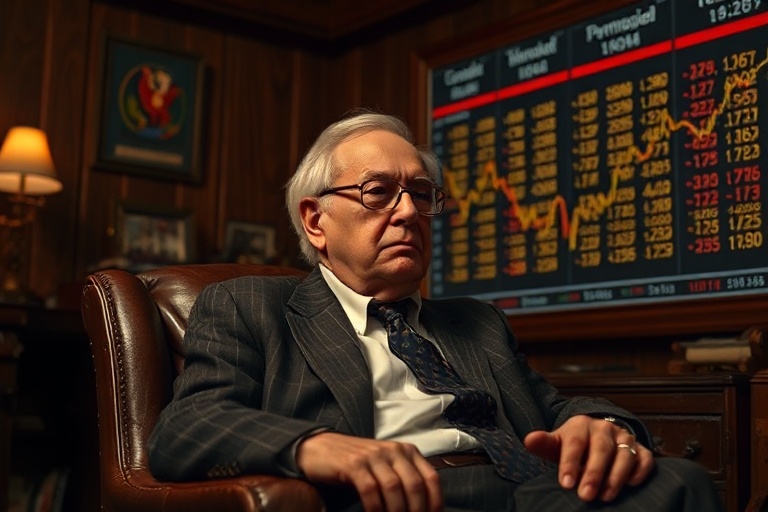
Warren Buffett’s Market Warning: A Cautionary Tale for Global Investors
Warren Buffett, the legendary investor and CEO of Berkshire Hathaway, has once again sounded the alarm about the stock market’s long-term outlook. His recent remarks, delivered during Berkshire’s annual shareholder meeting, reflect growing concerns about valuation levels, economic uncertainty, and the potential for prolonged volatility. While Buffett has always emphasized patience and discipline in investing, his latest warnings carry extra weight given the current global economic climate—marked by high interest rates, geopolitical tensions, and shifting consumer behaviors.
Buffett’s comments are not just directed at U.S. investors. The ripple effects of a potential market correction could be felt worldwide, particularly in emerging economies where capital flows are highly sensitive to changes in global risk appetite. His perspective offers a sobering counterpoint to the optimism that often surrounds periods of market expansion. For those who have grown accustomed to steady gains, his words serve as a reminder that markets are cyclical—and history suggests that complacency can be costly.
The Roots of Buffett’s Caution
Buffett’s skepticism about stretched valuations isn’t new. He has long warned against the dangers of speculative bubbles, famously stating, “Be fearful when others are greedy, and greedy when others are fearful.” His current concerns stem from several key factors:
- Record-high corporate debt levels: Many companies have taken advantage of low interest rates to borrow heavily, which could become unsustainable as rates remain elevated.
- Valuation multiples that defy historical norms: Certain sectors, particularly technology and AI-related stocks, are trading at valuations that exceed their long-term earnings potential.
- Geopolitical instability: Conflicts in Eastern Europe and the Middle East, along with trade tensions between major economies, add layers of unpredictability to global markets.
- Central bank policy divergence: The Federal Reserve’s restrictive monetary policy contrasts with easing measures in other regions, creating currency and capital flow volatility.
These conditions mirror past periods when Buffett advised caution. For instance, in the late 1990s, he famously avoided tech stocks despite their surging popularity. His approach paid off when the dot-com bubble burst. Similarly, after the 2008 financial crisis, he deployed Berkshire’s massive cash reserves to invest in undervalued assets—a strategy that reinforced his reputation as a contrarian investor.
Global Implications: Why Buffett’s Warning Resonates Beyond U.S. Markets
The interconnected nature of today’s financial system means that a significant market downturn in the U.S. would likely trigger a global sell-off. Emerging markets, which rely on foreign investment for growth, could face capital flight and currency depreciation. Countries with high external debt, such as those in Latin America or Southeast Asia, may struggle to refinance obligations, leading to economic instability.
Buffett’s warning also highlights the psychological dimension of investing. In an era where retail trading has surged—fueled by social media and commission-free platforms—momentum-driven strategies can amplify market swings. Retail investors, often less experienced than institutional players, may find themselves caught in the crossfire of a correction. This dynamic was evident during the meme-stock frenzy of 2021, when volatile trading patterns disrupted traditional valuation models.
Moreover, Buffett’s emphasis on long-term value investing contrasts sharply with the short-termism that dominates much of today’s market discourse. His approach encourages investors to focus on a company’s fundamentals rather than day-to-day price movements. This philosophy is particularly relevant in regions where economic growth is tied to productivity and innovation rather than speculative bets.
How Investors Are Responding to Buffett’s Advice
While Buffett’s warnings are not a call to abandon the market entirely, they do suggest a need for recalibration. Investors are adopting various strategies in response to his caution:
- Increased allocation to defensive sectors: Industries like utilities, healthcare, and consumer staples tend to perform better during economic downturns. Buffett himself has historically favored these sectors for their stability.
- Diversification across asset classes: Holding a mix of stocks, bonds, and alternative investments can reduce exposure to any single market’s volatility. Gold and other precious metals are often cited as hedges during uncertain times.
- Focus on cash and liquidity: Buffett has emphasized the importance of maintaining a strong cash position to capitalize on opportunities when others are forced to sell. This strategy requires discipline but can provide a significant advantage during market dislocations.
- Global rotation toward undervalued markets: Some investors are looking beyond traditional U.S. equities to regions where valuations remain attractive. Countries with lower debt levels and stronger growth prospects, such as parts of Southeast Asia or Eastern Europe, are drawing renewed interest.
For individual investors, Buffett’s advice underscores the importance of aligning one’s portfolio with personal risk tolerance and long-term goals. Panic selling during a downturn can lock in losses, while a well-considered strategy can turn volatility into opportunity. His approach is not about avoiding risk altogether but about managing it intelligently.
A Historical Perspective: Lessons from Past Corrections
Buffett’s warnings are rooted in decades of market experience. A look back at history reveals that his cautionary stance is often vindicated. For example:
- The 1973-74 stock market crash: Buffett’s early investments in undervalued stocks during this period laid the foundation for Berkshire Hathaway’s future success.
- The 2000 dot-com bubble: While many investors chased tech stocks to unsustainable highs, Buffett avoided the sector entirely, preserving capital for future opportunities.
- The 2008 financial crisis: Buffett’s investments in Goldman Sachs and other distressed assets demonstrated the value of contrarian thinking when others were fleeing the market.
These examples illustrate that Buffett’s warnings are not driven by pessimism but by a deep understanding of market cycles. His ability to remain patient while others chase short-term gains has been a hallmark of his success. For today’s investors, his message is clear: the best time to prepare for a downturn is before one occurs.
What’s Next? Balancing Optimism with Prudence
Despite his caution, Buffett has not suggested that investors should abandon the market entirely. Instead, he advocates for a balanced approach—one that acknowledges both the opportunities and risks that lie ahead. The key is to remain vigilant without succumbing to fear.
For those looking to navigate the current environment, Buffett’s advice can be distilled into a few actionable steps:
- Review your portfolio: Ensure that your investments align with your long-term objectives and risk tolerance. Avoid chasing trends that may not be sustainable.
- Stay informed: Keep an eye on economic indicators, central bank policies, and geopolitical developments. These factors can provide early signals of shifting market conditions.
- Seek professional guidance: If you’re unsure about how to adjust your strategy, consider consulting a financial advisor who can provide personalized advice.
- Focus on quality: Prioritize companies with strong balance sheets, competitive advantages, and proven management teams. These attributes are often rewarded in the long run.
Buffett’s latest warnings serve as a reminder that investing is not a game of chance but a discipline that rewards patience and prudence. In a world where markets are increasingly influenced by algorithmic trading, social media, and global events, his message is more relevant than ever.
As the world continues to grapple with economic uncertainty, Buffett’s perspective offers a grounding force. His approach is not about predicting the future but about preparing for it. For investors willing to listen, his warnings could be the difference between riding out a storm and being swept away by it.