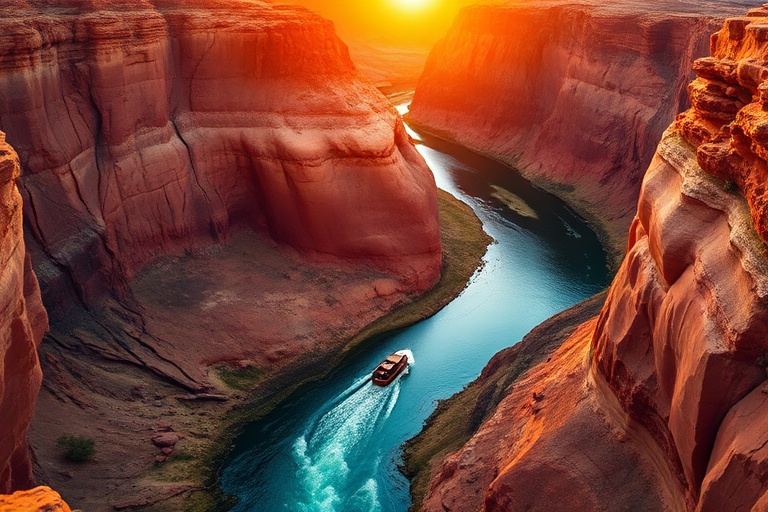
The Colorado River: A Lifeline Under Strain
The Colorado River stretches 1,450 miles from the Rocky Mountains to the Sea of Cortez, carving through some of the most iconic landscapes in North America. Over the past century, this river has become the backbone of the American West, sustaining cities like Phoenix, Las Vegas, and Los Angeles, as well as vast agricultural regions. Yet, its future is increasingly uncertain as climate change, overuse, and political disputes threaten its very existence.
Once a wild and unpredictable force, the Colorado River has been tamed by a network of dams, reservoirs, and canals that transformed the arid Southwest into a habitable—and thriving—region. The Hoover Dam alone, completed in 1936, symbolizes humanity’s ambition to conquer nature. But this control comes at a cost. The river now supports over 40 million people, irrigates millions of acres of farmland, and generates billions of dollars in economic activity. Without it, the economic and social fabric of the region could unravel.
A Shared Resource in Crisis
The Colorado River is not just an American river—it’s a shared resource that flows through seven U.S. states and Mexico. The 1922 Colorado River Compact divided the river’s water among these entities, but the agreement was based on overly optimistic estimates of its flow. Today, the river’s average annual flow has decreased by nearly 20% since the compact was signed, a trend that scientists attribute to rising temperatures and prolonged drought.
In 2023, federal officials took unprecedented steps to address the crisis, announcing cuts to water deliveries for Arizona, Nevada, and Mexico. These reductions, though necessary, have sparked tensions among states that have long relied on the river’s bounty. California, with its senior water rights, has resisted deeper cuts, while smaller states argue they are being unfairly penalized. The situation has forced policymakers to confront a harsh reality: the Colorado River’s supply cannot meet its demand.
The river’s challenges extend beyond the U.S. In Mexico, the Colorado River Delta has been reduced to a fraction of its former size, devastating ecosystems and local communities. Efforts to restore parts of the delta have shown promise, but they require cooperation across borders—a rare commodity in today’s geopolitical climate.
Cultural and Environmental Significance
The Colorado River is woven into the cultural identity of the American West. Indigenous tribes, including the Navajo, Hopi, and Mojave, have depended on the river for centuries, and their water rights remain a contentious issue. Sacred sites along the river, such as the Grand Canyon, hold deep spiritual significance, yet their preservation is often at odds with development and resource extraction.
The river also plays a crucial role in the region’s biodiversity. It sustains species like the humpback chub and the razorback sucker, both endangered due to habitat loss and invasive species. Conservation groups have worked for decades to restore these species, but their efforts are undermined by the river’s shrinking flows and the proliferation of dams that block migration routes.
Artists, writers, and filmmakers have long been captivated by the Colorado River’s stark beauty and raw power. Authors like Edward Abbey and Edward Curtis immortalized its landscapes, while photographers like Ansel Adams captured its rugged grandeur. Today, the river continues to inspire, but its future hangs in the balance, leaving many to wonder what will be left for the next generation to admire.
Innovative Solutions for a Sustainable Future
Addressing the Colorado River’s crisis will require innovative thinking and unprecedented cooperation. One promising approach is water recycling, which treats wastewater for reuse in agriculture and urban areas. Cities like Los Angeles and San Diego have invested heavily in these technologies, reducing their reliance on the river.
Agriculture, which consumes about 80% of the river’s water, is another focus. Farmers are adopting more efficient irrigation techniques, such as drip irrigation and soil moisture sensors, to reduce waste. Some are even transitioning to less water-intensive crops, though economic incentives often discourage such changes.
Desalination is another potential solution, though it remains energy-intensive and costly. Advances in technology could make it a viable option in the future, particularly for coastal communities. Meanwhile, groundwater recharge projects aim to replenish aquifers depleted by over-pumping, offering a buffer against drought.
But technology alone won’t solve the problem. Policymakers must also address the structural inequities in water allocation. Indigenous tribes, for example, have historically been sidelined in water management decisions. Recognizing their rights and involving them in negotiations could lead to more equitable and sustainable solutions.
Ultimately, the Colorado River’s fate will depend on whether society can prioritize long-term sustainability over short-term convenience. The river has sustained life in the desert for millennia, but its resilience is not infinite. The choices made today will determine whether it continues to flow—or whether it becomes a relic of a bygone era.
Key Takeaways
- The Colorado River supports over 40 million people and $1.4 trillion in economic activity annually.
- Climate change has reduced the river’s average flow by nearly 20% since the 1922 Compact was signed.
- Water cuts in 2023 marked the first time in history that reductions were imposed on all major users.
- Indigenous tribes, agriculture, and ecosystems all face existential threats due to the river’s decline.
- Innovative solutions like water recycling and desalination offer hope but require significant investment and cooperation.
As the Colorado River’s crisis deepens, it serves as a stark reminder of the fragility of our natural resources. The American West’s growth was built on the assumption of abundance, but that assumption is no longer valid. The river’s story is not just one of environmental decline—it’s a call to action for a society willing to rethink its relationship with water, land, and each other.
For those interested in exploring the intersection of culture and environmentalism, our culture section delves into how communities around the world are adapting to similar challenges.
To learn more about the science behind water management, visit our science category, where experts break down the complexities of hydrology and policy.