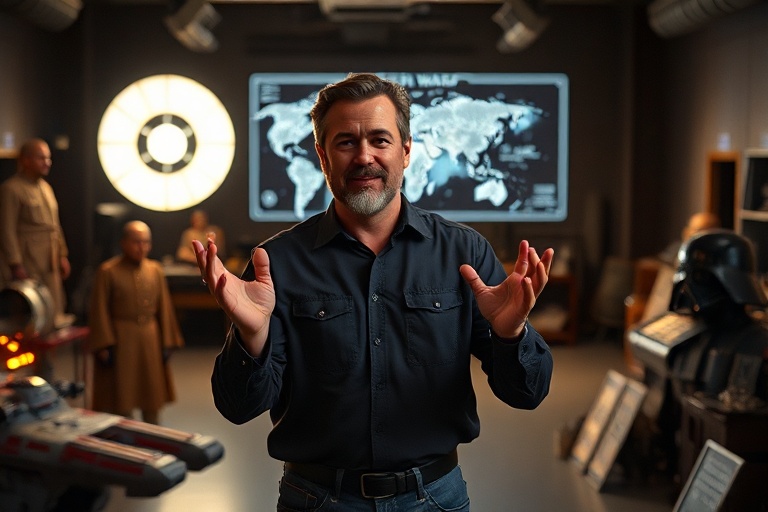
Dave Filoni: The Visionary Shaping Star Wars’ Future
Dave Filoni: The Architect of Modern Star Wars Storytelling
Dave Filoni has quietly reshaped one of the most influential franchises in pop culture history. As a director, writer, and executive producer, his work on Star Wars: The Clone Wars, Star Wars Rebels, The Mandalorian, and Ahsoka has earned him a reputation as the most important creative force in Star Wars since George Lucas himself. His influence extends beyond the screen, shaping how audiences engage with the franchise across television, film, and digital platforms.
Filoni’s career is a study in persistence and vision. He entered the entertainment industry with a background in animation and a deep love for Star Wars, which he cultivated through fan films and early work at Lucasfilm. Over two decades, he has evolved from an aspiring filmmaker to the steward of Star Wars’ animated legacy, ensuring that the stories of characters like Anakin Skywalker, Ahsoka Tano, and Din Djarin resonate with both longtime fans and new generations.
The Early Years: From Aspiring Filmmaker to Lucasfilm
Born in Mount Lebanon, Pennsylvania, in 1974, Filoni’s fascination with Star Wars began in childhood. He devoured the original trilogy and, like many fans, dreamed of contributing to the galaxy far, far away. After studying film at the University of Arizona, he honed his skills in animation, working on projects like Avatar: The Last Airbender and Avatar: The Legend of Korra. These experiences taught him the importance of character-driven storytelling—an approach that would later define his Star Wars work.
Filoni’s break came in 2005 when he was hired by Lucasfilm to oversee Star Wars: The Clone Wars, the animated series intended to bridge the gap between Attack of the Clones and Revenge of the Sith. At the time, skepticism surrounded the project, with many questioning whether another Star Wars story could feel fresh. Filoni, however, saw an opportunity to expand the saga beyond the films, focusing on the war’s emotional toll and the personal journeys of its characters.
Reviving Star Wars Animation: A New Era for the Franchise
When The Clone Wars premiered in 2008, it was met with mixed reviews. Critics argued that the animation style was too stylized, and the storytelling too serialized for casual viewers. Yet Filoni’s commitment to depth over spectacle paid off. Over seven seasons, he transformed the series into a critical darling, introducing Ahsoka Tano—a fan-favorite character who became the emotional core of the franchise. Ahsoka’s journey, from a brash young Padawan to a fully realized hero, mirrored Filoni’s own growth as a storyteller.
The success of The Clone Wars paved the way for Star Wars Rebels, which premiered in 2014. Set between Revenge of the Sith and A New Hope, the series followed a ragtag crew of rebels fighting against the Galactic Empire. Filoni again prioritized character arcs, particularly those of Ezra Bridger and Kanan Jarrus, while weaving in deeper connections to the Skywalker saga. The show’s blend of episodic adventures and serialized storytelling proved that Star Wars could thrive in animation, not just in live-action.
Transition to Live-Action: The Mandalorian and Beyond
Filoni’s transition from animation to live-action was seamless, thanks to his deep understanding of Star Wars’ mythology. When Jon Favreau approached him to develop The Mandalorian for Disney+, Filoni brought his signature blend of lore and emotion to the project. The series, set after Return of the Jedi, introduced Din Djarin, a lone bounty hunter navigating a galaxy still recovering from war. The show’s success—both critically and commercially—proved that Filoni could adapt his storytelling to live-action without losing the heart of the franchise.
Filoni’s role in The Mandalorian extended beyond directing. As an executive producer, he helped shape the series’ larger narrative, including the introduction of Grogu (Baby Yoda) and the expansion of the Star Wars universe. His influence is evident in the show’s tone, which balances humor, action, and emotional depth—a hallmark of his work. This approach has made The Mandalorian one of the most-watched series on Disney+, cementing Filoni’s status as a key figure in modern television.
The Global Impact of Star Wars Under Filoni
Filoni’s work has had a profound cultural impact, particularly in how Star Wars is perceived outside the United States. While the franchise has always had a global fanbase, Filoni’s storytelling has helped it resonate more deeply with international audiences. For example, The Clone Wars and Rebels were widely popular in Europe and Asia, where serialized storytelling is more common in television. His emphasis on character development over spectacle has made Star Wars more accessible to viewers who might not typically engage with blockbuster franchises.
In Latin America, The Mandalorian has been particularly well-received, with local adaptations and fan communities thriving in countries like Mexico and Brazil. Filoni’s inclusion of diverse characters and settings—such as the planet Mandalore, inspired by real-world cultures—has also helped Star Wars feel more inclusive. This global appeal is reflected in the franchise’s box office and streaming numbers, which continue to grow year over year.
Legacy and Future: What’s Next for Dave Filoni?
As Star Wars continues to expand, Filoni’s role is more critical than ever. He is currently involved in multiple projects, including Ahsoka, a live-action series that will delve deeper into the titular character’s story. Fans can also expect more collaborations with Jon Favreau and Kathleen Kennedy, as well as potential future films and series that will further explore the galaxy’s untold stories.
Filoni’s legacy is not just in the projects he has helmed but in the way he has redefined what Star Wars can be. He has shown that the franchise is not bound by the constraints of its past but can evolve with the times. Whether through animation or live-action, his work remains rooted in the core themes of hope, redemption, and the power of storytelling.
For aspiring filmmakers and Star Wars fans alike, Dave Filoni’s journey offers a blueprint for turning passion into impact. His ability to balance tradition with innovation has ensured that the galaxy far, far away remains as vibrant as ever.
Filoni’s Creative Process: A Behind-the-Scenes Look
Filoni’s approach to storytelling is methodical and collaborative. He often starts with a central theme or emotional core, building the plot around it. For example, The Clone Wars was driven by Anakin Skywalker’s fall to the dark side, while The Mandalorian focused on Din Djarin’s quest to protect Grogu. This thematic focus ensures that even the most action-packed episodes feel meaningful.
Collaboration is also key to Filoni’s process. He frequently works with writers, animators, and actors to refine his vision. For instance, during the production of The Mandalorian, Filoni and Favreau held extensive discussions to ensure the show’s tone aligned with the larger Star Wars mythology. This teamwork has been instrumental in maintaining consistency across the franchise.
Filoni is also known for his hands-on involvement in every aspect of production, from storyboarding to editing. His background in animation gives him a keen eye for visual storytelling, which he applies to live-action as well. Whether he’s directing an episode or overseeing post-production, his attention to detail is evident in every frame.
Why Filoni’s Work Matters Beyond Star Wars
Filoni’s impact extends beyond the Star Wars universe. His success has demonstrated the value of serialized storytelling in modern television, influencing other franchises to adopt deeper, more interconnected narratives. Shows like The Witcher and Stranger Things have benefited from this approach, proving that audiences crave stories with emotional depth and long-term payoff.
Additionally, Filoni’s work has highlighted the importance of diversity in storytelling. By introducing characters like Ahsoka Tano and Sabine Wren—who are not only strong but also culturally distinct—he has helped pave the way for more inclusive representation in mainstream entertainment. This shift is not just a trend but a necessary evolution in how stories are told.
As Star Wars continues to grow, Filoni’s role will be pivotal in shaping its future. Whether through new series, films, or even video games, his influence will be felt for generations to come. For fans, his work is a reminder that great storytelling is about more than just spectacle—it’s about heart, connection, and the power of a well-told tale.