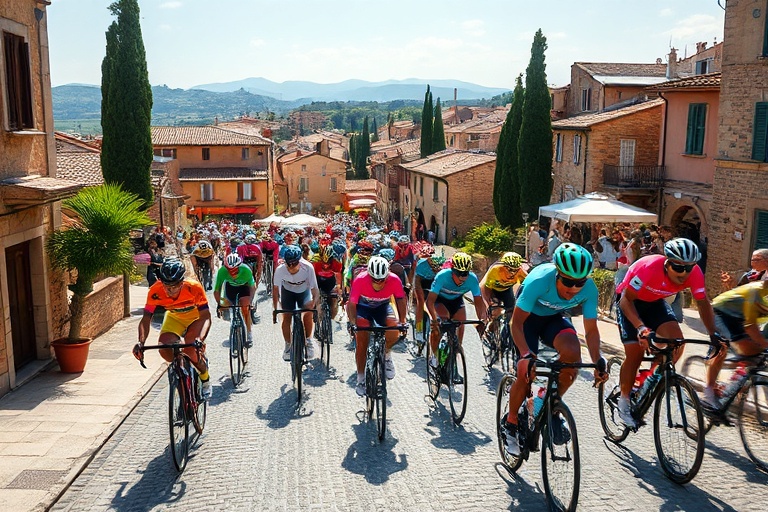
giro d’italia
The Giro d’Italia isn’t just a race—it’s a three-week odyssey through the soul of Italy, where cyclists confront the country’s most brutal climbs, endure its unpredictable weather, and push their bodies to the absolute limit. Now in its 106th edition, the Giro has evolved from a post-World War I propaganda tool into one of cycling’s most prestigious Grand Tours. Its story weaves together history, culture, and human endurance, making it far more than just a sporting event.
The Origins: From Political Tool to Sporting Legend
The Giro d’Italia was born in 1909, conceived by the Gazzetta dello Sport newspaper as a way to boost circulation during a time when Italian cycling was in decline. The first edition covered 2,448 kilometers over eight stages, with the winner, Luigi Ganna, taking home 5,325 lire—a life-changing sum at the time. The race quickly became a symbol of national pride, especially during the fascist era when Benito Mussolini used it to promote his regime’s ideals of strength and vitality.
Yet despite its political origins, the Giro developed its own identity. The introduction of iconic climbs like the Passo dello Stelvio and the Gavia Pass in the 1950s and 60s transformed it into a true test of a cyclist’s mettle. These brutal ascents, often above 2,000 meters with gradients exceeding 10%, became the stuff of legend, separating the contenders from the pretenders.
A Race Defined by Its Challenges
The Giro’s reputation for brutality is well-earned. Unlike the Tour de France, with its relatively predictable stages, the Giro thrives on unpredictability. Riders face everything from snowy mountain passes in May to sweltering heat in the south. The infamous “Giro Killer” stages often feature multiple hors catégorie climbs in a single day, where a single mistake can cost a rider dearly.
The race’s route changes annually, but it always includes a mix of:
- High-altitude finishes: Stages ending at mountain refuges like the Passo dello Stelvio (2,758m) or the Colle delle Finestre (2,176m), where the thin air and steep gradients test even the fittest riders.
- Time trials: Short, punchy efforts like the 2023 stage in Cesena, where aerodynamic positioning and raw power determine the outcome.
- Cobbled sections: Rare but brutal stretches of pavement that force riders to navigate treacherous terrain while maintaining speed.
- Sprinters’ stages: Flat, fast runs along the Adriatic coast or through the Po Valley, where teams vie for stage wins in chaotic bunch finishes.
The Heroes of the Giro: Icons Who Defined an Era
Few sporting events can boast a roster of champions as storied as the Giro’s. From Alfredo Binda, who won five editions in the 1920s and 30s, to Eddy Merckx, who claimed his first Giro in 1968 and went on to dominate cycling like no other, the race has been a proving ground for legends. More recently, riders like Vincenzo Nibali, Nairo Quintana, and Tadej Pogačar have etched their names into Giro history with performances that blend tactical brilliance and sheer willpower.
One of the most dramatic moments came in 1999, when Marco Pantani—already a Giro champion in 1998—launched a solo attack on the Passo di Gavia, a climb so steep that the snow hadn’t yet melted in May. His 58-kilometer solo ride remains one of the most iconic moments in cycling history, a testament to the Giro’s ability to produce unforgettable drama.
The Pink Jersey: Symbol of Suffering and Triumph
The maglia rosa, or pink jersey, is the Giro’s most coveted prize. Introduced in 1931, the jersey’s color was chosen to match the pages of the Gazzetta dello Sport. Wearing it isn’t just about leading the race—it’s about enduring the suffering that comes with protecting it. Riders who don the maglia rosa must balance aggression with caution, knowing that a single bad day can cost them everything.
Some riders have made the pink jersey their own. Fausto Coppi, the “Campionissimo,” won it five times and dominated the Giro in the 1940s and 50s with a style so effortless it seemed inhuman. More recently, Chris Froome’s 2018 victory—despite a late crash and a fractured wrist—showed the Giro’s ability to reward resilience above all else.
The Giro’s Broader Impact: Beyond the Race
The Giro d’Italia isn’t just a sporting event; it’s a cultural phenomenon that shapes the regions it passes through. Host towns and villages experience an economic boost, with hotels, restaurants, and local businesses thriving during the three-week spectacle. The race also serves as a platform for social and environmental causes, with stages often dedicated to raising awareness about sustainability, health, and local heritage.
The Giro’s influence extends beyond Italy’s borders as well. For many international riders, winning the Giro is a career-defining achievement. It’s often seen as a stepping stone to the Tour de France, but for some, like Colombian climber Nairo Quintana, it becomes the ultimate goal. The race’s global appeal has grown significantly in recent years, with stages held in Israel, Hungary, and the Netherlands, further cementing its status as a truly international event.
The Future of the Giro: Innovation and Tradition
As cycling evolves, so too does the Giro. Race organizers have embraced innovation, introducing new technologies like real-time power data for fans and augmented reality experiences for spectators. Yet the race’s soul remains rooted in tradition. The iconic climbs, the passionate tifosi lining the roads, and the relentless suffering of the riders are as much a part of the Giro as ever.
Looking ahead, the Giro faces challenges common to all Grand Tours: balancing commercial interests with sporting integrity, adapting to climate change (which has shortened some high-altitude stages due to lack of snow), and ensuring the race remains accessible to fans. Yet if history is any indication, the Giro will continue to thrive, evolving while staying true to its core identity.
Why the Giro Matters
The Giro d’Italia is more than a race—it’s a celebration of human endurance, a showcase of Italy’s diverse landscapes, and a testament to the power of sport to unite and inspire. In an era where cycling’s future is often debated, the Giro remains a constant, a reminder of why this sport captivates millions around the world.
For the riders, it’s a battle against their limits. For the fans, it’s a spectacle of drama and beauty. And for Italy, it’s a source of national pride. The Giro d’Italia isn’t just a stage race; it’s a living, breathing story of passion, pain, and glory.
To follow the latest Giro d’Italia news and analysis, visit Dave’s Locker Sports for comprehensive coverage, including stage previews, rider interviews, and post-race breakdowns.