The Vegas Golden Knights: How a New Franchise Rewrote Hockey’s Rulebook
The Vegas Golden Knights didn’t just join the National Hockey League (NHL) in 2017—they arrived with a roar, a spectacle, and an immediate challenge to the sport’s traditional power structures. Within six years, the franchise had captured the Stanley Cup in 2023, becoming the fastest expansion team in major North American professional sports to win a championship. This achievement didn’t happen in a vacuum. It reflected broader shifts in sports culture, urban identity, and the NHL’s own ambitions to expand beyond its historic markets.
The Golden Knights’ rise also mirrored Las Vegas’s transformation from a gambling-centric desert outpost into a global entertainment capital with serious cultural ambitions. The team’s success became a symbol of reinvention—not just for the city, but for the sport itself. As the franchise celebrates its seventh season, its impact extends far beyond the ice, touching on themes of identity, resilience, and the power of spectacle in modern sports.
The Birth of an Expansion Powerhouse
The NHL’s decision to grant Las Vegas a franchise in 2016 was met with skepticism. Critics questioned whether hockey could thrive in a city known for its nightlife and casinos, not its winter sports culture. Yet the league saw an opportunity. Las Vegas was one of the fastest-growing metropolitan areas in the United States, with a booming economy and a willingness to invest in high-profile entertainment. The Golden Knights’ ownership group, led by billionaire Bill Foley and the Maloof family (former owners of the Sacramento Kings), promised a team that would dazzle on and off the ice.
The franchise’s inaugural season in 2017-18 defied expectations. The Golden Knights won 51 games, reached the Stanley Cup Final, and became the first modern expansion team to achieve such success so quickly. Their inaugural campaign was a masterclass in cohesion, with a roster of underrated players and a coach, Gerard Gallant, who maximized their potential. The team’s success wasn’t just about talent; it was about culture. Vegas embraced the Golden Knights with unparalleled passion, filling T-Mobile Arena to capacity and creating an atmosphere that rivaled long-established franchises.
This immediate impact sent a message to the rest of the league: Las Vegas wasn’t just a market—it was a destination. The Golden Knights proved that a team could thrive in a non-traditional hockey market by leveraging the city’s unique strengths: its entertainment industry, its fanatical support, and its ability to draw global attention.
A Cultural Phenomenon Beyond the Rink
The Golden Knights’ influence extends well beyond wins and losses. The team has become a cornerstone of Las Vegas’s evolving identity, a city that has long struggled to define itself beyond its reputation as a playground for adults. Hockey, once an afterthought in the desert, is now a year-round conversation piece. The Golden Knights’ success has given Las Vegas a new narrative—one of ambition, discipline, and achievement.
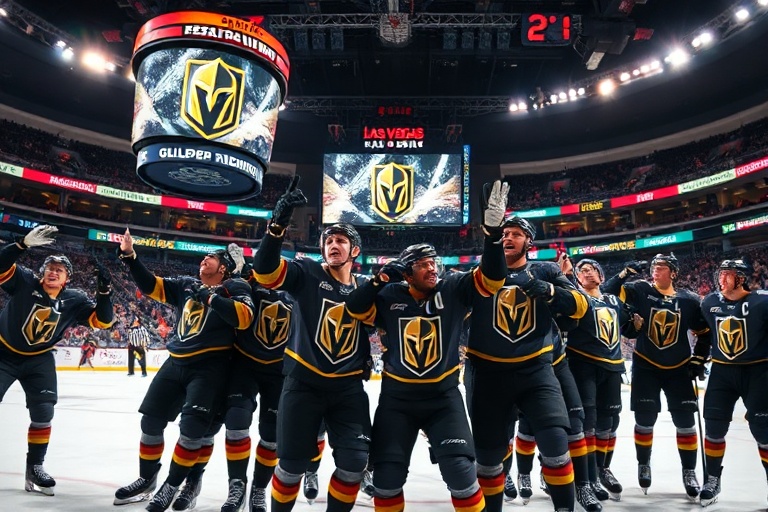
This cultural shift is evident in the team’s branding. The Golden Knights’ logo, with its medieval knight and sword, evokes a sense of chivalry and strength, while their color scheme of steel gray, gold, and black reflects both elegance and power. The team’s mascot, a knight named “Chomper,” has become a beloved figure in the community, engaging with fans at events and games. Even the team’s anthem, “Vegas Golden Knights” by country singer Jake Owen, has become a staple at sports bars and arenas across the country.
The Golden Knights have also played a role in diversifying the NHL’s fanbase. Hockey has long been criticized for its lack of racial and cultural diversity, particularly in the United States. The Golden Knights, however, have made strides in appealing to a broader audience. Their games feature a mix of traditional hockey fans and casual spectators drawn by the team’s entertainment value. The team’s outreach programs, including youth hockey initiatives and community events, have helped introduce the sport to new generations in a city where hockey wasn’t historically a priority.
In many ways, the Golden Knights embody the spirit of Las Vegas itself: bold, inclusive, and unafraid to break the mold.
The Business of Hockey in the Entertainment Capital
The Golden Knights’ success is as much a business story as it is a sports story. From the outset, the franchise was designed to operate like a high-end entertainment product. The team’s ownership understood that in Las Vegas, the game was just one part of the experience. T-Mobile Arena, where the Golden Knights play, is a state-of-the-art venue that hosts everything from concerts to UFC events. The team’s front office has leveraged this versatility, creating a product that appeals to both hockey purists and casual fans.
Financially, the Golden Knights have been a model of profitability. In their first season, the team generated over $200 million in revenue, a figure that has only grown as the franchise’s value has skyrocketed. According to Forbes, the Golden Knights are now valued at over $1 billion, making them one of the most valuable NHL franchises despite playing in a market traditionally perceived as risky. This financial success has not gone unnoticed. The NHL has taken note of the Golden Knights’ model, with commissioner Gary Bettman praising their ability to “think outside the box.”
The team’s business strategy extends to its approach to player acquisitions. The Golden Knights have mastered the art of the trade, often targeting undervalued players or those overlooked by other teams. This savvy has allowed them to build competitive rosters without overspending. Their Stanley Cup-winning team in 2023 was a testament to this philosophy, featuring players like Mark Stone and Jack Eichel, who were acquired through strategic moves rather than exorbitant contracts.
Beyond the rink, the Golden Knights have capitalized on Las Vegas’s global brand. The team’s marketing campaigns often play into the city’s reputation for excess and excitement. Commercials feature neon lights, high-energy music, and a cast of characters that feel straight out of a Vegas show. This approach has helped the team cultivate a fanbase that spans beyond Nevada, with supporters across the country and even internationally.
The Golden Knights’ business model is a case study in how to succeed in a non-traditional market. By blending hockey with the entertainment industry, they’ve created a franchise that is as much a part of Las Vegas’s identity as the Strip itself.
The Future: Building a Dynasty in the Desert
With a Stanley Cup already in hand, the Golden Knights are no longer just a Cinderella story—they’re a team with championship expectations. The 2023-24 season will be a test of whether their success was a fluke or the beginning of a dynasty. The franchise has already made moves to ensure competitiveness, re-signing key players like Mark Stone and adding depth through trades and free agency.
Yet the challenges ahead are significant. The NHL is a league of parity, where even the best teams can fall victim to a single bad season. The Golden Knights will need to navigate the salary cap, manage player development, and maintain the culture that has defined their rise. Injuries, roster turnover, and the natural evolution of the league will all play a role in their future.
Off the ice, the Golden Knights will continue to shape Las Vegas’s cultural landscape. The team has already announced plans for a new practice facility and community center, further embedding itself in the city’s fabric. There’s also talk of potential expansion, with some speculating about a second NHL team in Las Vegas or even a potential return to the Olympics, where the Golden Knights’ players could represent the U.S. or Canada.
The franchise’s journey is far from over. If their first seven years are any indication, the Golden Knights will continue to defy expectations, proving that in sports—as in Las Vegas—luck favors the bold.
The Golden Knights’ story is one of reinvention, ambition, and the power of a team to transcend its sport. As they move forward, they carry with them the hopes of a city that has always dared to dream big.