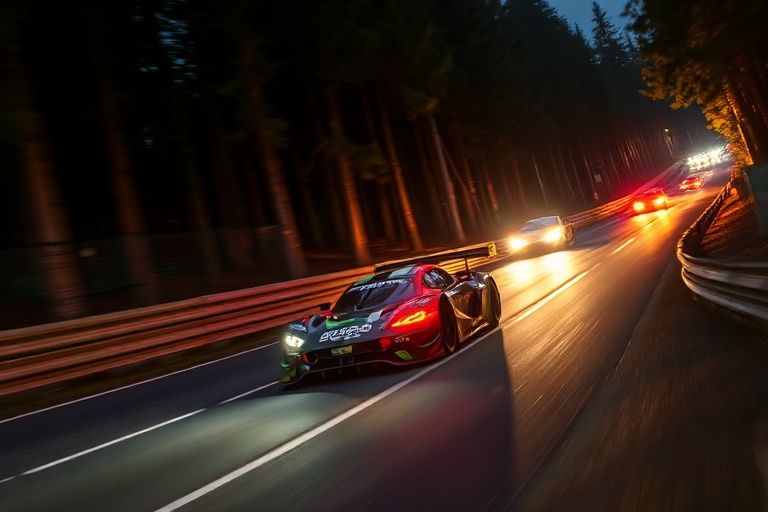
The Nürburgring 24 Hours is one of the most grueling and prestigious endurance races in the world. Held annually on the Nordschleife section of the Nürburgring circuit in Germany, this event tests both man and machine to their absolute limits. Unlike other endurance races that take place on purpose-built tracks, the Nürburgring 24 Hours challenges drivers with its treacherous combination of elevation changes, blind corners, and unpredictable weather conditions.
What sets this race apart is not just its length—24 hours of non-stop racing—but the fact that it takes place on one of the most demanding tracks in motorsport. The Nordschleife, often referred to as the “Green Hell” for its unforgiving nature, demands precision, stamina, and adaptability from every competitor. For teams and manufacturers, victory here is a badge of honor that speaks volumes about their engineering and driving capabilities.
The History and Legacy of the Nürburgring 24 Hours
The Nürburgring 24 Hours traces its origins back to 1970, when it was introduced as a way to showcase touring cars in a challenging endurance format. Over the decades, the race has evolved from a regional event into a global spectacle, attracting top-tier teams, manufacturers, and drivers from around the world. Its endurance format and the unique demands of the Nordschleife have made it a proving ground for both production-based cars and cutting-edge race machines.
One of the most defining characteristics of the race is its accessibility to privateer teams. Unlike the 24 Hours of Le Mans, which often favors factory-backed squads, the Nürburgring 24 Hours remains a platform where amateur and professional drivers can compete on equal footing. This has fostered a unique racing culture where passion and preparation often outweigh sheer budget.
- 1970: The inaugural race is held, featuring a mix of touring cars and prototypes.
- 1980s-1990s: The race gains international recognition, attracting major manufacturers like BMW, Porsche, and Mercedes-Benz.
- 2000s: The introduction of the SP (Special Production) class allows for more diverse competition, including GT3 and TCR cars.
- 2010s-Present: The race becomes a global streaming phenomenon, with live broadcasts reaching millions of fans worldwide.
What Makes the Nordschleife So Challenging?
The Nordschleife is a 20.8-kilometer (12.9-mile) circuit that winds through the Eifel mountains, featuring 73 corners, elevation changes of up to 300 meters (984 feet), and sections that drop into valleys and climb back up in rapid succession. Its unpredictable weather—sun, rain, and fog can all appear within minutes—adds another layer of complexity. Drivers must adapt their strategies on the fly, often switching between dry and wet setups mid-race.
For manufacturers, the Nordschleife is more than just a race track; it’s a real-world testing ground. Cars that perform well here often translate their strengths to road-going models, particularly in areas like braking, aerodynamics, and tire management. The race has become a benchmark for evaluating a vehicle’s overall capabilities, from its cooling systems to its suspension durability.
Another unique aspect of the Nürburgring 24 Hours is the “customer racing” phenomenon. Many teams enter with modified production cars, proving that success isn’t limited to multi-million-dollar prototypes. Brands like Audi, BMW, and Porsche regularly field entries in classes designed for near-stock or lightly modified vehicles, demonstrating the race’s inclusive yet fiercely competitive nature.
The Teams and Drivers Who Define the Race
The Nürburgring 24 Hours attracts a diverse field of competitors, ranging from factory-backed teams to privateer squads with modest budgets. Manufacturers often use the race to test new technologies or push the limits of existing ones. For example, in recent years, electric and hybrid vehicles have begun to make their mark, with teams like Audi and Mercedes experimenting with alternative powertrains in endurance conditions.
Drivers, too, are a mix of professionals and amateurs. While stars like Timo Bernhard and Marcel Fässler have claimed victories, the race is equally famous for its “ringers”—local drivers who know the circuit’s nuances better than anyone. These drivers often serve as mentors to less experienced teammates, guiding them through the intricacies of the Nordschleife’s most dangerous sections.
- Factory Teams: Manufacturers like Porsche, BMW, and Audi deploy their top-tier endurance squads, often featuring WEC and DTM drivers alongside engineers.
- Privateer Teams: Independent outfits with smaller budgets rely on passion and preparation, sometimes outperforming factory efforts.
- Customer Racing: Classes like SP9 (GT3) and SP10 (TCR) allow modified production cars to compete, proving that speed isn’t solely the domain of prototypes.
- Amateur Drivers: Many teams include non-professional drivers, who must navigate the Nordschleife’s challenges while managing fatigue over 24 hours.
The Race Weekend: More Than Just 24 Hours of Racing
The Nürburgring 24 Hours is not just a race; it’s a multi-day event that blends motorsport with festival-like atmosphere. The weekend kicks off with free practice sessions on Thursday, where teams fine-tune their setups and drivers familiarize themselves with the circuit. Friday is reserved for qualifying, which determines the starting grid. Unlike other races, the Nordschleife’s unpredictable conditions mean that a single lap can make or break a team’s chances.
Race day begins with a warm-up session before the main event at 3:00 PM on Saturday. The 24-hour marathon unfolds with a mix of daylight, dusk, night, and dawn racing, each phase presenting unique challenges. Teams must manage tire wear, fuel consumption, and driver stamina, often making critical decisions in the dead of night when fatigue sets in.
The post-race celebrations are as much a part of the tradition as the racing itself. Teams gather in the paddock, sharing stories and analyzing performances over beer and schnapps. The winning drivers are hoisted onto the podium, but the real victory lies in simply finishing the race—a testament to their skill and perseverance.
Why the Nürburgring 24 Hours Matters in Motorsport
The Nürburgring 24 Hours occupies a unique position in the world of motorsport. It’s a race that demands respect, not just from drivers but from engineers, strategists, and even tire manufacturers. The Nordschleife’s relentless nature exposes weaknesses in a car’s design, making it a critical proving ground for future road and race cars alike.
For fans, the race offers an unparalleled spectacle. The combination of high-speed straights, technical corners, and dramatic elevation changes creates a visual and auditory experience unlike any other. The atmosphere in the grandstands is electric, with spectators camping out for days to secure the best vantage points.
Perhaps most importantly, the Nürburgring 24 Hours embodies the spirit of endurance racing. It’s a test of human and mechanical endurance, where the smallest mistake can cost hours of effort. In an era where motorsport is increasingly dominated by hybrid and electric technologies, the race remains a reminder of the raw, unfiltered challenge that defines the sport at its core.
For those who have experienced it—whether as a driver, team member, or spectator—the Nürburgring 24 Hours is more than just a race. It’s a rite of passage, a challenge that leaves a lasting impression on everyone involved.
Learn more about endurance racing and its history on Dave’s Locker Sports.
Discover how modern technology is shaping motorsport on Dave’s Locker Technology.
Conclusion
The Nürburgring 24 Hours stands as a testament to the enduring appeal of motorsport. In a world where races are often decided by fractions of a second, this event challenges competitors to push beyond their limits for an entire day. The Nordschleife’s unforgiving nature ensures that only the most prepared and resilient teams can emerge victorious.
For manufacturers, the race is an opportunity to showcase engineering excellence and innovation. For drivers, it’s a chance to prove their skill against the ultimate test of endurance. And for fans, it’s a spectacle that captures the raw, unfiltered essence of racing.
Whether you’re a seasoned motorsport enthusiast or a casual observer, the Nürburgring 24 Hours offers an experience like no other. It’s a race that demands respect, rewards perseverance, and leaves a lasting legacy in the world of endurance motorsport.