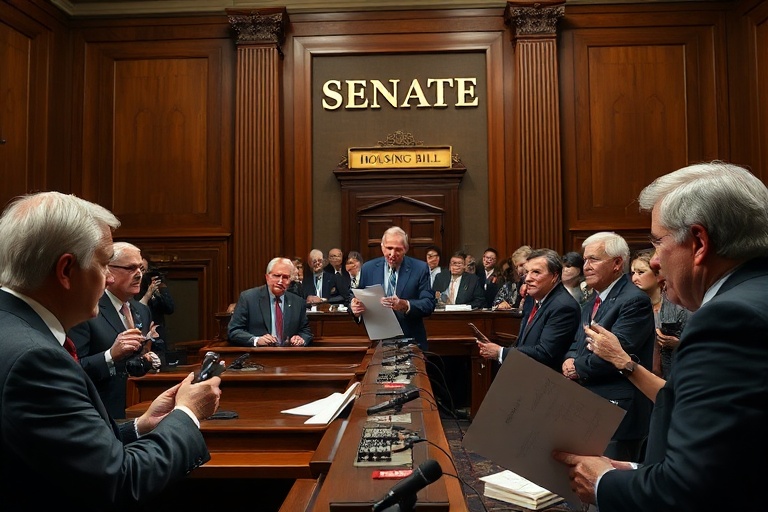
The Senate’s latest housing bill, designed to address affordability and supply shortages across the United States, has hit an unexpected roadblock in the House of Representatives. While the Senate passed the legislation with bipartisan support, House leaders have delayed its consideration, citing procedural concerns and competing legislative priorities. This delay has left housing advocates, developers, and millions of renters and homeowners in limbo, wondering when—or if—the bill will ever become law.
The bill, officially titled the Housing Affordability and Supply Act, aims to allocate $75 billion in federal funding to incentivize new home construction, provide rental assistance, and modernize existing housing infrastructure. Its supporters argue that the measure is long overdue, given the worsening housing crisis that has priced out middle-class families in cities like San Francisco, New York, and Austin. Opponents, however, claim the bill’s price tag is too steep and its implementation too bureaucratic to be effective.
The Senate’s Push for Reform
The Senate’s version of the bill passed in late May with a 62-36 vote, marking one of the few instances of bipartisan agreement in a deeply divided chamber. Key provisions included:
- Tax credits for developers who build affordable housing units in high-cost areas.
- $30 billion in rental assistance for low-income families struggling with rising rents.
- $20 billion for infrastructure upgrades to revitalize aging apartment buildings and public housing projects.
- Zoning reform incentives to encourage states and municipalities to ease restrictions on new home construction.
Senator Maria Lopez (D-CA), a lead sponsor of the bill, framed it as a necessary intervention in a market where demand far outstrips supply. “For too long, we’ve treated housing as a luxury rather than a basic human need,” she said in a floor speech. “This bill doesn’t just help families—it strengthens our economy by putting construction workers, architects, and small businesses back to work.”
Globally, the U.S. is not alone in grappling with housing shortages. Cities like Berlin and Tokyo have implemented strict rent controls and public housing expansions, while Vancouver has experimented with vacant home taxes to discourage speculative investment. The U.S. approach, however, leans heavily on market-based solutions, a strategy that has drawn both praise and criticism.
House Resistance and Political Calculus
Despite the Senate’s momentum, House Speaker Kevin McCarthy (R-CA) has signaled reluctance to bring the bill to the floor. In a closed-door meeting with Republican colleagues, McCarthy reportedly cited concerns over federal spending and the bill’s potential to expand government involvement in local housing markets. “We need solutions that empower communities, not ones that tie their hands with red tape,” he told reporters.
The delay has frustrated housing advocates, who point to the bill’s potential to ease homelessness in cities like Los Angeles, where over 60,000 people sleep on the streets nightly. According to a report by the National Low Income Housing Coalition, the U.S. is short by 7.3 million affordable homes—a gap that has widened as construction costs soar and wages stagnate.
Meanwhile, some House Democrats have accused Republicans of playing politics with a crisis that affects millions. “This isn’t about ideology—it’s about people,” said Representative James Chen (D-NY). “When families can’t afford a place to live, they can’t contribute to the economy. They can’t raise their kids. They can’t plan for the future.”
The standoff reflects broader tensions in American housing policy, where debates over affordability often intersect with racial and economic inequality. Historically, discriminatory lending practices and redlining have left communities of color disproportionately affected by housing instability. The current bill includes provisions to address these disparities, such as grants for historically Black colleges and universities to build student housing and funding for Native American tribes to develop reservation-based housing projects.
The Global Housing Crisis: Lessons for the U.S.
While the U.S. debates its approach, other nations have taken more aggressive steps to tackle housing shortages. In Vienna, Austria, over 60% of residents live in publicly funded or cooperative housing, a model that has kept rents stable for decades. The city’s success stems from a commitment to social housing as a public good, rather than a market commodity.
In contrast, cities like London and San Francisco have seen rents skyrocket as foreign investment and tech wealth drive up demand. In response, some European countries have implemented “empty home taxes” to penalize property owners who leave units vacant for speculative purposes. Portugal, for instance, taxes second homes at higher rates in urban centers, pushing landlords to either rent them out or sell.
For the U.S., the Senate’s bill represents an attempt to strike a balance between market-driven growth and public intervention. However, its delay in the House highlights the challenges of passing sweeping legislation in a polarized political climate. Without action, the housing crisis is likely to worsen, with younger generations priced out of homeownership and older adults struggling to afford rising property taxes.
What Happens Next?
The path forward remains uncertain. House leaders could schedule a vote in the coming weeks, or they may strip key provisions from the bill to secure enough Republican votes. Alternatively, the legislation could stall indefinitely, leaving states and municipalities to address the crisis on their own.
For now, housing advocates are mobilizing. Organizations like Enterprise Community Partners have launched campaigns to pressure lawmakers, while tenant unions in cities like Chicago and Philadelphia have organized rent strikes to demand immediate relief. Meanwhile, real estate developers warn that without federal support, the construction slowdown will deepen labor shortages and drive up costs even further.
As the summer heats up, so too does the pressure on Congress. For millions of Americans, the outcome of this delay could mean the difference between a stable home and a life on the margins.
Dave’s Locker offers independent journalism with a global perspective. Follow our News and Analysis sections for updates on this and other critical issues.