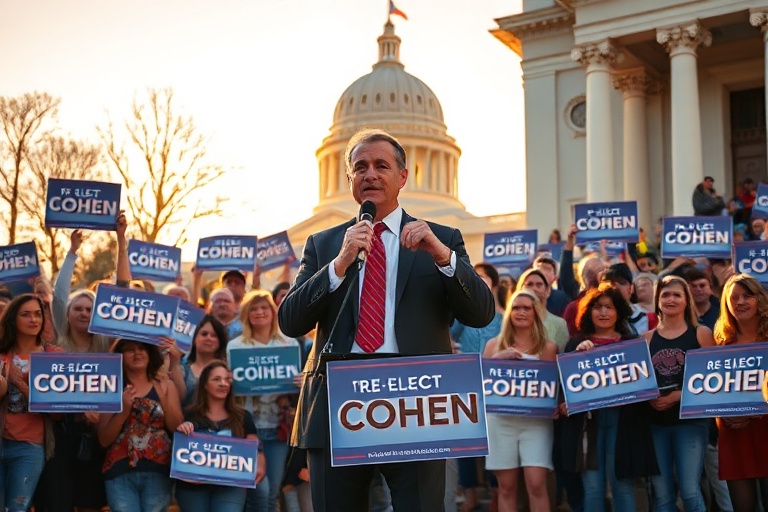
Steve Cohen’s Tennessee Reelection Bid: A Political Tightrope Walk
Steve Cohen’s Political Journey in Tennessee
Steve Cohen, the lone Democratic representative from Tennessee’s 9th Congressional District, has spent his political career navigating a deeply conservative state. First elected in 2006, Cohen has become a fixture in Memphis politics, often serving as a vocal advocate for urban issues while facing persistent challenges from Republican opponents. His reelection bid in 2024 is shaping up to be another high-stakes contest, one that reflects broader tensions in American politics.
The Memphis area, anchored by a majority-Black electorate, has long been a Democratic stronghold. Yet Tennessee’s state legislature and congressional delegation remain overwhelmingly Republican. Cohen’s ability to hold onto his seat hinges on mobilizing Black voters while appealing to a broader coalition that includes progressive whites and young activists. His campaign is a microcosm of the Democratic Party’s struggle to maintain influence in Southern states where demographic shifts are slow to translate into political power.
The Opponent Landscape in 2024
Cohen’s reelection campaign will face formidable opposition. Republicans have repeatedly targeted his seat, viewing it as a prime opportunity to flip a Democratic district. The likely GOP challenger is expected to be a conservative firebrand, possibly a state legislator or a former law enforcement official, someone who can energize the party’s base with promises of fiscal conservatism and law-and-order rhetoric.
Tennessee’s political climate has grown more polarized in recent years, with issues like abortion rights, gun control, and economic inequality dominating debates. Cohen, a staunch progressive, has positioned himself as a defender of these causes, but his opponents will argue that his voting record aligns too closely with national Democratic priorities. The race could hinge on whether voters see Cohen as a necessary voice for Memphis or an out-of-touch liberal in a conservative state.
Cultural and Demographic Shifts in Memphis
Memphis is a city of contrasts. Known for its rich musical heritage, from blues to rock ‘n’ roll, it is also a majority-Black city with deep economic disparities. The city’s cultural influence is undeniable, yet its political power is often overshadowed by Nashville’s rapid growth and Nashville’s status as the state capital. Cohen’s reelection bid is not just about his own political future but about whether Memphis can assert itself in a state where its interests are frequently sidelined.
The district Cohen represents includes parts of Shelby County, home to nearly one-third of Tennessee’s Black population. Historically, Black voters have turned out in high numbers for Democratic candidates, but enthusiasm can wane without strong local leadership. Cohen’s campaign will need to re-engage these voters while also appealing to younger, more diverse constituencies who are increasingly shaping the city’s political landscape.
Cultural institutions like Stax Museum of American Soul Music and the National Civil Rights Museum serve as reminders of Memphis’s legacy as a center of Black activism. Cohen has leveraged this history in his campaigns, positioning himself as a champion of civil rights and economic justice. Yet, critics argue that his tenure has not delivered enough tangible results for the district, leaving an opening for opponents to exploit.
National Implications of a Tennessee Race
While Tennessee’s 9th District race is local, its outcome could have national implications. Democrats are fighting to maintain their slim majority in the House, and losing even one seat could shift the balance of power. Cohen’s reelection bid is part of a broader strategy to hold onto urban districts in Republican-leaning states, a task that has grown more difficult in recent election cycles.
The 2024 election cycle is also shaping up to be a referendum on progressive policies. Cohen’s support for issues like Medicare for All, student debt relief, and climate action aligns with the national Democratic platform, but these positions may not resonate with Tennessee voters outside of Memphis. The race will test whether progressive policies can gain traction in the South or if voters remain skeptical of sweeping changes.
The Role of Outside Spending and Media Influence
Like many competitive races, Cohen’s reelection bid is expected to attract significant outside spending. Super PACs and national political groups will likely pour millions into advertising, both for and against him. The influx of money could drown out local voices, turning the race into a battleground for broader ideological fights rather than a discussion of Memphis-specific issues.
Social media will also play a critical role. Cohen has a strong online presence, using platforms like Twitter and Facebook to connect with constituents. However, misinformation and partisan attacks could spread rapidly, complicating his efforts to control the narrative. The rise of AI-generated content and deepfake videos adds another layer of complexity, making it harder for voters to distinguish truth from fiction.
What’s at Stake for Memphis and Tennessee
The outcome of Cohen’s reelection bid will have real consequences for Memphis. The city faces challenges like crumbling infrastructure, underfunded schools, and a housing crisis. Cohen has pushed for federal investment in these areas, but progress has been slow. If he loses, Memphis could see a shift in priorities, with a Republican representative less likely to advocate for urban issues at the national level.
Tennessee’s political future is also on the line. The state has seen rapid population growth, particularly in Nashville and surrounding areas, but Memphis has struggled to keep pace. The 9th District race could highlight the need for policies that address the state’s urban-rural divide, a topic often overlooked in statewide debates.
For Cohen, this election is about legacy. After nearly two decades in Congress, he has become a known quantity in Memphis politics. His supporters argue that his experience and progressive values are exactly what the district needs. His detractors, however, see him as a relic of an era when Democrats could win in the South without broad-based appeal.
Lessons from Past Races
Cohen’s reelection bids have never been easy. In 2018, he faced a tough challenge from Republican Charlotte Bergmann, who nearly unseated him in a shock upset. Cohen won by just 10 points, a margin that underscored his vulnerability. Since then, he has worked to strengthen his ties with the community, but the political winds have shifted further against Democrats in Tennessee.
The 2024 race will likely follow a similar pattern: high turnout, intense media scrutiny, and a battle over voter perception. Cohen’s campaign will need to counter the narrative that he is out of touch with Tennessee values, while his opponents will seek to paint him as a liberal extremist. The result will hinge on which side can best frame the debate.
Conclusion: A Race That Defines Tennessee’s Future
Steve Cohen’s reelection bid is more than a local contest; it is a test of whether Memphis can retain its voice in a state dominated by conservative politics. The race reflects broader trends in American politics, where urban centers increasingly find themselves at odds with state legislatures and congressional delegations. For Cohen, the challenge is clear: prove that he remains a vital advocate for Memphis or risk being swept away by the tide of conservative resurgence.
As Tennessee continues to grow and change, the outcome of this race could set the tone for the state’s political future. Will it embrace a more inclusive, progressive approach to governance, or double down on the policies of the past? The answer may lie in the votes cast in Memphis this November.
One thing is certain: the race for Tennessee’s 9th District will be closely watched as a barometer of Democratic strength in the South and a litmus test for the party’s ability to adapt to changing political landscapes.
For more on Tennessee politics, visit our Politics section.
Explore deeper analysis in our Analysis category.