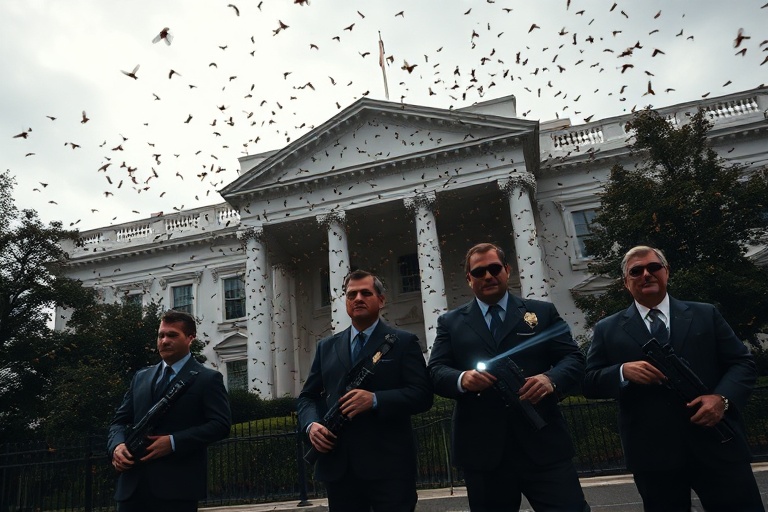
The White House lawn became an unexpected stage for nature’s drama on a clear afternoon in late May. A swarm of honeybees, numbering in the thousands, descended upon the South Lawn, drawing immediate attention from officials, reporters, and passersby. The event was brief but memorable—lasting just under 90 minutes before beekeepers safely relocated the colony. What began as a curiosity quickly evolved into a discussion about urban wildlife, ecosystem balance, and the symbolism of bees in American culture.
This wasn’t the first time bees have made headlines in Washington. In fact, the White House has a documented history with pollinators, from First Lady Michelle Obama’s vegetable garden to the more recent installation of bee habitats on the roof. But a swarm? That’s different. It’s raw, untamed nature asserting itself in a place where order usually dominates. The incident sparked conversations far beyond the Beltway, raising questions about urban planning, environmental stewardship, and even political symbolism.
How the Swarm Unfolded: A Timeline of Events
The bees were first spotted by a White House tour guide around 2:30 PM. Within minutes, the news rippled through the complex. Unlike a typical bee sighting, this swarm was active—bees clustered on a bush near the Rose Garden, their behavior indicating they were in transit rather than aggressive. Officials quickly contacted the U.S. Department of Agriculture’s (USDA) beekeeping team, which arrived with protective gear and a bee box.
The removal process took about an hour. Beekeepers used a combination of smoke and gentle brushing to coax the bees into a transport box. No one was stung. The colony was later identified as a healthy, queen-right swarm—meaning it had a fertile queen and was likely searching for a new home. The USDA released a statement calling the event “a natural occurrence” and emphasized that the bees posed no threat to the public.
Interestingly, the swarm coincided with National Honey Bee Day, a lesser-known observance that celebrates the insects’ role in agriculture. While the timing may have been coincidental, it added an unintended layer of irony to the proceedings. The White House, often a symbol of human governance, found itself temporarily hosting a microcosm of the natural world it usually seeks to control.
The Science Behind the Swarm: Why Bees Choose Unusual Locations
Honeybee swarms are a fascinating phenomenon. They occur when a colony outgrows its hive and splits, with the old queen and roughly 60% of the worker bees departing in search of a new home. This process is essential to the species’ survival and genetic diversity. But why the White House lawn?
Experts point to several possible factors:
- Urban Oasis: The White House grounds, with their manicured lawns, flowering shrubs, and proximity to the Potomac River, create an ideal stopover for swarms. Bees are drawn to sheltered, elevated spaces where they can cluster temporarily.
- Pheromone Trails: Scout bees may have detected pheromones from previous swarms or even lingering scents from the First Lady’s garden, which includes pollinator-friendly plants like lavender and sunflowers.
- Climate Factors: The late spring weather—warm but not yet scorching—provided perfect conditions for swarming. Bees are less active during extreme heat or cold, making May an optimal month for such events.
- Human Activity: While counterintuitive, human presence can inadvertently aid swarms. The White House’s security protocols, which limit pesticides and herbicides, create a relatively bee-friendly environment in an otherwise sterile urban landscape.
Dr. Marla Spivak, a MacArthur “Genius” Grant recipient and bee researcher at the University of Minnesota, noted in a recent interview that “urban areas can be deathtraps for bees, but they also offer unexpected refuges. The White House, with its lack of immediate threats, is a prime example.” Her work highlights how green spaces in cities—even highly managed ones—can become lifelines for pollinators.
Symbolism and Public Reaction: More Than Just a Bee Swarm
If the bees had landed anywhere else, it might have been a footnote. But the White House is more than a building; it’s an idea. The swarm quickly became a canvas for interpretation, with social media users and commentators attaching their own meanings to the event.
Some saw it as a sign of ecological imbalance. “Bees swarming the White House? That’s not normal,” tweeted one user. “We’ve messed up the planet so badly that even the insects are rebelling.” Others took a more optimistic view, framing the swarm as a reminder of nature’s resilience. “In a city of concrete and power, a swarm of bees chose the people’s house to rest,” wrote another. The contrast between human control and natural chaos was hard to ignore.
Political analysts also weighed in. The incident occurred amid debates over environmental policy, including the EPA’s regulation of neonicotinoids (a class of pesticides linked to bee decline). Some commentators drew a direct line between the swarm and broader concerns about climate change and habitat loss. “Nature is sending a message,” argued a columnist in The Hill. “And it’s one we’d be wise to listen to.”
The White House’s official response was measured. Press Secretary Karine Jean-Pierre stated that “the safety and well-being of our staff and visitors are paramount,” but she also acknowledged the “unique circumstances” of the event. The incident, she said, “highlights the importance of protecting pollinators.”
What Happens Next? Lessons From the Swarm
The bee swarm at the White House may have been fleeting, but its implications are lasting. For urban planners, it’s a case study in how cities can better accommodate wildlife. For beekeepers, it’s a reminder of the growing demand for hive relocation services in unexpected places. And for policymakers, it’s a prompt to revisit regulations around pesticide use, green spaces, and public education on pollinator conservation.
Already, calls have emerged for the White House to formalize its role as a haven for bees. Ideas include:
- Expanding the First Lady’s kitchen garden to include more native flowering plants.
- Installing additional bee hotels (structures that provide nesting sites for solitary bees) on the grounds.
- Partnering with local schools to launch educational programs on urban beekeeping.
- Committing to “bee-friendly” landscaping practices, such as reducing nighttime lighting (which disorients bees) and avoiding monoculture lawns.
These steps wouldn’t just benefit bees. They’d also align with broader goals of sustainability and environmental justice. According to a 2023 report from the National Wildlife Federation, urban areas could support up to 50% more pollinator species with relatively minor changes to landscaping. The White House swarm may have been a one-time event, but it’s part of a larger pattern—and one that’s worth paying attention to.
For now, the bees are safely relocated to a managed apiary in Maryland, where they’ll continue their role as pollinators. The White House, meanwhile, has returned to its usual rhythm. But the questions linger: What does it mean when nature asserts itself in the heart of power? And what can we learn from a swarm that chose the people’s house as its temporary home?
The answers may be simpler than we think. Sometimes, the most profound lessons come not from grand gestures, but from the quiet, buzzing presence of a few thousand bees.
For more on how urban spaces are adapting to support wildlife, explore our Environment section. To understand the role of pollinators in agriculture, visit our Science hub.