USS Arizona: The Sunken Battleship That Became a Memorial
The wreck of the USS Arizona remains one of the most haunting and powerful symbols of World War II. Sunk during the attack on Pearl Harbor on December 7, 1941, the battleship now serves as a war memorial, resting beneath the waters of Hawaii’s Pearl Harbor. Over 1,100 crew members perished when a Japanese bomb penetrated its forward magazine, triggering a cataclysmic explosion that sent the ship to the ocean floor in minutes.
More than eight decades later, the USS Arizona continues to command attention—not just as a relic of naval history, but as a living monument to the lives lost and the nation’s resolve. Its submerged hull, encrusted with coral and visited daily by thousands, tells a story of sudden catastrophe and enduring legacy. Understanding the ship’s role in history, its present condition, and its cultural significance offers a window into both wartime sacrifice and postwar reconciliation.
The Battleship’s Final Hours: A Day That Changed History
Commissioned in 1916, the USS Arizona was a Pennsylvania-class battleship designed for the U.S. Navy’s expanding global presence. By 1941, it had become a fixture of the Pacific Fleet, though it was undergoing modernization when the attack on Pearl Harbor began. On the morning of December 7, the ship was moored along Battleship Row at Ford Island, caught in a moment of vulnerability.
The Japanese strike force launched its assault at 7:48 a.m., targeting U.S. battleships and airfields across Oahu. Within minutes, Arizona was struck by multiple bombs. The most devastating was a 1,760-pound armor-piercing projectile that penetrated the forward turret area and detonated the ship’s powder magazine. The resulting explosion lifted the 31,400-ton vessel out of the water before it settled into the mud below, engulfed in flames and smoke.
In just nine minutes, the USS Arizona was gone. Of the 1,512 men aboard that morning, 1,177 perished—nearly half of the total American fatalities from the attack. The ship’s destruction became an immediate symbol of American outrage and a rallying cry for entry into the war. President Franklin D. Roosevelt’s “Day of Infamy” speech the following day galvanized public support for intervention, shifting the nation’s trajectory toward full-scale war.
From Sunken Hull to Sacred Memorial
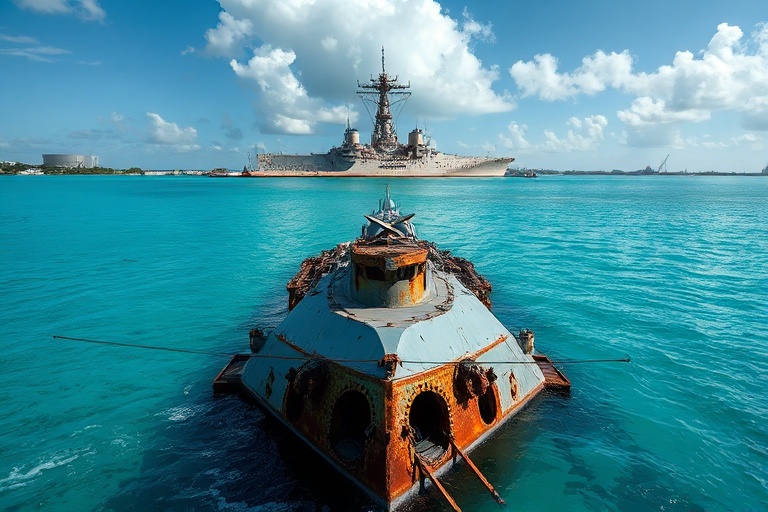
In the years following the attack, the USS Arizona remained submerged and undisturbed, its hull gradually becoming a submerged tomb. In 1949, the U.S. Navy ceded control of the wreck to the National Park Service, which established the World War II Valor in the Pacific National Monument. Today, the site includes the USS Arizona Memorial, a white structure built over the ship’s remains, accessible by boat from the Pearl Harbor Visitor Center.
Visitors approach the memorial via a small Navy-operated launch. The structure spans the wreck’s length, with an open-air shrine room and a marble wall inscribed with the names of the 1,177 sailors and Marines who died aboard. Oil continues to seep from the ship’s hull—known as “Black Tears”—a poignant reminder of the ongoing loss. Each year on December 7, a memorial service is held, attended by survivors, dignitaries, and descendants.
The memorial also includes the USS Utah Memorial and the USS Oklahoma Memorial, but the USS Arizona remains the central focus. More than two million people visit annually, making it one of the most visited historic sites in the United States. The site serves multiple roles: as a place of mourning, a museum of wartime history, and a place of education for younger generations.
Preservation and Controversy: Balancing Memory and Environmental Concerns
Maintaining the USS Arizona as a memorial presents complex challenges. Saltwater corrosion, structural instability, and the slow but steady release of fuel oil from the wreck’s bunkers threaten the site’s integrity. The National Park Service, in partnership with the Navy, conducts ongoing monitoring and conservation efforts. Divers periodically assess the hull’s condition and collect oil samples to measure leakage.
There has also been debate over potential salvage or recovery efforts. Some argue that recovering artifacts or even the ship’s bell could preserve history for future generations. Others believe the wreck should remain undisturbed as a war grave, honoring the dead where they fell. In 1984, a decision was made to leave the USS Arizona in place, with only minimal interventions such as the installation of a cofferdam to collect leaking oil.
Environmental concerns have grown as the ship continues to deteriorate. The oil, estimated at around 500,000 gallons, poses a long-term risk to the harbor ecosystem. A 2018 study by the National Park Service and the University of Hawaii found that the leakage rate had slowed but not stopped. Engineers and historians continue to discuss the best path forward—whether to contain the oil indefinitely or prepare for a controlled extraction process in the decades ahead.
The USS Arizona in Public Memory and Diplomacy
The USS Arizona occupies a unique place in American consciousness. Unlike many war memorials, it is not a monument built after the fact—it is the actual site of catastrophe, preserved as it was in 1941. This authenticity gives it a visceral power. It is a place where history is not just commemorated, but experienced through the senses: the sight of the memorial against the harbor, the smell of salt and oil, the sound of the water lapping against the structure.
Internationally, the USS Arizona has become a symbol of reconciliation. In 1962, Emperor Hirohito of Japan visited the memorial during a state visit to the United States, a gesture that symbolized the healing of wartime wounds. More recently, Japanese naval vessels have participated in joint ceremonies at Pearl Harbor, including a 2016 visit by Japan’s largest warship, the JS Kaga, to honor the fallen of both nations.
These moments reflect a broader trend in postwar diplomacy—moving from enmity to mutual respect. The USS Arizona, once a target of war, now serves as a bridge between former adversaries. It reminds us that memory can be both painful and unifying, and that even in the darkest moments of history, humanity can choose a path toward understanding.
Key Facts About the USS Arizona
- Commissioned: October 17, 1916
- Displacement: 31,400 tons
- Length: 608 feet
- Crew aboard during attack: 1,512
- Casualties: 1,177 killed
- Current status: War grave and national memorial
- Oil leakage: Approximately 2–5 quarts per day (known as “Black Tears”)
- Annual visitors: Over 2 million
The USS Arizona is more than a shipwreck. It is a narrative of loss, resilience, and redemption. It challenges us to remember not only the scale of the tragedy but also the humanity of those who perished within its steel walls. As long as oil continues to rise from its hull and visitors pause in silent reflection, the memory of December 7, 1941, will endure—not as a distant historical event, but as a living presence in the heart of American memory.
In an age where historical amnesia often threatens to erase the lessons of the past, the USS Arizona stands as a quiet but unyielding teacher. It asks us to look closely at the cost of war, the fragility of peace, and the enduring power of remembrance. Nearly a century after its destruction, the Arizona still speaks—if we are willing to listen.
For those interested in exploring more about military history and memorials, visit the News and Culture sections on Dave’s Locker.