The rivalry between Chicago and Montréal stretches beyond hockey rinks and baseball diamonds. These two North American metropolises represent distinct approaches to urban development, cultural identity, and economic strategy. While one leans into its industrial legacy and towering skyline, the other embraces its European roots and artistic soul. Their differences create a fascinating case study in how cities evolve—and how they shape the nations they anchor.
The Economic Engines: Industry vs Innovation
Chicago’s economy has long been defined by its industrial might and financial infrastructure. As the birthplace of the skyscraper and home to the world’s first futures exchange, the city remains a critical hub for commerce and logistics. The Port of Chicago connects the Great Lakes to global markets, while O’Hare International Airport serves as a primary gateway between North America and the rest of the world. Manufacturing, finance, and transportation sectors continue to drive employment, though the city faces challenges in adapting to a post-industrial economy.
Montréal, by contrast, has transformed itself into a magnet for tech startups and creative industries. The city’s bilingual workforce and lower operational costs have attracted international corporations like Google, Ubisoft, and Facebook to establish major offices there. Québec’s robust support for innovation—through grants, tax incentives, and research partnerships—has positioned Montréal as Canada’s leading AI research center. While Chicago’s economy hums with traditional strength, Montréal’s future appears rooted in the digital revolution.
These contrasting models reveal two possible paths for North American cities: one that doubles down on legacy industries, and another that bets on emerging sectors. The outcomes will influence how both cities compete in the 21st-century economy.
Cultural Identity: The Midwest Meets the Francophone North
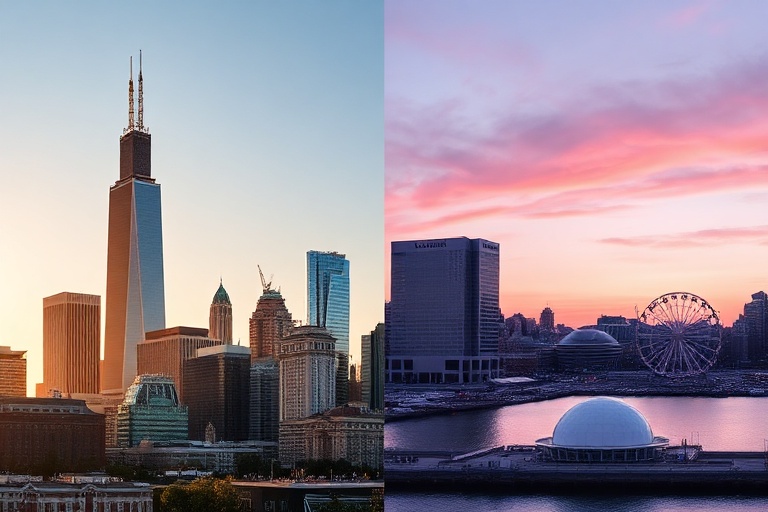
Chicago’s cultural identity is a study in contrasts. It’s a city where jazz clubs sit beside gospel choirs, where street art flourishes in neighborhoods scarred by disinvestment, and where deep-dish pizza debates rage as fiercely as political divisions. The city’s architecture—from the monolithic Willis Tower to the delicate lacework of Frank Lloyd Wright’s Prairie homes—reflects its ambition and contradictions. Chicagoans often describe their city as raw, unpolished, and fiercely independent.
Montréal’s identity is more cohesive, though no less complex. As the largest French-speaking city in North America outside Paris, it maintains a cultural continuity that Chicago lacks. The city’s European charm—narrow streets, cobblestone squares, and centuries-old churches—coexists with a thriving contemporary art scene. Festivals like the Just for Laughs comedy festival and Igloofest’s electronic music celebration draw international crowds, while the city’s culinary scene blends French technique with multicultural influences. The result is a cultural ecosystem that feels both timeless and cutting-edge.
These differences extend beyond aesthetics. Chicago’s cultural output often feels like a reaction to its environment—gritty, improvisational, and resistant to polish. Montréal’s culture, meanwhile, carries the weight of history while pushing boundaries in music, film, and design. The two cities offer contrasting models for how urban culture develops: one shaped by necessity and reinvention, the other by preservation and evolution.
The Urban Landscape: Sprawl vs Density
Chicago’s urban fabric is defined by its sprawl. The city’s 230 square miles contain neighborhoods that feel like separate cities—each with its own character, cuisine, and community. The Loop’s towering business district gives way to working-class enclaves like Pilsen and Logan Square, where bungalows and three-flats dominate the skyline. Public transit exists, but car ownership remains essential for most residents. This sprawling geography creates challenges in equitable service delivery and infrastructure maintenance.
Montréal, by comparison, is a study in density. The island’s 14 square miles are packed with mixed-use buildings, pedestrian-friendly streets, and an extensive metro system. Neighborhoods like the Plateau and Mile End offer walkable living with amenities within a few blocks. Even the city’s suburbs are more compact than Chicago’s, with higher transit ridership and lower car dependence. This density has environmental benefits—lower emissions, reduced sprawl—but also creates housing pressures in desirable areas.
The two cities’ approaches to urban planning highlight different priorities. Chicago’s model prioritizes individual choice and space, while Montréal’s emphasizes efficiency and community. The trade-offs become clear when considering issues like affordability, sustainability, and quality of life.
The Broader Implications: What These Rivalry Cities Teach Us
The Chicago vs Montréal dynamic offers lessons for urban planners, policymakers, and residents across North America. Their contrasting models reveal the trade-offs inherent in different development strategies. Chicago’s struggle to adapt its industrial base mirrors challenges faced by other Rust Belt cities, while Montréal’s tech-driven growth provides a blueprint for post-industrial transformation.
Culturally, the cities demonstrate how heritage shapes identity. Chicago’s messy, improvisational spirit reflects its history as a city of immigrants and innovators. Montréal’s bilingual, Franco-European character shows how culture can be both a unifying force and a point of tension. Both models have value, but their success depends on context and adaptation.
Urbanistically, the comparison highlights the costs and benefits of density versus sprawl. Chicago’s vast geography offers freedom but strains infrastructure. Montréal’s compact design fosters community but risks exclusionary housing markets. The ideal solution likely lies somewhere in between, tailored to each city’s unique needs.
Ultimately, Chicago and Montréal represent two viable paths forward for North American cities. One is rooted in reinvention, the other in preservation. Both are necessary for a continent grappling with rapid change, economic uncertainty, and cultural evolution.
Key Takeaways: Chicago vs Montréal
- Economic Focus: Chicago’s industrial legacy contrasts with Montréal’s tech-driven innovation hub.
- Cultural Identity: Chicago’s raw, improvisational culture meets Montréal’s European-infused artistic scene.
- Urban Design: Chicago’s sprawling neighborhoods face off against Montréal’s dense, walkable districts.
- Policy Lessons: Both cities offer models for adaptation—Chicago in post-industrial revival, Montréal in tech integration.
As North America’s cities continue to evolve, the Chicago vs Montréal rivalry reminds us that there’s no single blueprint for success. The most resilient cities will be those that learn from both models—balancing tradition with innovation, density with livability, and heritage with progress.
For more on urban development and cultural trends, explore our News and Culture sections.