Nicholas Kristof: A Lifetime of Advocacy Through Journalism
Nicholas Kristof has spent more than three decades as a journalist, using his platform to shine a light on some of the world’s most pressing humanitarian crises. His reporting transcends traditional news coverage, blending investigative rigor with a deeply human touch. Whether documenting genocide in Darfur, the AIDS epidemic in Africa, or the struggles of women in the developing world, Kristof has consistently prioritized voices that are often marginalized or ignored.
Born in 1959 in Yamhill, Oregon, Kristof grew up on a sheep farm, an upbringing that instilled in him a sense of empathy and resilience. His early fascination with global affairs led him to Harvard, where he studied history and later earned a Rhodes Scholarship to study law at Oxford. Yet journalism ultimately called to him, and in 1984, he joined The New York Times as a correspondent. Over the years, he has served in Los Angeles, Hong Kong, Beijing, and Tokyo, covering conflicts, political upheavals, and social injustices with an unyielding commitment to truth.
A Career Defined by Moral Clarity and Unflinching Reporting
Kristof’s work is distinguished by its moral clarity. He doesn’t just report on suffering; he humanizes it. His Pulitzer Prize-winning coverage of the Tiananmen Square protests in 1989 remains a defining moment in modern journalism, capturing both the brutality of the crackdown and the courage of those who resisted. In 2006, he and his wife, Sheryl WuDunn, published Half the Sky: Turning Oppression into Opportunity for Women Worldwide, a groundbreaking book that reframed global gender inequality as not just a moral issue but an economic and social one.
The book’s title, borrowed from a Chinese proverb, encapsulates Kristof’s approach: systemic change begins with individual stories. His reporting often follows this model, pairing broad analysis with intimate portraits of people whose lives have been upended by war, poverty, or discrimination. This methodology has earned him both admiration and criticism. Some argue that his advocacy occasionally blurs the line between journalism and activism, a tension Kristof has acknowledged but defended as necessary in an era where neutrality can sometimes equate to complicity.
The Power of Personal Narrative in Global Journalism
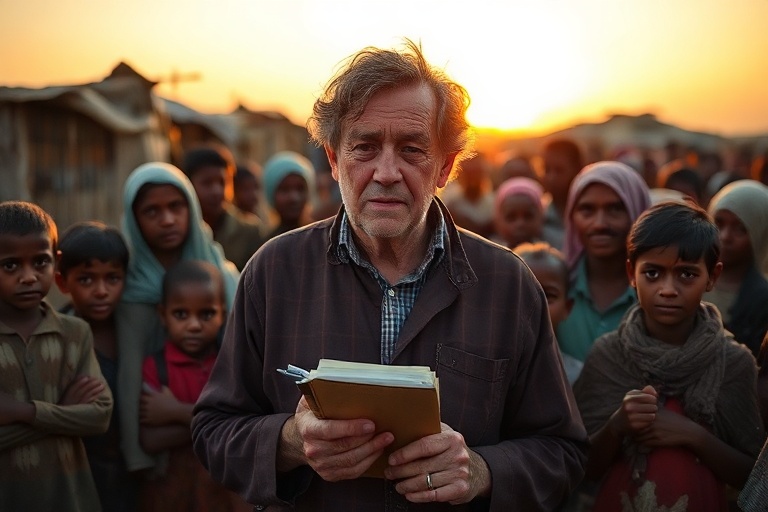
Kristof’s writing style is deceptively simple. He avoids jargon and academic posturing, opting instead for clear, compelling prose that invites readers into the lives of his subjects. His dispatches from conflict zones or refugee camps are rarely detached; they’re immersive, often placing the reader alongside him as he interviews survivors or negotiates access with wary officials.
This approach has made his work accessible to a broad audience, bridging the gap between scholarly analysis and public consciousness. For instance, his 2014 New York Times series on the Rohingya crisis in Myanmar combined harrowing firsthand accounts with data-driven context, forcing global readers to confront the scale of the atrocities. Such reporting doesn’t just inform—it mobilizes. It has contributed to policy shifts, increased humanitarian aid, and even inspired grassroots movements.
Yet Kristof’s influence extends beyond traditional journalism. His New York Times op-ed columns, which he has written since 1996, tackle everything from climate change to education reform, often advocating for solutions rooted in evidence and empathy. His willingness to engage with readers through social media has also kept his work relevant in an era where news cycles move at breakneck speed.
The Criticisms and Controversies That Shape His Legacy
No influential figure escapes controversy, and Kristof is no exception. Critics argue that his focus on individual stories can sometimes oversimplify complex issues, reducing systemic problems to anecdotal morality tales. Others contend that his advocacy-led journalism risks compromising his objectivity, particularly when he calls for specific policy responses to crises.
His 2012 column urging the U.S. to intervene in Syria’s civil war drew sharp backlash from some peers who viewed it as crossing into editorializing. Kristof defended the piece, stating that in cases of mass atrocities, silence is complicity. This debate reflects a broader tension in modern journalism: Can reporters remain neutral while advocating for justice? Kristof’s answer is clear—he believes journalism must serve a higher purpose.
Another recurring critique involves his portrayal of non-Western communities. Some scholars argue that his framing of African or Asian struggles often centers Western savior narratives, reinforcing stereotypes despite his intentions. Kristof has responded by expanding his team to include more local journalists and amplifying voices from the communities he covers, a step that acknowledges the limitations of outsider perspectives.
A Lasting Impact on Journalism and Global Advocacy
Kristof’s legacy is multifaceted. He has redefined what it means to be a foreign correspondent, proving that journalism can be both rigorous and compassionate. His work has influenced a generation of reporters who see storytelling as a tool for change, not just information. Organizations like Human Rights Watch and The Guardian’s investigative team have cited his reporting as inspiration for their own methodologies.
Beyond journalism, Kristof’s impact is visible in policy circles. His advocacy for microfinance, girls’ education, and maternal health has shaped initiatives by the World Bank, UNICEF, and the U.S. Agency for International Development. In 2020, he and WuDunn were awarded the National Humanities Medal for their contributions to public discourse, a rare honor for journalists.
Yet perhaps his most enduring contribution is the way he has modeled journalism as an act of solidarity. In an era where media distrust is rampant and objectivity is often weaponized, Kristof’s career reminds us that journalism’s highest purpose is to bear witness—and to act when necessary.
What’s Next for Kristof? A Continued Push for Accountability
Even in retirement from daily reporting at The New York Times, Kristof shows no signs of slowing down. He remains a prominent voice on social media, frequently amplifying underreported stories and challenging his followers to engage with global issues. His Substack newsletter, The Lookout, curates a mix of hard news, opinion, and calls to action, further blurring the lines between journalism and advocacy.
Looking ahead, Kristof has hinted at exploring new formats, including documentary filmmaking and podcasting, to reach wider audiences. His focus remains on the most vulnerable populations, particularly women and children in conflict zones. With authoritarianism on the rise and humanitarian crises escalating, his work feels more urgent than ever.
For aspiring journalists, Kristof’s career offers a blueprint: prioritize humanity in reporting, question power structures relentlessly, and never mistake neutrality for passivity. For the public, his work is a call to action—proof that even in a fragmented media landscape, one voice can still make a difference.