Norway’s Eurovision Legacy: From Folk Ballads to Futuristic Pop
Norway’s relationship with the Eurovision Song Contest is one of contrasts—whimsical pop melodies standing beside avant-garde experimentation, heartfelt ballads clashing with surreal stage performances. Since its debut in 1960, Norway has sent 62 entries to Eurovision, a journey marked by both near-misses and historic victories. The country’s approach to the contest has often defied convention, blending Scandinavian minimalism with bold artistic choices that challenge European norms.
From the icy fjords of Oslo to the neon glow of Lisbon’s Altice Arena, Norwegian Eurovision acts have carried a distinct cultural voice. Whether through the haunting harmonies of its folk traditions or the futuristic synths of modern electropop, Norway has carved a niche that is instantly recognizable. This legacy is not just about winning—it’s about redefining what Eurovision can be.
Victory and Innovation: Norway’s Eurovision Highlights
Norway’s first Eurovision win came in 1985, when Bobbysocks! delivered a jubilant duet that captured the spirit of the era. The song “La det swinge” became a pan-European anthem, its catchy chorus and playful energy embodying the contest’s ability to uplift national pride. Yet, Norway’s most iconic victory arrived decades later in 2009, when Alexander Rybak stormed the stage in Moscow with “Fairytale.” The song’s violin-driven melody and Rybak’s virtuosic performance earned a record-breaking 387 points, a score that stood unchallenged for over a decade.
But Norway’s true contribution to Eurovision lies in its willingness to push boundaries. The country has consistently chosen entries that prioritize artistic expression over commercial appeal. This was evident in 2006 when Christine Guldbrandsen performed “Alvedansen,” a delicate ballad rooted in Norwegian folk traditions. In 2014, Carl Espen’s “Silent Storm” showcased a raw, emotional vocal delivery that resonated deeply across the continent.
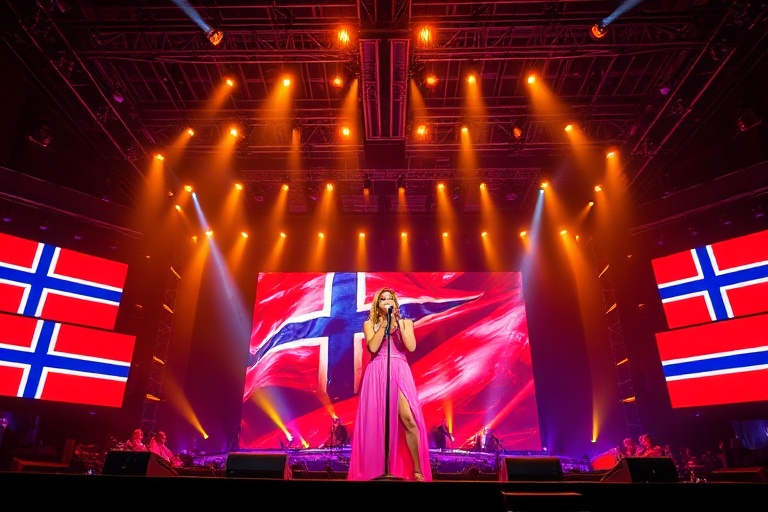
Norway’s stage productions are equally distinctive. The country has pioneered the use of LED screens, holograms, and immersive lighting to create visual experiences that rival the music itself. The 2010 entry “My Heart Is Yours” by Didrik Solli-Tangen featured a minimalist set that evolved with the song’s crescendo, while Subwoolfer’s 2022 futuristic wolf costumes and neon aesthetic brought a new level of theatricality to the contest.
The Cultural Significance of Norway in Eurovision
Eurovision is more than a music competition—it’s a cultural exchange that reflects the values and aesthetics of participating nations. For Norway, Eurovision has served as a platform to showcase its unique blend of modernity and tradition. The country’s entries often draw from its rich musical heritage, whether through the use of Hardanger fiddle melodies, Sami joik chants, or the melancholic tones of Nordic folk.
This cultural duality is mirrored in Norway’s hosting of the 1986 contest in Bergen. The event was a celebration of Norwegian landscapes and heritage, with the opening sequence featuring a sailboat gliding through fjords and performers dressed in traditional Bunad costumes. Yet, the staging was undeniably contemporary, with a sleek, modern production that aligned with the contest’s global appeal.
Norway’s Eurovision entries also reflect its societal values. The country has a long history of progressive policies, gender equality, and environmental consciousness, themes that occasionally surface in its songs. For example, the 2017 entry “Grab the Moment” by JOWST and Aleksander Walmann was a pop anthem celebrating living in the present, while the 2021 song “Fallen Angel” by TIX tackled themes of mental health with raw honesty.
Why Norway Stands Out in the Eurovision Landscape
Norway’s Eurovision journey is defined by three key traits:
- Artistic Risk-Taking: Norwegian entries often prioritize artistic vision over radio-friendly hooks. This has led to both triumphs and flops, but it ensures the country remains a source of innovation.
- Minimalism Meets Maximalism: Whether through the stripped-back elegance of Sigvart Dagsland’s 1990 performance or the over-the-top theatrics of Subwoolfer, Norway balances subtlety and spectacle.
- Cultural Authenticity: Norwegian entries frequently incorporate indigenous sounds, dialects, or traditions, offering a refreshing contrast to the homogenizing trends of pop music.
Challenges and Criticisms: The Flip Side of Norway’s Eurovision Journey
Despite its successes, Norway’s Eurovision strategy has faced criticism. Some argue that the country’s experimental approach alienates casual viewers, leading to lower televoting scores. Others point to the occasional lack of mass appeal in Norwegian entries, which struggle to compete with the polished pop acts from larger markets like Sweden or Italy.
Norway’s 2018 entry “That’s How You Write a Song” by Alexander Rybak was a rare attempt to blend Eurovision-friendly pop with his signature violin-driven style. While it finished fifth, some fans felt it lacked the boldness of his 2009 win. Similarly, the 2023 entry “Masterpiece” by Alessandra Mele, though praised for its energy, failed to make the top 10, raising questions about Norway’s future strategy.
There’s also the matter of representation. While Norway has celebrated LGBTQ+ themes in its entries, such as the 2022 song “Give That Wolf a Banana” by Subwoolfer, which included queer-coded lyrics, the country has faced scrutiny over its treatment of Sami people and other indigenous groups. Eurovision’s global stage demands sensitivity, and Norway must navigate these cultural complexities carefully.
The Future of Norway in Eurovision
As Eurovision continues to evolve, Norway faces a pivotal moment. The rise of streaming platforms and social media has democratized the contest, allowing smaller countries like Norway to compete on creativity rather than budget. The 2024 contest, hosted in Malmö, Sweden, presents an opportunity for Norway to reassert its artistic dominance.
Looking ahead, Norway’s Eurovision strategy may lean further into its cultural identity. The country’s recent entries have explored themes of nature, mental health, and societal change—topics that resonate globally. With a new generation of artists emerging from Norway’s vibrant music scene, the stage is set for another era of innovation.
For fans of Eurovision, Norway remains a wildcard—a country that refuses to play by the rules and instead crafts its own narrative. Whether through a haunting folk ballad or a neon-clad pop spectacle, Norway’s Eurovision story is far from over.
To explore more about how smaller countries navigate the complexities of Eurovision, visit our Music section. For a deeper look at Scandinavia’s role in global pop culture, check out our Culture category.