pantheon
What Is the Pantheon?
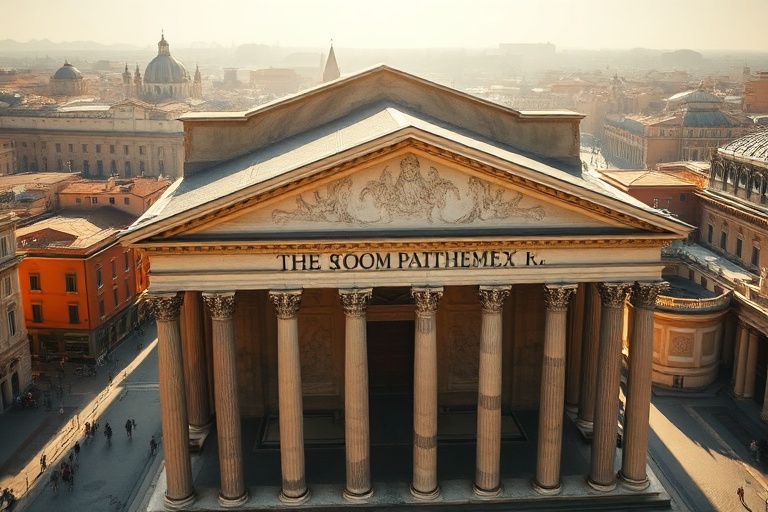
The Pantheon stands as one of the most enduring architectural marvels of ancient Rome. Built around 126 CE under Emperor Hadrian, its name derives from the Greek pan (all) and theon (gods), suggesting a temple dedicated to all Roman deities. Yet its precise original purpose remains debated among historians. Some argue it functioned as a dynastic sanctuary, while others propose it served as an imperial audience hall. What remains undisputed is its revolutionary design—a massive concrete dome with an oculus at its apex, a feat of engineering that has inspired builders for nearly two millennia.
The Pantheon’s interior reveals its genius. The coffered ceiling reduces weight while creating a mesmerizing geometric pattern. The walls, nearly 20 feet thick at the base, taper upward, distributing the dome’s immense pressure. Light filters through the oculus, a 27-foot opening that moves with the sun, casting ever-changing shadows across the marble floors. This interplay of light and structure wasn’t merely aesthetic—it symbolized the connection between earth and sky, mortals and gods. The building’s proportions, based on the Roman foot, embody mathematical harmony, with its height equaling its diameter. Few structures from antiquity achieve such perfect balance between form and function.
A Brief History of Construction and Transformation
The Pantheon’s origins trace back to an earlier temple commissioned by Marcus Agrippa in 27 BCE. That structure burned down in 80 CE, and Emperor Domitian rebuilt it, only for lightning to strike it in 110 CE. Hadrian’s reconstruction, completed around 126 CE, incorporated elements from both predecessors while introducing innovations of his own. Unlike many Roman temples, the Pantheon faces north, a decision that may reflect its secondary role as an imperial audience chamber. The inscription on its facade—M•AGRIPPA•L•F•COS•TERTIVM•FECIT (“Marcus Agrippa, son of Lucius, consul for the third time, built this”)—honored Agrippa even as Hadrian stamped his own authority on the project.
After the fall of Rome, the Pantheon’s fate diverged from most ancient monuments. In 609 CE, Pope Boniface IV consecrated it as a Christian church, saving it from destruction. This act of repurposing ensured its survival through the Middle Ages, Renaissance, and beyond. In 1747, Pope Benedict XIV declared it a sanctuary for artists, further protecting its legacy. Today, it functions as both a church and a tourist destination, drawing over six million visitors annually. Its continuous use for nearly 2,000 years makes it a rare living monument, bridging antiquity and modernity.
Key Phases in the Pantheon’s Evolution
- Original Construction (27 BCE): Agrippa’s temple dedicated to Mars and Venus, destroyed by fire in 80 CE.
- Domitian’s Rebuild (80–110 CE): A second temple, lost to lightning in 110 CE.
- Hadrian’s Reconstruction (113–126 CE): The current structure, blending Agrippa’s name with Hadrian’s vision.
- Christian Conversion (609 CE): Rededicated as Santa Maria ad Martyres, ensuring its preservation.
- Modern Era (18th–21st Century): Restored as a cultural and religious landmark, protected by UNESCO.
The Pantheon’s Architectural and Cultural Legacy
The Pantheon’s influence extends far beyond Rome. Its dome became a template for structures as diverse as Florence’s Santa Maria del Fiore and the United States Capitol. Renaissance architects, including Brunelleschi, studied its proportions to perfect their own domed designs. The oculus, an engineering marvel, inspired later buildings to incorporate celestial elements, from Baroque churches to modern skylights. Even the term oculus entered architectural lexicon, describing circular openings in ceilings and domes.
Beyond its physical impact, the Pantheon shaped cultural narratives. It embodied Roman imperial ambition, showcasing the empire’s ability to harness engineering and artistry. The building’s longevity also challenged assumptions about antiquity’s fragility. While many Roman structures crumbled, the Pantheon endured, a testament to the durability of concrete and the power of adaptive reuse. Its survival through political upheavals—from the fall of Rome to the rise of the papacy—mirrors the resilience of ideas it represents.
Artists and writers have long revered the Pantheon. Raphael, the Renaissance master, chose it as his final resting place. Goethe called it the “best-preserved ancient building” in his Italian travel diaries. Even in popular culture, the Pantheon appears in films like Roman Holiday and The Lizzie McGuire Movie, cementing its status as a symbol of Rome’s timeless allure. Its image graces postcards, textbooks, and digital wallpapers, proving its reach extends into the digital age.
Why the Pantheon Still Matters Today
The Pantheon’s relevance persists in unexpected ways. Its concrete formula, a mix of volcanic ash and lime, has intrigued modern engineers studying sustainable building materials. The structure’s thermal mass regulates temperature, a principle now applied in green architecture. Some climate scientists even use the Pantheon as a case study in resilience, noting how it adapts to environmental changes over centuries.
In an era of disposable architecture, the Pantheon offers a counterpoint. Its builders prioritized permanence, not speed. They invested in materials meant to last, a philosophy increasingly rare in today’s fast-paced construction industry. The Pantheon also challenges modern notions of authenticity. Unlike many heritage sites, it isn’t a static relic—it’s a living space, used daily for worship and contemplation. This duality raises questions about how we preserve history without fossilizing it.
For designers and architects, the Pantheon remains a masterclass in problem-solving. How did a civilization without modern tools create such a stable structure? What can contemporary builders learn from its material choices? These questions invite a deeper look at pre-industrial innovation. The Pantheon also serves as a reminder of the power of patronage. Hadrian’s vision, funded by imperial resources, demonstrates how state investment in culture can yield enduring results—a lesson for policymakers today.
Lessons from the Pantheon for Modern Society
- Invest in Longevity: The Pantheon’s materials and design prioritized durability over expediency, a model for sustainable development.
- Adapt or Perish: Its transition from pagan temple to Christian church illustrates the importance of adaptive reuse in heritage conservation.
- Mathematics as Art: The building’s proportions demonstrate how technical precision can create aesthetic perfection.
- Symbolism in Structure: Every element, from the oculus to the coffers, carries meaning, showing how form and function can intertwine.
- Cultural Resilience: Surviving wars, fires, and regime changes, the Pantheon embodies the endurance of human creativity.
As we grapple with climate change and urban decay, the Pantheon offers quiet inspiration. It proves that beauty and utility aren’t mutually exclusive. It shows that buildings can be both functional and symbolic. And perhaps most importantly, it reminds us that the past isn’t just a source of nostalgia—it’s a reservoir of solutions waiting to be rediscovered.
Next time you see a domed building or step into a sunlit atrium, pause to consider the Pantheon. Its shadow stretches far beyond the Tiber, touching every corner of the world where architecture meets ambition.