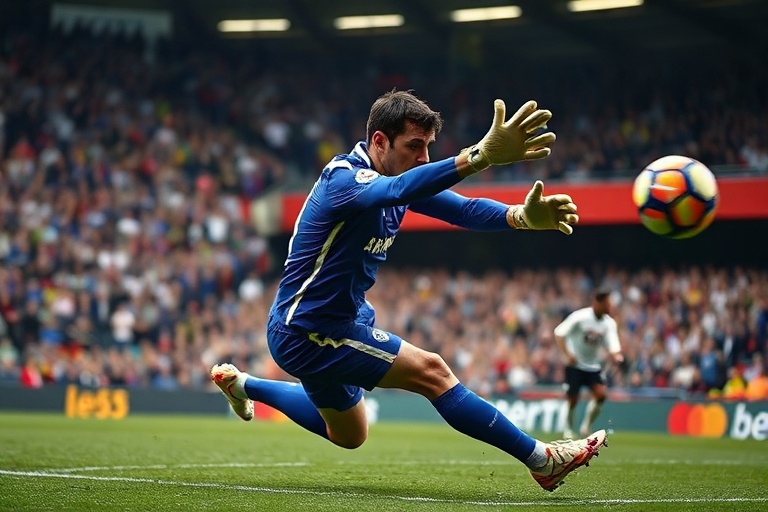
Petr Čech’s career between the posts was defined by an unshakable presence, razor-sharp reflexes, and a quiet authority that made him one of the most respected goalkeepers in football history. From his early days in the Czech Republic to his dominance in the Premier League and Champions League with Chelsea, Čech’s journey was marked by consistency, innovation, and resilience. His record-breaking clean sheets and pivotal saves didn’t just preserve victories—they redefined what it meant to be a modern goalkeeper.
The Early Years: From Plzeň to Stamford Bridge
Born on May 20, 1982, in Plzeň, Czechoslovakia, Čech began his football journey as a promising youth player before making his professional debut for FK Chmel Blšany in 1999. His performances quickly caught the attention of larger clubs, leading to a move to Sparta Prague in 2001. At Sparta, Čech’s shot-stopping abilities and composure under pressure earned him the nickname “The Little Prince of the Goal.” His rapid rise culminated in a record-breaking 2003–04 season, where he conceded just 14 goals in 30 league matches, helping Sparta claim the Czech First League title.
Chelsea’s scouting network took notice, and in 2004, the London club signed Čech for approximately £7 million. The transition to the Premier League was immediate, but not without challenges. Čech faced skepticism from some quarters, questioning whether he could adapt to the physicality and pace of English football. His early performances, however, silenced critics. In his debut season, he set a new Premier League record with 25 clean sheets and played a pivotal role in Chelsea’s first-ever league title triumph, establishing himself as a world-class goalkeeper before his 23rd birthday.
Redefining Goalkeeping: The Science and Style of Čech
What truly set Čech apart was his methodical approach to the position. Unlike the more flamboyant personalities of his era, Čech relied on positioning, anticipation, and technical precision rather than acrobatic dives. His use of the “sweeper-keeper” role under José Mourinho allowed Chelsea to play with a high defensive line, trusting Čech to rush off his line and clear through balls that would have eviscerated less composed defenders.
Čech’s influence extended beyond shot-stopping. He was a vocal organizer of the defense, often seen barking instructions during set pieces and open play. His communication skills were as crucial as his reflexes, ensuring that his backline operated as a cohesive unit. This leadership quality became even more apparent during his later years at Chelsea and Arsenal, where younger players benefited from his experience.
His technical evolution was also noteworthy. Čech was one of the first goalkeepers to embrace data-driven training, using video analysis to study opponents’ penalty tendencies and set-piece routines. This analytical mindset helped him save 18 penalties in his Premier League career—a record that stood for years. His ability to read the game extended to his distribution, where he often played long diagonal balls to exploit spaces behind opposition defenses, a tactic that became a hallmark of Chelsea’s counter-attacking style under Mourinho and later Antonio Conte.
Injury and Comeback: A Test of Resilience
Čech’s career took a dramatic turn in October 2006 during a match against Reading. A collision with Stephen Hunt resulted in a depressed skull fracture, a life-threatening injury that required emergency surgery. The prognosis was uncertain, and many feared he might never play again. Yet, just three months later, Čech returned to action, wearing a rugby-style headguard—a piece of equipment he later helped popularize among goalkeepers. That headguard became synonymous with his resilience, a visible reminder of the physical and mental fortitude he displayed throughout his career.
Legacy at Chelsea and Beyond: The Arsenal Years
After 11 years at Chelsea, during which he won four league titles, four FA Cups, three League Cups, and the 2012 Champions League, Čech departed in 2015 as a club legend. His move to Arsenal in 2015 was met with skepticism by some Gunners fans, but he quickly silenced doubters by forming a formidable partnership with David Ospina and later Bernd Leno. Even in his mid-30s, Čech remained a reliable presence, helping Arsenal win the FA Cup in 2017 and reaching the 2018 Europa League final.
His retirement in 2019 marked the end of an era. Čech finished his Premier League career with 202 clean sheets, a record that stood until it was surpassed by Joe Hart and later Alisson Becker. His influence, however, transcended statistics. He inspired a generation of goalkeepers, including Thibaut Courtois, who credited Čech as a mentor during his time at Chelsea.
The Man Behind the Gloves: Leadership and Personality
Off the pitch, Čech was known for his dry wit and intellectual curiosity. He spoke multiple languages fluently, including Czech, English, French, and German, and pursued interests in music and psychology. His 2018 autobiography, Pavel, co-written with journalist Martin Mihulka, offered an intimate look at his life, from his childhood in Plzeň to the highs and lows of his football career.
Čech’s post-retirement career has been equally impressive. He joined Chelsea’s backroom staff as a technical and performance advisor, working closely with goalkeeping coach Henrique Hilário. His insights have been invaluable in developing young talents like Édouard Mendy and Kepa Arrizabalaga. Čech has also been an advocate for mental health awareness in football, drawing from his own experiences with injury and pressure to support players navigating similar challenges.
A Final Reflection on a Remarkable Career
Petr Čech’s legacy is one of quiet dominance. He wasn’t the flashiest goalkeeper of his era, nor did he play with the showmanship of some of his peers. Instead, he redefined greatness through consistency, intelligence, and an unwavering commitment to his craft. His career serves as a testament to the power of preparation, adaptability, and resilience—qualities that extend far beyond the football pitch.
For fans of the game, Čech’s career offers more than just nostalgia. It provides a blueprint for what it means to excel in a role often overshadowed by the glamour of outfield players. His story is a reminder that leadership isn’t always loud, and that true greatness is measured not just by trophies, but by the impact left on teammates, rivals, and future generations.
As football continues to evolve, Čech’s influence remains palpable. Whether through his innovative techniques, his leadership qualities, or his unyielding professionalism, he has cemented his place among the all-time greats. His journey from a young goalkeeper in Plzeň to a global icon is a story of determination, adaptability, and unwavering excellence.
For those looking to understand what it takes to be a world-class goalkeeper, there’s no better example than Petr Čech.
Explore more about legendary goalkeepers and their impact on the game on our Sports and Analysis pages.