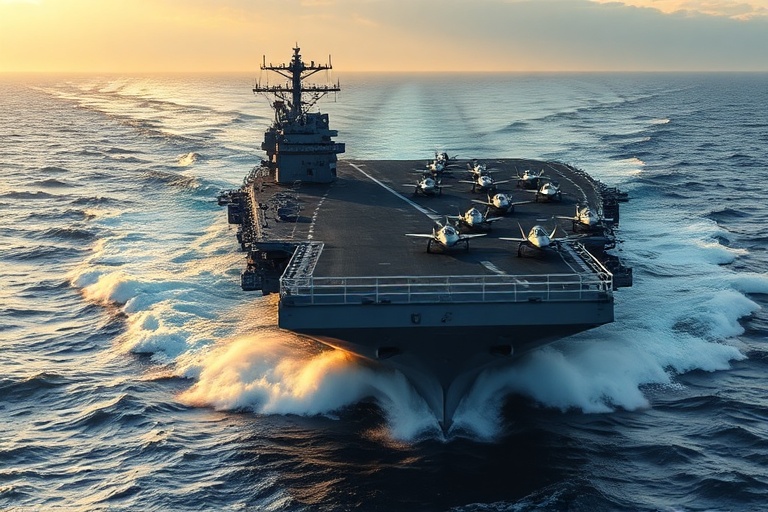
The USS Gerald R. Ford, the U.S. Navy’s most technologically advanced aircraft carrier, has completed another pivotal deployment, returning to its homeport after months at sea. This milestone isn’t just about the ship’s operational readiness—it’s a testament to the evolving role of naval power in an increasingly complex global landscape. The carrier’s return comes at a time when maritime security concerns are reshaping defense strategies worldwide.
The Significance of the Ford’s Latest Deployment
The USS Gerald R. Ford’s most recent voyage was more than a routine exercise. It served as a proving ground for cutting-edge systems that could redefine naval warfare. During the deployment, the carrier tested its Electromagnetic Aircraft Launch System (EMALS) and Advanced Arresting Gear (AAG) under real-world conditions, alongside its new dual-band radar and integrated warfare systems. These technologies promise faster sortie rates and reduced maintenance compared to traditional steam catapults.
Defense analysts note that the Ford’s deployment aligns with the Navy’s push to maintain dominance in contested maritime environments. With China rapidly expanding its carrier fleet and Russia modernizing its naval forces, the Ford’s capabilities send a clear message about U.S. commitment to global security. The carrier’s return also highlights the challenges of sustaining such a complex system in operational environments, from crew fatigue to maintenance demands in harsh conditions.
Key Milestones Achieved During Deployment
- First Operational Use of EMALS: The electromagnetic launch system demonstrated its ability to handle a wide range of aircraft, including F-35C Lightning IIs, without the mechanical stress of steam catapults.
- Advanced Sensor Testing: The Ford’s AN/SPY-3 and AN/SPY-4 radars provided critical data on tracking hypersonic threats and coordinating with other fleet assets.
- Sustained High Operational Tempo: The carrier maintained a sortie generation rate of over 160 sorties per day, showcasing its potential to project power rapidly.
- Logistical Innovations: The Ford introduced automated systems for supply chain management, reducing the burden on crew and improving efficiency in resupply operations.
Broader Implications for U.S. Naval Strategy
The USS Gerald R. Ford’s return isn’t just a win for the Navy—it’s a signal to allies and adversaries alike. The carrier’s advanced systems are designed to counter emerging threats, from hypersonic missiles to cyber warfare. As the Ford re-enters the fleet rotation, it forces a reevaluation of how the U.S. projects power at sea. Traditional carriers like the Nimitz-class are being complemented by Ford-class vessels, which offer enhanced survivability and lethality.
Military strategists point out that the Ford’s deployment also underscores the importance of carrier strike groups (CSGs) in modern naval doctrine. These groups are no longer just floating airfields; they are multi-domain platforms capable of integrating with satellites, drones, and land-based assets. The Ford’s return ensures that the U.S. maintains a qualitative edge in power projection, even as budget constraints and global commitments strain resources.
Challenges on the Horizon
While the Ford’s deployment is a success, it also highlights persistent challenges. The carrier’s advanced systems require highly trained personnel, and the Navy is still refining its training protocols. Additionally, the Ford-class program has faced criticism over cost overruns and delays, though recent improvements in production efficiency suggest these issues may be stabilizing. The ship’s return also raises questions about the future of naval aviation, particularly as unmanned systems and directed-energy weapons enter the fray.
Another critical consideration is the Ford’s role in potential conflicts. In a scenario involving China or Russia, the carrier’s survivability could be tested by anti-access/area-denial (A2/AD) systems. The Navy is investing in electronic warfare and decoy systems to mitigate these risks, but the Ford’s return forces a reckoning with the realities of modern naval combat.
What’s Next for the USS Gerald R. Ford?
The Ford’s return marks the beginning of a new phase for the carrier and the fleet. Over the next year, the ship will undergo post-deployment maintenance and upgrades, with a focus on integrating lessons learned from its latest voyage. The Navy plans to deploy the Ford again in 2025, this time as part of a larger exercise involving allied nations. This joint operation could include drills with Japan, South Korea, or NATO partners, reinforcing collective defense capabilities.
Longer-term, the Ford-class program is set to expand. The second ship in the class, the USS John F. Kennedy, is nearing completion, and construction on the USS Enterprise is underway. These vessels will form the backbone of the U.S. carrier fleet for decades, ensuring that America remains a dominant maritime power. The Ford’s return is not just a technical achievement—it’s a strategic investment in the future of naval warfare.
Implications for Industry and Innovation
The Ford’s advancements are also rippling through the defense industry. Companies like General Atomics and Huntington Ingalls Industries are leveraging the technologies developed for the Ford to pursue new contracts, from next-generation drones to advanced radar systems. The carrier’s success could accelerate innovation across the sector, particularly in areas like directed-energy weapons and AI-driven logistics.
For defense contractors, the Ford-class program represents a critical revenue stream. With the U.S. committed to maintaining a 12-carrier fleet, the demand for these advanced systems will likely grow. However, the program’s success will depend on the Navy’s ability to balance innovation with fiscal responsibility—a challenge that will shape the future of American naval power.
Conclusion: A New Era for Naval Power
The USS Gerald R. Ford’s return is more than a routine homecoming. It symbolizes the Navy’s adaptation to a rapidly changing world, where technological superiority and operational flexibility are paramount. As the Ford re-enters the fleet rotation, it sets the stage for a new era of naval warfare, one defined by speed, precision, and integration. For the U.S., the carrier’s success is a reminder that dominance at sea remains a cornerstone of global security.
Looking ahead, the Ford’s journey will be closely watched by allies and adversaries alike. Its advancements will shape defense strategies, influence procurement decisions, and redefine the boundaries of naval power. The return of the USS Gerald R. Ford isn’t just a milestone—it’s a declaration that America’s naval might is evolving to meet the challenges of the 21st century.
For those interested in further reading on naval innovation and defense technology, explore our coverage of Technology and News at Dave’s Locker.