The streets of Caracas have become a battleground—not just for political power, but for the very survival of a nation. Venezuela’s descent into economic and political chaos has sparked fury among its citizens, who face hyperinflation, food shortages, and a crumbling infrastructure. This crisis, years in the making, has drawn global attention and ignited protests that show no signs of abating.
The situation is dire. According to the International Monetary Fund, Venezuela’s inflation rate exceeded 200,000% in 2023, rendering the bolívar nearly worthless. Basic goods like flour, medicine, and fuel are scarce, forcing families to rely on black markets and remittances from relatives abroad. The humanitarian toll is staggering, with over 7 million people displaced since 2015, according to the UNHCR.
The Roots of Venezuela’s Fury: Economic Collapse and Political Gridlock
The origins of Venezuela’s crisis trace back to the early 2000s, when the late President Hugo Chávez’s socialist policies began reshaping the economy. While his administration nationalized key industries and expanded social programs, it also relied heavily on oil revenues—leaving the country vulnerable when global oil prices crashed in 2014. Nicolás Maduro, Chávez’s successor, has struggled to reverse the damage, instead tightening control over the economy and suppressing dissent.
The opposition, led by figures like María Corina Machado and Edmundo González, has accused Maduro’s government of rigging elections and eroding democratic institutions. International observers, including the Organization of American States, have condemned the lack of transparency in recent votes. Meanwhile, the U.S. and European Union have imposed sanctions on Venezuelan officials, further isolating the regime.
Key Factors Contributing to Venezuela’s Crisis
- Overdependence on Oil: Venezuela’s economy, once buoyed by high oil prices, collapsed when prices plummeted. The state-owned PDVSA, once a cash cow, is now a shadow of its former self, plagued by corruption and mismanagement.
- Hyperinflation and Currency Devaluation: The bolívar has lost 99% of its value since 2013. Citizens often use the U.S. dollar for transactions, but wages remain pitifully low.
- Sanctions and Isolation: U.S. sanctions on oil exports and gold trading have crippled Venezuela’s ability to access international markets, exacerbating shortages.
- Humanitarian Exodus: Over 7 million Venezuelans have fled the country, creating one of the largest displacement crises in modern history.
Protests and Repression: The Human Cost of Venezuela’s Fury
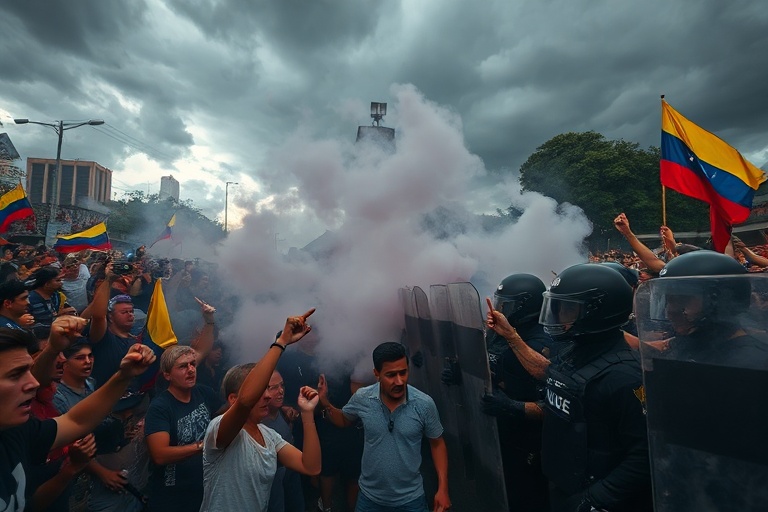
Venezuela’s fury is most visible in the streets. Since 2014, protests have erupted sporadically, met with brutal crackdowns by security forces. The Amnesty International reports that over 15,000 people have been arbitrarily detained since 2017, with many subjected to torture and extrajudicial killings.
In 2019, mass demonstrations erupted after Maduro’s disputed reelection. Security forces responded with live ammunition, tear gas, and mass arrests. The Human Rights Watch documented at least 6,000 extrajudicial killings by state forces between 2018 and 2022. The message was clear: dissent would not be tolerated.
Yet, the fury persists. In 2023, a wave of protests erupted over the disappearance of activists and the collapse of public services. Videos shared on social media showed protesters clashing with police, while others documented long lines at gas stations and empty supermarket shelves. The government’s response? More repression.
Global Implications: Venezuela’s Crisis and Its Far-Reaching Consequences
Venezuela’s turmoil isn’t confined to its borders. The crisis has destabilized the region, fueling migration flows that have overwhelmed neighboring countries like Colombia and Peru. In Colombia alone, over 2.5 million Venezuelans have sought refuge, straining public services and sparking tensions.
The humanitarian fallout extends beyond Latin America. The World Health Organization warns that Venezuela’s healthcare system is on the brink of collapse, with outbreaks of preventable diseases like measles and diphtheria. Meanwhile, the U.S. has accused Maduro’s regime of trafficking drugs and collaborating with guerrilla groups, further complicating diplomatic efforts.
Venezuela’s crisis also highlights the failures of 21st-century socialism. While some leftist governments in Latin America, like Bolivia and Nicaragua, still defend Maduro, others have distanced themselves. The Latinobarómetro survey found that support for socialism has plummeted in the region, with many voters blaming leftist policies for economic stagnation.
The Path Forward: Can Venezuela Break Free from Its Fury?
The future of Venezuela remains uncertain. Opposition leaders insist that Maduro’s grip on power is weakening, pointing to mass defections from the military and growing international isolation. In 2023, the U.S. offered to lift sanctions in exchange for free and fair elections—a potential lifeline for a desperate population.
But the road to recovery is long and fraught with obstacles. Even if Maduro were to step down, rebuilding Venezuela’s economy would require massive investment, institutional reform, and reconciliation. The country’s infrastructure is in tatters, its institutions are corrupt, and its people are exhausted.
For now, Venezuela’s fury burns bright. The protests continue. The shortages persist. And the world watches, waiting to see whether this nation of resilient people can reclaim its future—or be consumed by the flames of its own crisis.
The question isn’t whether Venezuela will change—it’s when, and at what cost.