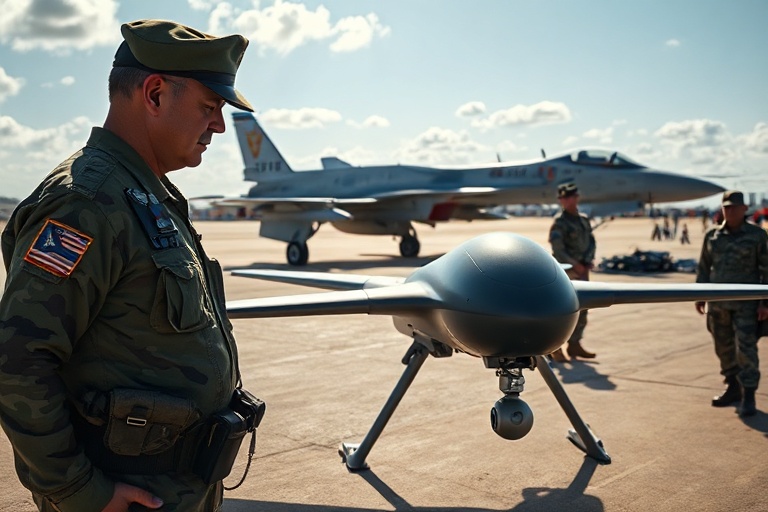
Cuba’s Military Drone Acquisition: What It Means for Regional Security
By [Your Name] |
Cuba’s recent acquisition of military drones marks a notable shift in its defense strategy, reflecting both regional security concerns and evolving technological capabilities. While details remain scarce, reports suggest Havana has procured a limited number of unmanned aerial systems (UAS) from allies in recent years. These systems, though modest in scale, signal an intent to modernize Cuba’s military toolkit amid persistent tensions with the United States and neighboring states.
The move comes at a time when drone technology has become a cornerstone of modern warfare, from reconnaissance to precision strikes. For Cuba, a country long constrained by economic embargoes and limited defense budgets, drones represent a cost-effective way to bolster surveillance and tactical capabilities without the need for large-scale investments in manned aircraft. The acquisition also underscores Havana’s reliance on non-Western suppliers, likely including China and Russia, which have emerged as key arms suppliers to the island nation.
Experts warn, however, that Cuba’s drone program faces significant hurdles, including maintenance challenges, pilot training gaps, and the risk of technological obsolescence. Without sustained investment and operational expertise, these systems may struggle to fulfill their intended roles. Still, the symbolic value of drone acquisition should not be underestimated, as it sends a message to regional actors about Cuba’s evolving defense posture.
The Geopolitical Context Behind Cuba’s Drone Strategy
Cuba’s decision to pursue military drones cannot be viewed in isolation. The island nation has long operated under the shadow of U.S. military dominance, particularly in the Caribbean and Gulf of Mexico. The presence of American military bases in Guantanamo Bay and the U.S. Southern Command’s regional activities have historically shaped Havana’s defense priorities. In this context, drones offer a way to monitor maritime and airspace without provoking direct confrontation with superior conventional forces.
Regional dynamics further complicate the picture. Cuba’s alignment with Venezuela, Nicaragua, and other governments often at odds with Washington has intensified its need for asymmetrical defense tools. Drones provide a means to conduct surveillance over disputed territories, such as the waters near the Florida Straits or the potential oil-rich areas in the Caribbean. Analysts suggest that Cuba may use these systems to track drug trafficking routes or monitor U.S. military movements, though such operations would carry significant risks.
Diplomatic records indicate that Cuba has sought drone technology for over a decade, with early attempts to acquire systems from Europe blocked by embargo restrictions. The shift toward Chinese and Russian suppliers reflects Havana’s pragmatic approach to circumvent Western limitations. Both Beijing and Moscow have demonstrated willingness to supply Cuba with military hardware, often in exchange for political support or economic concessions. This transactional relationship has enabled Cuba to slowly build its drone inventory, though at a pace far slower than its regional counterparts.
- U.S. Response: The Biden administration has yet to publicly address Cuba’s drone acquisition, but past statements suggest skepticism about Havana’s military modernization. The U.S. has historically opposed arms transfers to Cuba, viewing them as destabilizing in an already volatile region.
- Regional Reactions: Countries like Colombia and Brazil, which have invested heavily in drone technology, have not commented on Cuba’s moves. However, their own experiences highlight the operational and ethical challenges of integrating drones into military doctrine.
Technical Capabilities and Operational Limitations
While Cuba has not disclosed the specific models of drones acquired, reports point to systems similar to China’s CH-4 or Wing Loong series, which are widely used for reconnaissance and light strike missions. These medium-altitude, long-endurance (MALE) drones are capable of flying for up to 24 hours at altitudes of 18,000 feet, carrying electro-optical sensors and, in some cases, precision-guided munitions. For a country like Cuba, such platforms would provide a significant intelligence advantage, particularly in monitoring maritime activities.
However, Cuba’s operational capacity remains constrained by several factors. First, the country lacks a robust domestic drone industry, meaning maintenance and repairs will likely depend on foreign suppliers. This dependency could become a liability if political relations sour or supply chains are disrupted. Second, training pilots and sensor operators requires specialized expertise, which may be in short supply within Cuba’s military ranks. Third, the country’s aging infrastructure, including air traffic control systems and ground stations, may struggle to support advanced drone operations.
Another critical limitation is Cuba’s limited stockpile of compatible munitions. Without access to a steady supply of guided missiles or bombs, the drones’ utility would be restricted to surveillance and reconnaissance roles. Even then, their effectiveness would depend on the quality of Cuba’s intelligence networks and data processing capabilities, areas where the country has historically faced challenges.
Despite these limitations, the acquisition of drones represents a step forward for Cuba’s military. It signals an acknowledgment of modern warfare realities and a willingness to adapt to evolving threats. Whether this modernization effort will translate into tangible military advantages remains an open question, but it undoubtedly reshapes the strategic calculus in the Caribbean.
Broader Implications for Latin America and U.S. Interests
Cuba’s drone acquisition is part of a broader trend in Latin America, where countries are increasingly turning to unmanned systems to address security challenges. Nations like Mexico and Colombia have deployed drones to combat drug cartels, while Brazil and Argentina have used them for border surveillance. Cuba’s entry into this arena adds a new dimension to regional security dynamics, particularly as it aligns more closely with non-Western powers.
For the United States, Cuba’s drone program presents a dual challenge. On one hand, it complicates efforts to monitor Cuban military activities, particularly in the absence of traditional manned aircraft. On the other, it raises concerns about the proliferation of drone technology in the hands of governments hostile to U.S. interests. The potential for Cuban drones to be used in support of Venezuela or Nicaragua’s military operations could escalate tensions in Central America and the Caribbean.
Analysts also point to the broader implications of drone proliferation in the region. As more countries acquire unmanned systems, the risk of accidental escalation or miscalculation grows. Incidents involving drones in the South China Sea or the Middle East have demonstrated how quickly such technology can lead to unintended confrontations. In Latin America, where maritime and airspace disputes are already contentious, the introduction of drones could further destabilize the security environment.
The U.S. response to Cuba’s drone acquisition is likely to focus on diplomatic pressure and technological countermeasures. Washington has already invested in electronic warfare systems to detect and disrupt drone operations, and it may encourage regional allies to do the same. However, the effectiveness of such measures will depend on Cuba’s ability to integrate drones into its military operations—a process that could take years.
“Cuba’s drone program is less about immediate military capability and more about signaling its intent to modernize in a way that bypasses traditional channels,” said [Expert Name], a defense analyst at the [Think Tank]. “It’s a calculated move, but one with significant risks given Cuba’s economic and logistical constraints.”
Conclusion: A Small Step with Outsized Consequences
Cuba’s acquisition of military drones is a modest but symbolically significant development in the country’s long-standing struggle to modernize its armed forces. While the systems acquired may lack the sophistication of those used by larger militaries, their introduction signals Havana’s intent to adapt to the realities of 21st-century warfare. The move also highlights the growing influence of China and Russia in Latin America, as they fill the void left by Western restrictions.
Yet, the road ahead is fraught with challenges. Maintenance, training, and operational constraints could limit the drones’ effectiveness, leaving Cuba with a capability that is more symbolic than practical. For regional actors, the acquisition underscores the need for vigilance in monitoring drone proliferation and its potential to alter security dynamics. Meanwhile, the United States faces a dilemma: how to respond to a development that, while not immediately threatening, signals Cuba’s evolving role in a shifting geopolitical landscape.
As Cuba continues to integrate drones into its military strategy, the world will watch closely to see whether this acquisition is merely a symbolic gesture or the beginning of a more substantial modernization effort. One thing is certain: in an era where drones have become a defining feature of modern warfare, even small players like Cuba cannot afford to be left behind.
For those interested in exploring similar defense trends, visit our News and Analysis sections for more insights.