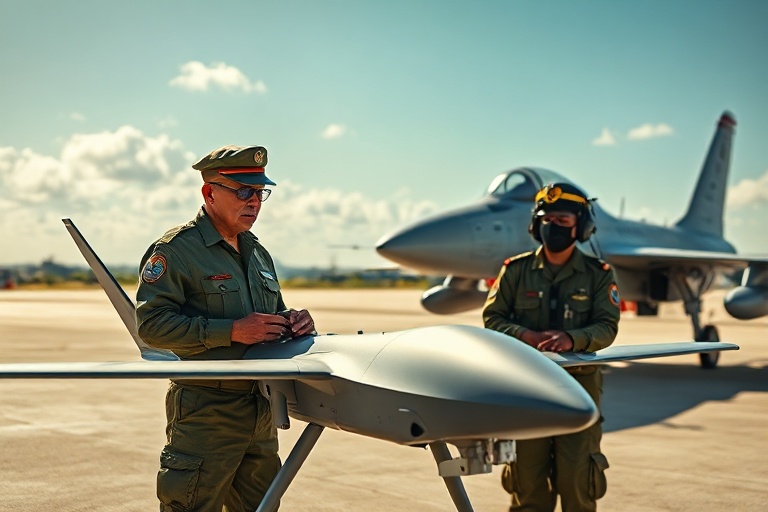
In early 2024, Cuba confirmed the acquisition of a batch of military drones from an unspecified supplier, marking one of the most significant changes in the country’s defense posture in decades. While Havana has historically relied on aging Soviet-era equipment and limited modernization efforts, this move signals a strategic pivot that could reshape the balance of power in the Caribbean and Central America.
The drones—reportedly medium-altitude, long-endurance models with surveillance and reconnaissance capabilities—arrived without fanfare, but their deployment is already drawing attention from regional militaries, intelligence agencies, and policymakers. The acquisition comes at a time when Cuba faces mounting economic pressures, heightened tensions with the United States, and growing instability in neighboring Haiti, where gang violence has spiraled out of control.
From Soviet Relics to Surveillance Drones: Cuba’s Military Evolution
Cuba’s military has long operated under severe constraints. After the collapse of the Soviet Union in 1991, Havana lost its primary arms supplier, leaving its armed forces with a shrinking inventory of MiG-21s, T-55 tanks, and other Cold War-era hardware. The U.S. embargo further limited access to advanced weaponry, forcing Cuba to rely on improvisation, maintenance of existing systems, and occasional purchases from allies like Russia and China.
Recent years, however, have seen a gradual shift. Cuba has renewed defense cooperation with Moscow, purchasing helicopters and other equipment while also investing in cyber capabilities. The drone acquisition represents a new chapter. While Havana has not disclosed the exact model or origin of the drones, analysts suggest they may include Chinese-made systems similar to those used by Venezuela and Nicaragua, both of which have deepened ties with Beijing.
This transition reflects broader trends in Latin America, where drones have become a tool of both state security and asymmetric warfare. From Colombia’s use against drug cartels to Brazil’s deployment along the Amazon, unmanned systems are reshaping how nations monitor borders, track threats, and project power. Cuba’s entry into this arena is less about projecting force abroad and more about enhancing its ability to surveil its own territory—a response to internal challenges and external pressures alike.
Regional Reactions: Who’s Concerned and Why
The drone acquisition has not gone unnoticed. The United States, which maintains a military base at Guantanamo Bay and has long viewed Cuba as a security concern, has closely monitored the developments. A State Department spokesperson stated that Washington is “aware of Cuba’s military acquisitions” but declined to elaborate on potential responses.
Neighboring countries, particularly the Dominican Republic and Jamaica, have expressed unease. Both nations have experienced a surge in drug trafficking and irregular migration, issues that Cuba’s improved surveillance capabilities could either exacerbate or mitigate, depending on how Havana chooses to deploy the drones. The Dominican government has already increased patrols along its northern coast, citing concerns over potential spillover effects.
Mexico, another key player in the region, has taken a more measured stance. While acknowledging Cuba’s sovereign right to modernize its military, Mexican officials have emphasized the need for transparency. “We welcome any effort to enhance regional security,” said a foreign ministry representative, “but we must ensure these capabilities are not used in ways that destabilize our neighbors.”
Below is a breakdown of regional responses:
- United States: Monitoring closely; no immediate policy shift announced.
- Dominican Republic: Increased border patrols; concerned about migration and trafficking.
- Jamaica: Engaging in diplomatic consultations; wary of potential security risks.
- Mexico: Calls for transparency; emphasizes regional cooperation.
- Venezuela: Publicly supportive; sees Cuba’s move as part of a broader alliance.
The Geopolitical Chessboard: Russia, China, and Cuba’s New Alliances
Cuba’s drone acquisition cannot be viewed in isolation. It is part of a larger realignment in Latin America, where traditional U.S. influence is being challenged by Russian and Chinese engagement. Russia, in particular, has deepened its military ties with Havana, supplying not only helicopters but also advisors and training. The Kremlin’s strategy in the region has been twofold: to regain a foothold lost after the Cold War and to counter U.S. influence.
China, meanwhile, has cultivated relationships across the Caribbean, investing heavily in infrastructure and offering military hardware to countries like Jamaica and Trinidad and Tobago. While Beijing has not confirmed supplying the drones to Cuba, its broader role in the region’s militarization is undeniable. The presence of Chinese-made drones in Cuba would underscore a growing trend: the export of surveillance technology to governments seeking to bolster their domestic security apparatus.
This shift has implications for U.S. policy. Washington has long viewed the Caribbean as its backyard, but the rise of non-Western powers in the region complicates that narrative. The Biden administration’s focus on countering China and Russia globally may soon extend to the Americas, where competition for influence is intensifying.
For Cuba, the drones offer a lifeline. With Venezuela’s economy in shambles and Nicaragua’s government facing international isolation, Havana is increasingly turning to Beijing and Moscow for support. The acquisition of drones is not just about defense; it’s about survival in a region where alliances are fluid and economic survival is precarious.
What’s Next: Scenarios and Consequences
The introduction of military drones into Cuba’s arsenal opens several possible futures. One scenario sees Havana using the systems to crack down on internal dissent, particularly as economic conditions worsen and protests grow. The government has long relied on a combination of repression and surveillance to maintain control, and drones could enhance that capability.
Alternatively, the drones could be deployed to monitor drug trafficking routes, a move that might earn Cuba goodwill in Washington. The U.S. has repeatedly called on Cuba to do more to combat narcotics trafficking, and enhanced surveillance could align with those demands.
A third possibility is that the drones remain largely symbolic, serving as a deterrent against perceived U.S. aggression rather than an active tool of war. Given Cuba’s limited operational experience with such systems, their primary function may be psychological—signaling to both domestic and foreign audiences that the country is adapting to modern security challenges.
Regardless of how Cuba uses the drones, their arrival is a reminder of the region’s shifting dynamics. The Caribbean is no longer a quiet backwater but a contested space where global powers vie for influence, and local actors navigate an increasingly complex security landscape.
For policymakers, the challenge will be to respond without escalating tensions. Diplomatic engagement, transparency, and confidence-building measures will be essential to prevent a new arms race in a region already burdened by economic and social crises.
Conclusion: A New Chapter in Caribbean Security
Cuba’s acquisition of military drones is more than a military upgrade; it is a geopolitical statement. In a region where borders are porous, economies are fragile, and alliances are fragile, the introduction of advanced surveillance technology could either stabilize or destabilize. The coming months will reveal how Havana intends to use these capabilities—and how its neighbors, and the world, will respond.
One thing is certain: the era of Cuba relying solely on Cold War relics is over. The drones are here, and they signal the beginning of a new chapter in Caribbean security.
For further analysis on regional military trends, explore our News section, where we cover evolving defense dynamics across Latin America and the Caribbean.