Ronda Rousey’s WWE Journey: From Olympic Champion to Global Sports Icon
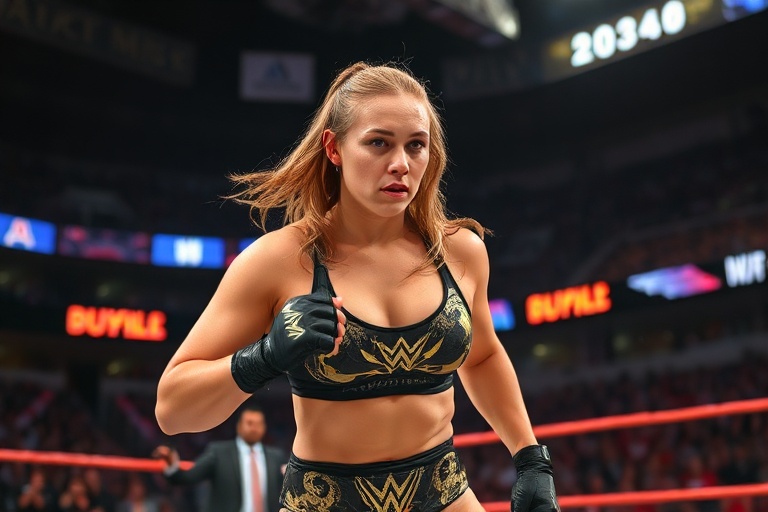
Ronda Rousey’s transition from Olympic judoka to WWE superstar remains one of the most compelling narratives in modern sports entertainment. Her arrival in the WWE in 2018 marked a pivotal moment not just for professional wrestling, but for the broader intersection of combat sports and mainstream athletics. Rousey brought a level of credibility few athletes could match, blending Olympic pedigree with the theatrics of sports entertainment.
The former UFC champion’s WWE career unfolded against a backdrop of shifting cultural attitudes toward women in sports. While female athletes had long fought for recognition in combat sports, Rousey’s move to WWE represented a new frontier—one where physical dominance and athletic prowess were celebrated in a theatrical setting. Her presence helped redefine perceptions of women in sports entertainment, proving that elite athletes could thrive beyond their original disciplines.
Breaking Barriers in Women’s Wrestling
Rousey’s WWE debut on January 28, 2018, at the Royal Rumble was met with immediate anticipation. Fans and pundits alike wondered how a fighter known for her judo and MMA skills would adapt to the scripted nature of wrestling. Her first match, a victory over former champion Brie Bella at WrestleMania 34, sent a clear message: she was not just a sideshow but a legitimate competitor.
The cultural impact of her arrival extended far beyond North America. In Japan, where Rousey had trained in judo and later competed in MMA, her WWE debut was seen as a homecoming of sorts. Japanese wrestling fans, accustomed to high-flying women’s divisions, recognized her as an athlete who could elevate the sport further. Meanwhile, in Europe and Latin America, her fame as an Olympic medalist provided WWE with a global ambassador—someone who could draw casual fans unfamiliar with wrestling’s traditions.
Rousey’s influence was particularly strong in regions where women’s wrestling had historically been sidelined. Her matches were broadcast in over 30 languages, reaching audiences in markets where women’s sports often struggled for visibility. By the time she headlined WWE’s Evolution pay-per-view in 2018—a women’s only event—Rousey had become a symbol of progress, not just in wrestling but in global sports culture.
The Athletic and Theatrical Balance
Critics and fans alike debated whether Rousey’s wrestling style would translate effectively. Unlike traditional WWE stars who trained in performance-based wrestling schools, Rousey’s background was in combat sports, where real aggression and technique were paramount. This created a unique dynamic in her matches, where her judo throws and MMA-inspired strikes stood out against the more choreographed style of her peers.
Her first feud in WWE was against Alexa Bliss, a contrast in styles that highlighted Rousey’s strengths. While Bliss relied on speed and psychology, Rousey’s power and intensity overwhelmed opponents. This dynamic was intentional—WWE positioned Rousey as the anti-Diva, a term the company had previously used to describe its women’s division. Her undefeated streak in her early WWE career reinforced the idea that she was an unstoppable force.
Yet, the transition wasn’t seamless. Wrestling requires a different kind of endurance—matches can last 15 minutes or longer, compared to the five-minute rounds in MMA. Rousey’s early struggles with stamina were evident in some matches, though her charisma and star power often masked these shortcomings. By 2019, she had refined her in-ring approach, blending athleticism with the storytelling WWE demanded.
A Global Perspective on Rousey’s Legacy
Rousey’s WWE career must be understood within the broader context of women’s sports evolution. In the 2010s, female athletes gained unprecedented visibility, thanks in part to movements like #MeToo and increased media coverage of women’s leagues. Rousey’s presence in WWE was not just about entertainment; it was a statement that women could excel in multiple athletic disciplines without being confined to one.
Her impact was felt most strongly in markets where combat sports were already popular. In Brazil, for example, Rousey’s fights were widely followed, and her WWE appearances drew significant attention. Similarly, in Australia, where she had trained as a judoka, fans embraced her as a national hero. This global appeal made her one of WWE’s most marketable stars, capable of drawing audiences beyond the traditional wrestling fanbase.
Rousey’s tenure also coincided with WWE’s push for gender equality in its programming. The company’s women’s division, once an afterthought, became a focal point of its product by the mid-2010s. Rousey’s arrival accelerated this shift, proving that women’s wrestling could draw ratings and live event attendance. Her matches with Charlotte Flair, Becky Lynch, and Sasha Banks were some of the most-watched segments of WWE’s weekly shows.
The Challenges and Criticisms
Not all of Rousey’s WWE journey was smooth. Some fans criticized her for relying too heavily on her star power rather than developing a deeper connection with the audience. Others pointed to her occasional struggles with selling moves—a key aspect of wrestling’s storytelling. Despite these critiques, her ability to draw casual viewers to WWE events remained unmatched.
There were also questions about how WWE managed her career. Unlike traditional WWE stars who followed a set progression (from NXT to main roster to main event status), Rousey’s path was unconventional. She entered at the top, feuded with established stars, and even challenged for the women’s championship within months of her debut. This approach alienated some purists but appealed to casual fans who saw her as a crossover star.
By 2020, Rousey’s WWE career had taken a backseat to her work in Hollywood and her return to MMA. Yet, her impact on the company’s women’s division was undeniable. She had helped legitimize women’s wrestling in the eyes of mainstream audiences, paving the way for the next generation of stars like Bianca Belair and Rhea Ripley.
A Lasting Influence on Sports Entertainment
Ronda Rousey’s WWE tenure was more than a novelty act—it was a cultural bridge between combat sports and entertainment. Her ability to transcend disciplines demonstrated that elite athletes could succeed in multiple arenas, provided they had the charisma and work ethic to adapt.
For WWE, her presence was a calculated risk that paid off. She brought in new viewers, expanded the company’s global reach, and helped redefine what it meant to be a women’s wrestler. While her in-ring career may have been short-lived, her legacy in sports entertainment is secure. She proved that women could be the focal point of a major sports league, not just an afterthought.
Looking ahead, Rousey’s story serves as a blueprint for future athletes considering a leap into entertainment. Her career highlights the importance of authenticity—fans respected her because she was genuinely skilled, not just a performer. In an era where authenticity is increasingly valued, Rousey’s WWE journey remains a case study in how to bridge the gap between sports and entertainment without losing credibility.
As women’s wrestling continues to evolve, Rousey’s influence will be felt for years to come. Whether she returns to WWE or not, her impact on the industry is already cemented. She was not just a guest star; she was a trailblazer who changed the game.