The morning of December 7, 1941, began with the stillness of a typical Sunday at Pearl Harbor, the U.S. Pacific Fleet’s primary base in Hawaii. By the time the day ended, over 2,400 Americans were dead, 1,178 were wounded, and eight battleships, three destroyers, and four other vessels lay damaged or destroyed. The attack, carried out by the Imperial Japanese Navy, propelled the United States into World War II and reshaped the course of 20th-century history.
This wasn’t just a military strike—it was a calculated act of aggression designed to cripple American naval power in the Pacific and secure Japan’s dominance in the region. The surprise nature of the attack, combined with the severity of its impact, ensured that December 7 would forever be remembered as “a date which will live in infamy,” as President Franklin D. Roosevelt declared the following day.
The Attack Unfolds: A Timeline of Surprise and Devastation
The Japanese assault began just before 8:00 a.m. local time, launched from six aircraft carriers positioned 230 miles north of Oahu. The first wave of 183 planes—including bombers, torpedo planes, and fighters—struck military installations across the island, targeting airfields, battleships, and command centers. Within minutes, chaos erupted as anti-aircraft fire filled the sky and ships exploded under relentless bombardment.
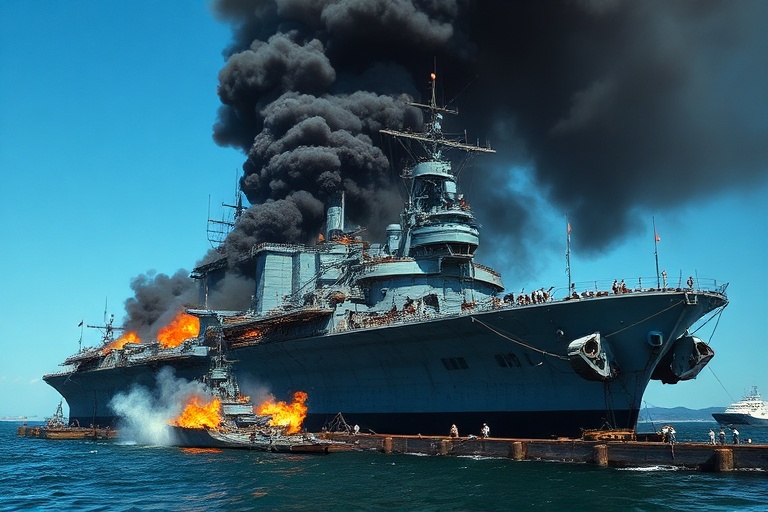
The USS Arizona became the most symbolic casualty of the attack. Hit by an armor-piercing bomb that detonated its forward magazine, the battleship erupted in a catastrophic explosion, sending a massive fireball into the air. Of the 1,512 crewmen aboard, 1,177 perished—nearly half of all American deaths that day. The USS Oklahoma, another battleship, capsized after multiple torpedo strikes, trapping hundreds of sailors inside.
The attack lasted just 90 minutes, but its psychological and physical toll was immense. By 9:45 a.m., the Japanese fleet had withdrawn, having achieved what they hoped would be a decisive blow. Yet, in a cruel twist of fate, the U.S. aircraft carriers—Enterprise, Lexington, and Saratoga—were at sea and thus spared, a detail that would later prove critical to the war’s outcome.
Key Targets and Their Impact
The Japanese strike force focused on several high-value targets:
- Battleships: Seven of the eight U.S. battleships anchored at Pearl Harbor were damaged; four sank. The USS West Virginia and California were later salvaged and returned to service.
- Airfields: U.S. Army and Navy aircraft were clustered on the ground, making them easy targets. Over 180 planes were destroyed or damaged, crippling air defenses.
- Fuel and repair facilities: While these were untouched, their survival allowed the U.S. to recover more quickly than Japan anticipated.
The Japanese missed a critical opportunity by failing to strike these facilities. Had they done so, the U.S. Pacific Fleet’s operational capacity would have been severely hampered for much longer. As it stood, the attack galvanized American resolve rather than cowed it—a fact Japan’s military leadership failed to anticipate.
Japan’s Strategy: Ambition, Assumptions, and Miscalculations
Japan launched the attack as part of a broader strategy to neutralize U.S. interference in its expansion across Southeast Asia. By December 1941, Japan had already invaded Manchuria, occupied French Indochina, and was locked in a brutal war with China. The U.S., through economic sanctions and oil embargoes, had become a major obstacle to Japan’s imperial ambitions.
Admiral Isoroku Yamamoto, the architect of the Pearl Harbor attack, understood the risks. He famously warned that Japan could “run wild” for six months after a surprise strike but cautioned that the U.S. would eventually mobilize its vast industrial and military resources to overwhelm Japan. His prediction proved accurate. The attack, while tactically brilliant, was strategically flawed because it failed to account for American resilience and industrial capacity.
Japan’s leaders gambled that a decisive first blow would force the U.S. into negotiations, allowing Japan to consolidate its gains in the Pacific. Instead, the attack had the opposite effect. Within hours of the strike, President Roosevelt addressed Congress, calling December 7 “a date which will live in infamy,” and secured a unanimous declaration of war against Japan. Germany and Italy, Japan’s Axis allies, declared war on the U.S. three days later, fully drawing America into World War II.
Intelligence Failures and Broken Trust
The U.S. had received warnings of possible Japanese aggression. On November 27, a war warning was sent to commanders in Hawaii, advising them that negotiations with Japan were at an end and that hostile action was possible. Yet, these warnings were vague, and local commanders failed to take adequate precautions. Radar operators detected incoming planes but assumed they were U.S. B-17 bombers en route from the mainland.
The attack exposed deep flaws in American intelligence-sharing and preparedness. The FBI and military intelligence agencies had cracked Japanese diplomatic codes, but critical intercepts—such as the “East Wind Rain” message, which signaled imminent hostilities—were not acted upon in time. Trust between branches of the military was also lacking, contributing to the chaos.
Legacy and Lessons: How Pearl Harbor Shaped Modern Defense
The immediate aftermath of Pearl Harbor was marked by grief, anger, and a national call to arms. Over 16 million Americans enlisted in the military during the war, and the nation’s industrial might was rapidly repurposed to support the Allied effort. Shipyards in California and Washington state churned out new vessels at unprecedented rates, while women entered the workforce in large numbers to fill labor shortages.
The attack also led to sweeping changes in U.S. defense policy and infrastructure. In 1947, the National Security Act reorganized the military, creating the Department of Defense, the Air Force as a separate branch, and the Central Intelligence Agency. These reforms were direct responses to the vulnerabilities exposed at Pearl Harbor.
Pearl Harbor demonstrated the unpredictability of modern warfare. It shattered the illusion that America’s geographic isolation could protect it from global conflicts. The attack underscored the need for early warning systems, intelligence coordination, and a standing military capable of rapid response—a lesson that would influence defense strategies throughout the Cold War and beyond.
Pearl Harbor in Popular Memory
Today, Pearl Harbor is more than a historical event—it is a symbol of sacrifice, resilience, and the cost of unpreparedness. The USS Arizona Memorial, built over the wreckage of the battleship, draws over two million visitors annually. The names of the fallen are inscribed on marble walls, a solemn reminder of the human toll.
The attack has been depicted in numerous films, books, and documentaries, each grappling with its complex legacy. Films like Tora! Tora! Tora! (1970) and Pearl Harbor (2001) blend historical events with dramatic storytelling, though the latter has faced criticism for its fictionalized romance subplot. Still, these portrayals keep the memory of Pearl Harbor alive in the public imagination.
The Road to Retribution: From Pearl Harbor to Hiroshima
The U.S. response to Pearl Harbor was swift and unrelenting. Within months, American forces launched the Doolittle Raid, a daring retaliatory strike on Tokyo that, while modest in damage, boosted morale at home. The tide of the war in the Pacific turned decisively at the Battle of Midway in June 1942, where U.S. forces sank four Japanese carriers—a loss from which Japan never recovered.
By 1945, the U.S. had adopted a strategy of island-hopping, securing key bases while bypassing others. The firebombing of Tokyo in March 1945 killed over 100,000 civilians, and the atomic bombings of Hiroshima and Nagasaki in August of that year forced Japan’s surrender. Some historians argue that the brutality of these later campaigns was a direct consequence of Pearl Harbor, a cycle of escalation that defined total war.
Others contend that Japan’s refusal to surrender after the initial attacks made further devastation inevitable. Regardless, the events of December 7, 1941, set in motion a chain of actions that would reshape the world order, leading to the rise of the U.S. as a superpower and the beginning of the Cold War.
Honoring the Fallen and Educating Future Generations
Every year on December 7, memorial services are held at Pearl Harbor and across the country. Veterans, families of the fallen, and dignitaries gather to honor those who perished and to reflect on the lessons of the attack. Schools incorporate Pearl Harbor into history curricula, ensuring that new generations understand its significance.
Organizations like the National WWII Museum and the Pearl Harbor National Memorial work to preserve artifacts, oral histories, and documents related to the attack. These efforts are vital in keeping the memory of Pearl Harbor from fading into the past.
As we look back on that pivotal day, it is clear that Pearl Harbor was more than a military disaster—it was a turning point that redefined America’s role in the world. The attack’s legacy endures not only in the monuments and museums that honor its victims but in the ongoing commitment to vigilance, preparedness, and the pursuit of peace.
The lessons of Pearl Harbor remind us that history is not merely a record of the past; it is a guide for the future. In an era of rising global tensions and evolving threats, the story of December 7, 1941, serves as a cautionary tale and a call to action—one that demands we remain ever watchful, ever ready, and ever resolute in the face of uncertainty.