Ronda Rousey’s Olympic Journey: A Foundation of Global Competition
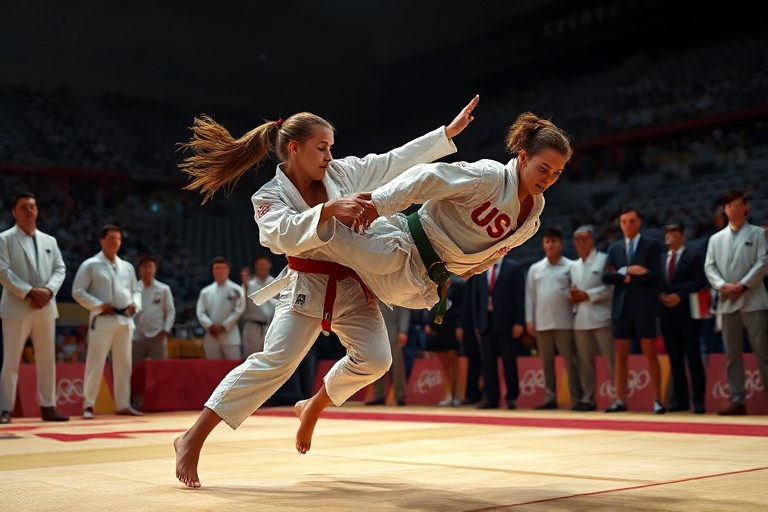
Ronda Rousey’s path to Olympic glory began not in the octagon of mixed martial arts, but on the tatami mats of judo. Born in Riverside, California, in 1987, Rousey was introduced to the sport at age 11 by her mother, AnnMaria De Mars, a judo world champion herself. This early exposure set the stage for a career defined by relentless discipline and unmatched intensity.
At just 17 years old, Rousey qualified for the 2004 Athens Olympics, becoming the youngest U.S. judoka to compete in over 20 years. Though she did not medal, her performance established her as a rising star in the sport. By the 2008 Beijing Olympics, Rousey had honed her skills further, winning a bronze medal in the 70 kg weight class. This achievement cemented her reputation as one of the most formidable judokas of her generation.
Her Olympic success was more than a personal triumph; it reflected judo’s growing global appeal. Originating in Japan, judo had evolved into a worldwide phenomenon, with strongholds in Europe, Asia, and the Americas. Rousey’s achievements helped popularize the sport in the United States, where it had long been overshadowed by combat sports like boxing and wrestling.
The Transition from Judo to MMA: A Strategic Evolution
After the 2008 Olympics, Rousey faced a critical decision. At 21, she was already a decorated judoka, but she sought a new challenge. The rise of mixed martial arts (MMA) presented an opportunity to apply her grappling expertise in a broader combat arena. Her transition from judo to MMA was not just a career shift—it was a cultural moment for women in combat sports.
In 2010, Rousey made her professional MMA debut, quickly rising through the ranks with her signature armbar submission. Her Olympic pedigree set her apart in a sport still struggling to gain mainstream respect for female fighters. By 2012, she had signed with Strikeforce, where her first-round armbar submission of Miesha Tate became a viral sensation. The victory catapulted her into the spotlight and caught the attention of Dana White and the UFC.
Rousey’s Olympic background became a key part of her brand. Unlike many fighters who came from wrestling or boxing backgrounds, her judo roots provided a technical depth that resonated with purists. It also offered a compelling narrative: the Olympic athlete transitioning into the brutal world of MMA. This story arc helped bridge the gap between traditional martial arts and modern combat sports, appealing to both niche audiences and casual viewers.
Cultural Impact: Breaking Barriers for Women in Sports
Rousey’s rise coincided with a broader movement toward gender equality in sports. At a time when women’s MMA was still fighting for legitimacy, Rousey’s Olympic credentials provided instant credibility. Her first UFC fight in 2013, a knockout victory over Liz Carmouche, was broadcast on Fox, marking the first time a women’s MMA fight headlined a major U.S. sports network.
Her influence extended beyond the octagon. Rousey became a symbol of female athletic power in an era dominated by discussions of pay equity and media representation. She was featured in high-profile campaigns, including one with ESPN where she posed in a judo gi, and she frequently spoke about the importance of self-defense for women. Her presence in pop culture—appearing in films like Furious 7 and The Expendables 3—further solidified her status as a crossover icon.
Rousey’s impact was particularly significant in Japan, where judo holds deep cultural significance. Japanese fans, who admired her Olympic success, embraced her transition to MMA with enthusiasm. This cross-cultural appeal demonstrated how combat sports could transcend borders, uniting audiences through shared admiration for athletic excellence.
Legacy and Influence: How Rousey Redefined Women’s MMA
Rousey’s tenure as UFC Women’s Bantamweight Champion from 2012 to 2015 was historic. She defended her title six times, becoming the face of women’s MMA and proving that female fighters could draw massive audiences. Her fights often drew over a million pay-per-view buys, a figure unheard of for women’s sports at the time. Yet, her reign was not without controversy. Critics argued that her reliance on armbars made her style predictable, while others praised her for dominating an era when women’s MMA was still in its infancy.
Her first professional loss, a knockout at the hands of Holly Holm in 2015, marked a turning point in her career. The defeat shattered her aura of invincibility and sparked debates about the longevity of fighters who rely heavily on a single skill set. Though she bounced back with a victory over Amanda Nunes in 2016, her UFC career never regained its peak dominance.
Despite her setbacks, Rousey’s legacy remains unassailable. She paved the way for the next generation of female fighters, including Amanda Nunes, Valentina Shevchenko, and Zhang Weili, all of whom have cited her as an inspiration. Her Olympic background gave her a unique platform, allowing her to advocate for women in sports while also challenging stereotypes about female athletes.
The Global Reach of Rousey’s Olympic and MMA Career
Rousey’s story is a testament to the power of judo as a global sport. While MMA has its roots in the United States, judo’s Olympic presence has ensured its worldwide reach. Countries like Japan, South Korea, and France have produced dominant judokas, while the U.S. and Brazil have seen judo’s influence grow through fighters like Kayla Harrison and Rafaela Silva.
Her career also highlights the evolving nature of combat sports. As MMA continues to grow, athletes with Olympic backgrounds are increasingly common. Wrestlers like Henry Cejudo and Kayla Harrison have transitioned seamlessly into MMA, while judokas like Hector Lombard and Yoshihiro Akiyama have made their mark. Rousey’s success helped legitimize this crossover, proving that Olympic sports could provide a strong foundation for MMA.
Where Is Ronda Rousey Now?
After retiring from MMA in 2018, Rousey transitioned into acting and commentary. She has appeared in films and TV shows, including a recurring role on the WWE’s Raw as a commentator and occasional wrestler. Her presence in the WWE underscores the growing crossover between combat sports and entertainment, a trend she helped pioneer.
Rousey has also remained active in judo, serving as a commentator for NBC’s Olympic coverage. Her insights have brought a deeper appreciation for judo to American audiences, further cementing her role as a bridge between the sport’s traditional roots and its modern evolution.
Lessons from Rousey’s Olympic to MMA Journey
Rousey’s career offers several key takeaways for athletes and fans alike. First, her success demonstrates the value of specialization. Her judo training provided a technical foundation that set her apart in MMA. Second, her ability to transition between sports highlights the importance of adaptability. While many athletes struggle to evolve beyond their early careers, Rousey embraced new challenges with determination.
Finally, her story underscores the power of representation. As one of the first female MMA fighters to achieve mainstream success, Rousey inspired countless young women to pursue combat sports. Her Olympic background gave her a unique platform, allowing her to advocate for gender equality in sports while also entertaining global audiences.
Conclusion: A Legacy That Transcends the Octagon
Ronda Rousey’s Olympic journey and subsequent rise in MMA represent more than just athletic achievement. Her career reflects the global nature of combat sports, the evolving role of women in athletics, and the power of storytelling in sports. From the tatami mats of judo to the bright lights of the UFC, Rousey’s path has left an indelible mark on the world of sports.
As MMA continues to grow, Rousey’s influence will endure. She proved that Olympic athletes could thrive in the brutal world of MMA, and she paved the way for future generations of female fighters. Her legacy is a reminder that greatness is not confined to a single sport or discipline—it is forged through persistence, adaptability, and an unyielding pursuit of excellence.
For fans of judo, MMA, or women’s sports, Ronda Rousey’s career offers a compelling narrative of triumph, resilience, and cultural impact. Her story is a testament to the power of sport to transcend boundaries and inspire change.
Explore more about combat sports and Olympic athletes on Sports.