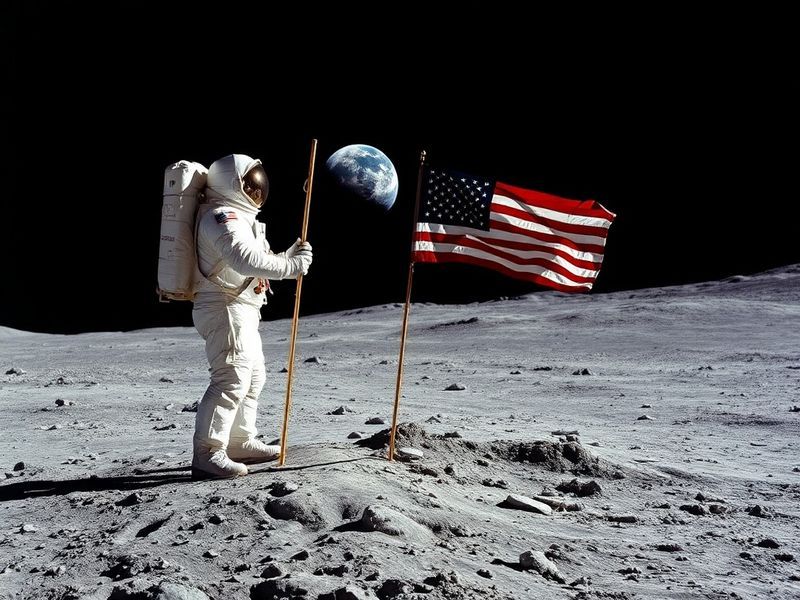
Neil Armstrong remains one of the most recognizable figures in human history, not because of his fame, but because of the quiet courage that defined his life. On July 20, 1969, he stepped onto the lunar surface and spoke the words, “That’s one small step for man, one giant leap for mankind.” The moment was broadcast to a global audience of 650 million people, cementing his place in history. Yet behind the iconic phrase and the grainy black-and-white footage is a man shaped by discipline, curiosity, and an unshakable sense of duty.
Born on August 5, 1930, in Wapakoneta, Ohio, Armstrong was fascinated by flight from an early age. He earned his student pilot’s license at just 16, before he could even drive. That early passion led him to the U.S. Navy as a naval aviator, then to Purdue University on a U.S. Navy scholarship. His academic and military training laid the foundation for his later achievements at NASA, where precision, adaptability, and calm under pressure became his defining traits.
From Test Pilot to Astronaut
Before becoming an astronaut, Armstrong was a test pilot, flying over 200 different types of aircraft. His work at the National Advisory Committee for Aeronautics (NACA), later part of NASA, earned him a reputation as a meticulous and fearless pilot. He flew the X-15 rocket plane to the edge of space and tested experimental aircraft that pushed the boundaries of speed and altitude.
In 1962, Armstrong was selected as one of the second group of NASA astronauts. Unlike many of his peers, he brought a rare blend of engineering insight and piloting skill. While others were known for their charisma or boldness, Armstrong stood out for his technical precision. He was assigned to the Gemini program, where he served as command pilot for Gemini 8 in 1966. During that mission, he executed the first successful docking of two spacecraft in orbit—an essential milestone ahead of the Apollo moon landings.
His ability to remain calm in emergencies was tested again when a stuck thruster nearly sent the spacecraft into a fatal spin. Armstrong’s quick thinking and steady hand saved the mission, earning him the respect of NASA leadership and solidifying his role in the upcoming Apollo program.
The Apollo 11 Mission: A Mission of Precision
Apollo 11 was not just a journey to the Moon—it was a carefully orchestrated sequence of events, each with zero margin for error. Armstrong was joined by Buzz Aldrin and Michael Collins. While Collins remained in lunar orbit aboard the command module, Armstrong and Aldrin descended to the surface in the lunar module, Eagle.
As Eagle approached the Moon, Armstrong noticed the automated landing system was guiding them toward a field of boulders near a crater. With less than 30 seconds of fuel remaining, he took manual control and piloted the spacecraft to a safe landing site in the Sea of Tranquility. The moment he set the lunar module down, he radioed to Mission Control: “Houston, Tranquility Base here. The Eagle has landed.”
Six hours later, Armstrong descended the ladder and placed his left foot on the lunar surface. His famous words echoed across the globe, but what often goes unnoticed is the physical and mental strain of that moment. The spacesuit weighed 180 pounds on Earth but only 30 pounds on the Moon. Movement was cumbersome. Visibility was limited through the helmet’s gold-tinted visor. Yet Armstrong moved with deliberate care, collecting the first lunar soil sample and planting the American flag.
The mission was not without risk. A misstep could have doomed the crew. But Armstrong’s training, composure, and years of experience made the impossible seem routine. When he returned to Earth, he was celebrated as a hero, but he consistently redirected praise toward the thousands of engineers, scientists, and technicians who made the mission possible.
A Life of Humility and Legacy
Despite his global fame, Armstrong lived a life marked by modesty. He rarely gave interviews and avoided the spotlight. After leaving NASA in 1971, he taught engineering at the University of Cincinnati, believing in the importance of education and mentorship. He also served on corporate boards and investigated the 1986 Challenger disaster as vice chairman of the presidential commission.
Armstrong’s legacy extends beyond the Moon landing. He embodied the spirit of exploration and the power of human ingenuity. He once said, “I am, and ever will be, a white-socks-and-sandals-wearing nerdy engineer.” The self-deprecating humor revealed a man who valued substance over spectacle.
He passed away on August 25, 2012, at the age of 82, following complications from heart surgery. His death was met with global tributes. Flags flew at half-staff. Astronauts aboard the International Space Station paused to honor his memory. Leaders from around the world acknowledged his role in redefining humanity’s place in the universe.
The Armstrong Effect: Inspiring Generations
Armstrong’s impact is not confined to history books. He inspired generations of engineers, pilots, and dreamers. The Apollo program proved that with vision, collaboration, and perseverance, humanity could achieve the seemingly impossible. His story continues to motivate students in STEM education, reminding them that curiosity and discipline can lead to extraordinary outcomes.
Even today, as private companies like SpaceX and Blue Origin push the boundaries of spaceflight, Armstrong’s legacy serves as a benchmark. He showed that exploration is not just about technology—it’s about courage, preparation, and the willingness to take calculated risks.
Lessons from a Quiet Pioneer
Armstrong’s life offers several enduring lessons:
- Master the fundamentals: His success came from rigorous training and deep technical understanding. He believed in preparation down to the smallest detail.
- Stay calm under pressure: Whether in flight tests or during the moon landing, Armstrong’s ability to remain composed under extreme stress was critical.
- Lead with humility: Despite being the first man on the Moon, he never sought personal glory. He attributed success to the team.
- Embrace exploration: His lifelong curiosity drove him to push beyond known limits—whether in aviation, engineering, or spaceflight.
Conclusion: A Legacy Written in the Stars
Neil Armstrong’s journey from a small Ohio town to the surface of the Moon is a testament to human potential. He was not a mythic figure, but a skilled professional who performed extraordinary tasks with quiet competence. His life reminds us that greatness is not always loud or flashy—sometimes it is measured in steady effort, thoughtful decisions, and unwavering dedication.
Decades after his historic walk, Armstrong’s words still resonate: “The important achievement of Apollo was demonstrating that humanity is not forever chained to this planet.” That idea—that we can reach beyond Earth—continues to shape space exploration today. As new missions prepare to return humans to the Moon and venture onward to Mars, Armstrong’s legacy lives on, not just in history, but in the future of discovery.
He may have been the first to set foot on the Moon, but his true achievement was inspiring all of humanity to look upward—and onward.