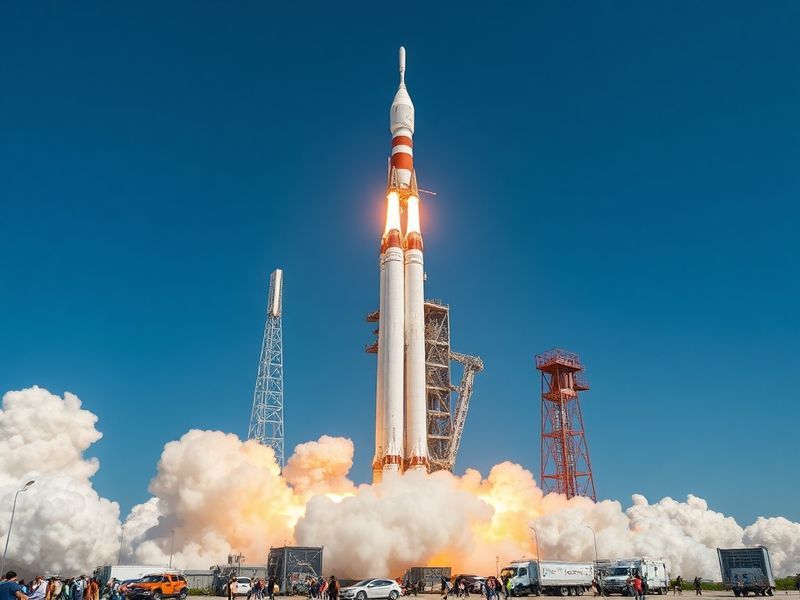
NASA’s Return to the Moon with Artemis 1
On November 16, 2022, NASA launched Artemis 1, an uncrewed mission that marked humanity’s first step toward returning to the Moon in over half a century. This wasn’t merely a repeat of the Apollo era—it was a bold declaration that space exploration had entered a new phase, one driven by international collaboration, cutting-edge technology, and a renewed sense of wonder. The mission’s success was a testament to decades of engineering refinement, political persistence, and scientific ambition.
The Space Launch System (SLS), NASA’s most powerful rocket since the Saturn V, propelled the Orion spacecraft on a 25-day journey covering 1.4 million miles. Its primary objectives included testing Orion’s heat shield during a high-speed re-entry and validating the spacecraft’s systems for future crewed missions. While Artemis 1 carried no astronauts, it carried the hopes of a generation inspired by the prospect of lunar exploration once again.
The Global Collaboration Behind the Mission
Artemis 1 wasn’t just an American endeavor—it was a global collaboration. The European Space Agency (ESA) contributed the Orion’s service module, which provided power, propulsion, and life support systems. International partners like Japan and Canada also played critical roles, with Japan’s JAXA developing the advanced lunar surface technologies slated for future missions and Canada contributing the robotic arm for the Gateway lunar outpost. This multinational effort reflected a shift in space exploration, where nations once rivals now work side by side.
Commercial partners were equally vital. Companies like SpaceX and Blue Origin are developing lunar landers and infrastructure under NASA’s Commercial Lunar Payload Services (CLPS) program. The Artemis program’s success depends on this public-private synergy, blending government funding with private sector innovation to reduce costs and accelerate timelines.
Technological Innovations and Challenges
The Artemis 1 mission showcased several groundbreaking technologies. Orion’s heat shield, the largest ever built, endured temperatures of 5,000°F during re-entry—a critical test for protecting future astronauts. The spacecraft also carried 10 CubeSats, small satellites deployed to study lunar ice, solar radiation, and other scientific phenomena. These secondary payloads demonstrated how Artemis could serve as a platform for broader lunar science.
Yet, the mission wasn’t without hurdles. Delays plagued the SLS’s development, with technical issues and budget overruns pushing the launch date from its original 2016 target. The Artemis program has faced scrutiny over its cost, estimated at $93 billion through 2025, raising debates about whether such investments are justified in an era of competing priorities on Earth. Critics argue that the funds could be redirected to climate research or social programs, while supporters contend that space exploration drives technological advancements that benefit all of humanity.
Cultural and Scientific Impact
The Apollo missions of the 1960s and 70s captivated the world, uniting people under the banner of exploration. Artemis 1 rekindled that spirit, but with a modern twist. Social media amplified the mission’s reach, with millions following Orion’s journey in real-time. Memes, livestreams, and educational content made the mission accessible to younger audiences, fostering a new generation of space enthusiasts.
Scientifically, Artemis 1 laid the groundwork for sustainable lunar exploration. The mission tested procedures for landing near the Moon’s south pole, where permanently shadowed craters may hold water ice—essential for future habitats and rocket fuel production. NASA’s goal of establishing a permanent lunar base by the 2030s hinges on the data collected from Artemis missions.
What Comes Next?
Artemis 1 was just the beginning. The next phase, Artemis 2, will carry a crew on a lunar flyby in 2025, followed by Artemis 3, which aims to land the first woman and person of color on the Moon in 2026. Beyond these missions, the Artemis program envisions a lunar Gateway—a space station orbiting the Moon that will serve as a staging point for deeper space exploration, including eventual missions to Mars.
The program’s long-term vision extends beyond flags and footprints. By leveraging lunar resources and developing reusable technologies, Artemis could pave the way for a sustainable human presence in space. This aligns with a broader trend in space exploration, where nations and companies are increasingly focused on practical applications—from mining asteroids to establishing off-world economies.
- Artemis 2 (2025): The first crewed mission, testing Orion’s systems with astronauts aboard.
- Artemis 3 (2026): The historic lunar landing, targeting the Moon’s south pole.
- Lunar Gateway: A small space station orbiting the Moon, supporting long-term exploration.
- Artemis Base Camp: A sustainable lunar surface outpost planned for the 2030s.
Artemis 1’s success was more than a technical achievement—it was a cultural reset. In an era marked by geopolitical tensions and environmental crises, the mission offered a rare moment of unity and optimism. It reminded the world that exploration, whether on Earth or beyond, remains one of humanity’s most enduring pursuits.
As NASA and its partners press forward, the Artemis program stands as a symbol of what’s possible when nations and industries collaborate toward a common goal. The Moon is no longer a distant dream but a tangible destination, and Artemis 1 proved that the journey has only just begun.
The Artemis program’s progress can be followed on NASA’s official website, which provides updates on each mission’s milestones and scientific discoveries.